
Choosing the right guitar stand for your home is a decision that directly impacts both the safety of your instrument and the organization of your living space. There is no single design that is universally superior; instead, the ideal choice depends on your floor space, the physical profile of your guitar collection, and the specific finish of your instruments. By understanding the core differences between A-frame and X-frame designs, you can select a setup that protects your gear while fitting seamlessly into your home.
Choose an A-frame if:
- You have limited floor space and need to store multiple guitars closely together in a row.
- You primarily play standard solid-body electric guitars that do not require heavy-duty lower support.
- You want a highly portable option that folds completely flat for easy storage.
Choose an X-frame if:
Products mentioned in this guide
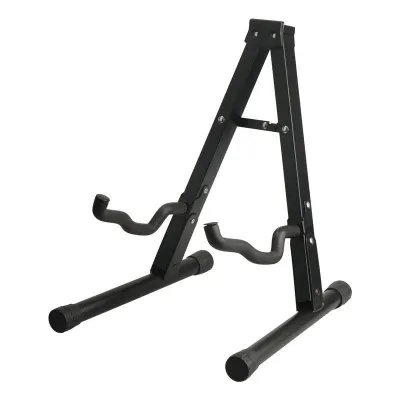
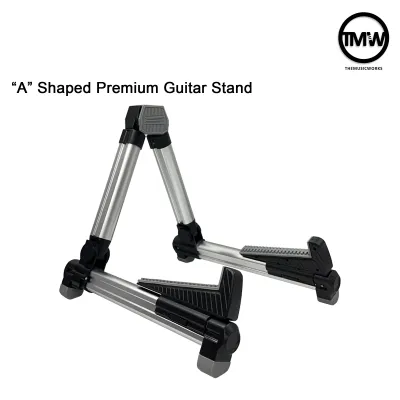
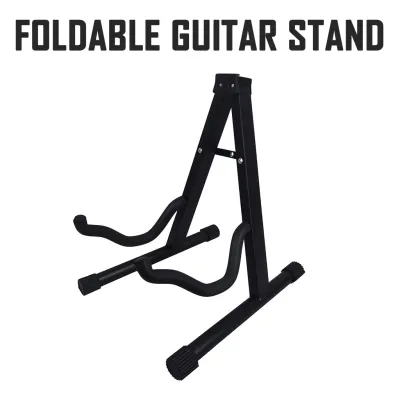
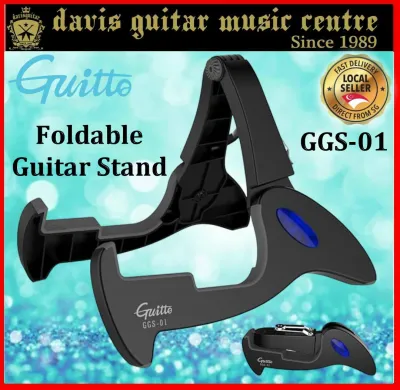

Prices are valid at publication and may change. Please refer to the product page for the latest price.
- You need maximum stability for heavier, longer, or bulkier instruments like bass guitars or jumbo acoustics.
- You have ample floor space to accommodate a wider, more secure footprint.
- You prefer a standalone display piece with integrated neck support to prevent forward tipping.
Verify first if:
- Your guitar features a delicate nitrocellulose lacquer finish. You must check the stand's contact materials for chemical compatibility regardless of whether you choose an A-frame or X-frame design.
Understanding the Designs: A-Frame vs X-Frame Guitar Stand Basics
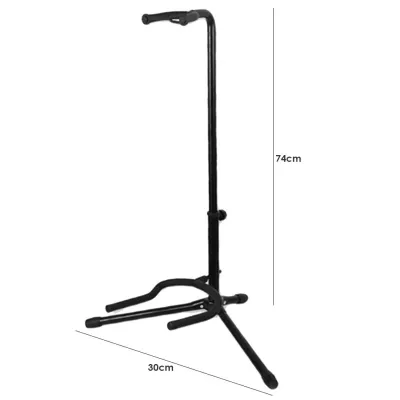
To make an informed decision, it is essential to understand the structural mechanics of both options. What musicians commonly refer to as an A-frame stand in a home context is often a vertical tripod-style stand. This configuration features a single central vertical pole supported by a three-point base that resembles the letter “A” or a tripod when deployed. At the top of this vertical shaft, a Y-shaped yoke cradles the neck of the guitar, usually secured by a safety strap or a gravity-activated gate. This vertical orientation keeps the guitar standing relatively upright, which minimizes the overall horizontal space the instrument occupies.
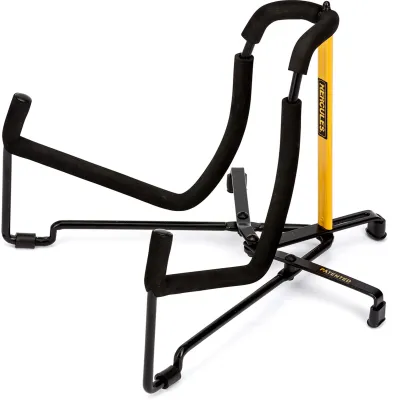
In contrast, an X-frame design relies on intersecting tubular metal legs that form a distinct “X” shape when viewed from the side or base. The lower portion of the X forms a broad, stable footprint on the floor, while the upper portion features padded cradles that hold the bottom of the guitar body. Many X-frame designs also include an adjustable vertical extension that rises to support the neck, though some low-profile variants omit the neck support entirely, relying solely on the deep cradle of the X-frame to hold the instrument’s body securely.
These foundational design differences dictate their physical footprint, center of gravity, and overall weight distribution in a home environment. The vertical design of the A-frame places the center of gravity higher, meaning it relies heavily on the tripod base to prevent lateral tipping. However, because the instrument stands nearly vertical, the forward-to-back footprint is remarkably shallow. The X-frame distributes the instrument’s weight over a much larger horizontal area. By leaning the guitar back at a more pronounced angle, the X-frame lowers the overall center of gravity, making it highly stable against accidental bumps, though this comes at the cost of requiring more floor space.
Key Comparison Dimensions for Home Use
When evaluating these two designs for a residential setting, several practical factors come into play. It is not just about holding the instrument upright; it is about how the stand integrates into your daily life, your room’s traffic patterns, and your cleaning routines.

Stability and Floor Space
The broad footprint of an X-frame stand serves as a physical buffer. In a busy living room or a shared family space, this wider base prevents the guitar from being easily knocked over. If a pet brushes past or a vacuum cleaner bumps the base, the low center of gravity and wide stance absorb the impact, keeping the instrument secure. However, this stability requires a significant amount of floor space. If you are trying to set up a music corner in a small bedroom or a compact study, a single X-frame stand can dominate the floor, leaving little room for amplifiers, cables, or seating.
The A-frame’s compact footprint is its primary advantage. Because the legs do not project far to the sides or rear, you can easily tuck an A-frame stand into a narrow gap between a desk and a wall. For musicians with multiple instruments, A-frames can be lined up side-by-side, allowing a collection of three or four guitars to occupy the same floor space that two X-frames would require. The trade-off is lateral stability. Because the base is narrower, a sharp side-impact can cause the stand to tilt. If you choose an A-frame, it is best placed in low-traffic areas, such as a dedicated studio room or a corner shielded by other furniture.
Guitar Compatibility and Neck Support
The lower support arms of a guitar stand must match the depth and shape of the instrument’s body. X-frame stands often feature deep, adjustable cradles that can pivot to match the contour of the guitar’s lower bouts. This is particularly beneficial for acoustic guitars, which have deep bodies (often 10 to 12 centimeters), or classical guitars with wide, flat bases. A-frame stands, especially more compact floor models, may have fixed, narrower lower brackets. While these brackets are perfect for thin-bodied electric guitars (typically 4 to 5 centimeters deep), they can cause a thick acoustic guitar to sit awkwardly high or slide forward, compromising its security.
A-frame stands with vertical neck supports almost always feature telescopic height adjustment. This allows you to slide the neck yoke up or down to match the exact scale length of your instrument, ensuring the yoke cradles the neck just below the headstock. This is crucial for maintaining a stable three-point balance. X-frame stands, particularly low-profile ones, may lack neck support entirely, which leaves the neck vulnerable to being bumped. If the X-frame does have a neck support, it is often a fixed-height bar that may not align perfectly with short-scale instruments like ukuleles or long-scale instruments like bass guitars.
Guitars with offset or asymmetrical bodies, such as the Fender Jazzmaster, Gibson Explorer, or Flying V, present unique storage challenges. Because the bottom edge of these instruments is uneven, they cannot sit level on a standard, symmetrical lower cradle. An X-frame stand with self-adjusting, pivoting lower cradles can adapt to these asymmetrical angles, keeping the guitar centered. A standard A-frame stand with rigid, fixed lower prongs will often cause an offset guitar to lean dangerously to one side, increasing the risk of it slipping out of the stand entirely.
Portability and Storage
For home users who frequently clear their space or travel to local jam sessions, how a stand folds is highly important. A-frame stands are highly praised for their portability. Most models fold completely flat in a single motion, collapsing the base legs parallel to the vertical shaft. Once folded, an A-frame is incredibly slim, allowing you to slide it under a bed, tuck it behind a bookcase, or even slide it into the external pocket of a padded gig bag.
X-frame stands are inherently bulkier when collapsed. While the intersecting legs do fold together, the protruding lower cradle arms and the upper neck support bracket often remain fixed in their perpendicular orientation. This results in an awkward, three-dimensional shape that does not lie flat. Storing a folded X-frame in a tight closet or packing it into a car trunk alongside other gear requires careful positioning to avoid snagging other items or damaging the stand’s adjustment knobs.
If your guitar stand is intended to remain permanently assembled in a dedicated home studio, portability is a minor consideration, making the structural stability of the X-frame highly appealing. However, if your home setup is dynamic—perhaps you practice in the living room during the day but need to pack everything away in the evening—the effortless folding and slim profile of the A-frame make it much more practical for daily life.
Matching the Stand to Your Guitar Type
To ensure the safety of your instrument, it is helpful to match the stand design to the specific physical characteristics of your guitar category. Different instruments have unique weight distributions and body depths that interact differently with each stand type.
- Standard Electric Guitars: Solid-body electric guitars, such as Stratocasters or Les Pauls, are relatively compact and have a balanced center of gravity. Both A-frame and X-frame stands accommodate these instruments exceptionally well. If you own multiple electric guitars, utilizing several A-frame stands lined up in a row is the most efficient way to keep your collection organized and accessible without cluttering your room.
- Acoustic and Classical Guitars: Acoustic instruments are lightweight but physically bulky. Their hollow bodies act like sails, making them highly susceptible to drafts or light bumps. An X-frame stand is generally the safer choice for acoustics. The deep lower cradle securely holds the wide body, while the angled stance ensures the guitar rests back securely against the support pads, preventing the instrument from tipping forward and putting stress on the delicate neck joint or headstock.
- Bass Guitars: Bass guitars present a specific challenge due to their long necks and heavy tuning machines, which create a top-heavy distribution of weight. A standard, lightweight stand can easily tip under the weight of a solid-body bass. For these instruments, an X-frame stand with a heavy-duty steel construction and a wide, stable base is highly recommended. The lower center of gravity provided by the X-frame design counteracts the top-heavy nature of the bass, ensuring it remains upright even if accidentally nudged.
- Odd-Shaped and Headless Guitars: If you play headless guitars or instruments with extreme body shapes (like a Flying V), traditional stands may not work. Headless guitars lack a headstock to catch on a standard hanging neck yoke, meaning they must be supported entirely from the bottom. In this scenario, a low-profile X-frame stand that cradles the body securely without relying on a neck yoke is often the only viable option. Conversely, for a Flying V, a hanging stand (a variation of the vertical tripod/A-frame design where the guitar hangs by its headstock) is required, as there is no flat bottom surface to rest on a cradle.
Safety and Finish Protection: What to Verify Before Buying
One of the most common and costly mistakes guitar owners make is ignoring the chemical composition of the padding on their stands. Many high-end, vintage, or reissue guitars (such as those made by Gibson, Martin, or Fender Custom Shop) are finished with nitrocellulose lacquer. This classic finish is highly porous and chemically volatile. Cheap guitar stands often use padding made from vulcanized rubber, low-grade neoprene, or synthetic foams containing plasticizers. Over time, these plasticizers migrate from the foam into the guitar’s finish, causing a chemical reaction that literally melts or discolors the lacquer, leaving permanent, unsightly black marks on the neck and bottom bouts of the instrument.
Before purchasing any stand, it is vital to verify the manufacturer’s specifications regarding finish safety. Look for stands explicitly labeled as “nitro-safe” or “safe for all finishes.” High-quality manufacturers often use specially formulated, non-reactive silicone, high-density cork, or premium felt padding that does not contain volatile plasticizers. If a product description is vague or simply states “rubber padding” without further elaboration, it is safest to assume it is not compatible with nitrocellulose finishes. Stands typically range from S$15 for basic models to over S$60 for premium, nitro-safe designs, making the investment in a quality stand highly cost-effective compared to a costly finish repair.
If you already own a stand and are unsure of its material safety, or if you own a guitar with an unidentified finish, you do not need to discard the stand. A simple, highly effective safeguard is to create a physical barrier between the stand’s padding and your guitar. Wrapping the contact points (the lower cradle and the neck yoke) with a clean, 100% cotton cloth, a strip of natural cotton flannel, or even a clean cotton sock will prevent any chemical transfer. This inexpensive precaution is highly recommended for both A-frame and X-frame stands alike.
Final Verdict: How to Choose the Right Stand for Your Room
Selecting the perfect stand for your home setup does not require guessing. By following a systematic, step-by-step approach, you can identify the exact design that will protect your investment and fit your living space.
- Step 1: Measure your available floor space. Before browsing online marketplaces or visiting a local music shop, measure the exact floor area where you plan to keep your guitar. If you only have a narrow 40-centimeter gap next to your desk, a compact A-frame is the logical choice. If you have an open, high-traffic living area, allocate a larger 60-by-60 centimeter footprint for a stable X-frame.
- Step 2: Identify the heaviest, deepest, or most awkwardly shaped guitar in your collection. This instrument will dictate the required cradle size and weight capacity. A heavy, long-scale bass or a deep-bodied acoustic dreadnought demands the robust support and deep cradle of an X-frame. A standard, lightweight electric guitar will sit perfectly fine on a space-saving A-frame.
- Step 3: Check your guitar's finish type. Determine if your instrument has a nitrocellulose lacquer finish. If it does, strictly limit your search to verified nitro-safe stands, or prepare cotton covers for the contact points.
Ultimately, the “best” stand is not about which design is objectively superior, but which one safely holds your specific instrument while fitting seamlessly and securely into your living space. Taking the time to evaluate your room’s traffic, your guitar’s physical dimensions, and its finish will ensure your instrument remains safe and always within arm’s reach when inspiration strikes.
Frequently Asked Questions (FAQ)
Is it safe to leave my guitar on a stand long-term?
Modern guitars are robustly engineered to withstand constant string tension (often exceeding 50 to 70 kilograms of force), so resting a guitar on a properly designed stand will not warp the neck or damage its structural integrity. However, leaving a guitar out on a stand long-term exposes it to environmental hazards that can cause serious damage over time.
In tropical climates like Singapore, environmental control is a major concern. The high relative humidity (which frequently hovers around 80% or higher) can cause the wood of acoustic and semi-hollow guitars to swell, leading to high action, warped tops, or lifting bridges. Conversely, running air conditioning can cause rapid drops in humidity and temperature, stressing the wood joints. Additionally, dust accumulation can degrade electronics, and exposure to direct sunlight through windows can fade finishes and dry out fretboards.
For high-value instruments, or if your home is not strictly climate-controlled with a dehumidifier maintaining a stable 45% to 55% relative humidity, it is highly recommended to store your guitar in its original hardshell case when not in use. If you prefer the convenience of a stand for daily practice, use the stand during your active playing sessions, but return the instrument to its case with a specialized humidity-control pack for long-term storage or during extended periods of inactivity.
Community discussion
Share your experience or ask a question. Comments are reviewed before publication.