
Selecting the right acoustic wall panel involves looking past aesthetic designs and marketing claims to evaluate technical specifications. To address issues like echo, muddy sound, or poor speech clarity in a home studio, listening room, or office, you must understand how a panel interacts with sound waves. By analyzing metrics such as the Noise Reduction Coefficient (NRC), panel thickness, density, and core material composition, you can design an effective acoustic treatment plan tailored to your specific space.
Understanding NRC Ratings for Sound Absorption
The Noise Reduction Coefficient (NRC) is a standard rating representing the average sound energy a material absorbs. Expressed as a decimal between 0.0 (complete reflection) and 1.0 (complete absorption), this value is calculated by testing the material at 250, 500, 1000, and 2000 Hz. For example, a panel with an NRC rating of 0.75 absorbs roughly 75% of the sound energy that strikes it, reflecting the remaining 25%. Some highly porous or thick materials can achieve ratings slightly above 1.0 in laboratory testing due to the way sound wraps around the edges of the test samples.
Different environments require different levels of absorption. In a standard living room or home office where you simply want to reduce flutter echo and improve speech clarity, panels with an NRC rating between 0.40 and 0.65 are often sufficient. For demanding environments like home recording studios, podcast booths, or music rehearsal spaces, you should look for panels with an NRC rating of 0.80 or higher to manage reflections across a broader frequency range.
Products mentioned in this guide



Prices are valid at publication and may change. Please refer to the product page for the latest price.
It is critical to distinguish between sound absorption and sound isolation. Sound absorption, measured by NRC, controls reflections within a room to improve internal sound quality. Sound isolation, measured by Sound Transmission Class (STC), blocks sound from traveling between rooms. Installing acoustic wall panels will not stop external traffic noise or prevent your music from disturbing neighbors; instead, it prevents sound from bouncing off your walls and creating muddy reflections.
How Thickness and Density Influence Frequency Control
While the NRC rating provides a useful average, it does not show how a panel handles different frequencies. The physical thickness of an acoustic wall panel directly dictates its ability to absorb lower frequencies. High-frequency sound waves have short wavelengths and are easily absorbed by thin panels, whereas low-frequency sound waves have long wavelengths that pass through thin materials. A standard 25 mm (1-inch) panel is effective for high-frequency flutter echo but does little for low-end buildup, whereas a 50 mm (2-inch) or 100 mm (4-inch) panel is necessary to absorb mid-range and low-mid frequencies.

Core material density, measured in kilograms per cubic meter (kg/m³), also plays a vital role in acoustic efficiency and structural integrity. If a material is too dense, it can act as a reflective surface, bouncing high-frequency sound waves back into the room. Conversely, if a material is too sparse, sound waves pass through without losing much energy. Finding the right density ensures that sound waves encounter enough resistance to convert acoustic energy into trace amounts of heat, while providing the panel with the structural rigidity needed to resist sagging.
When shopping for acoustic panels, always verify the actual physical dimensions and density specifications via the manufacturer’s official technical data sheets. Product titles on online marketplaces often use vague terms like ‘heavy-duty’ or ‘high-density’ without providing concrete numbers. Checking the verified specifications ensures you are purchasing a product capable of addressing your specific acoustic issues rather than a thin, cosmetic wall covering.
Comparing Common Core and Finish Materials
The core material of an acoustic wall panel determines its absorption profile, durability, and weight. Fiberglass is a highly efficient, industry-standard core material that offers excellent absorption across a wide frequency range, though it must be wrapped in fabric. Mineral wool is another dense, fibrous option providing exceptional low-frequency control and natural fire resistance. Acoustic foam is lightweight, easy to cut, and budget-friendly, but it typically has lower density and is less effective at absorbing lower frequencies. Polyester (PET) felt, made from recycled plastics, is a durable, impact-resistant, and aesthetically clean alternative that requires no fabric wrapping, making it ideal for high-traffic areas.
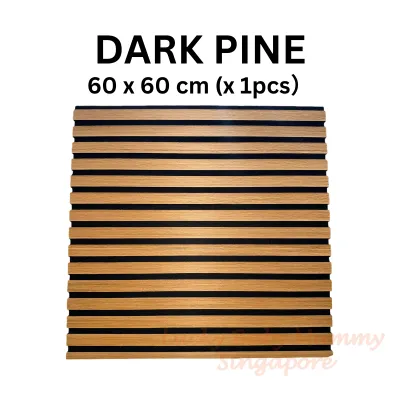
The outer finish of a panel affects both its acoustic performance and its maintenance. Acoustically transparent fabric wraps allow sound waves to pass through to the core unimpeded, but they accumulate dust and require gentle vacuuming. Wood slats or perforated wood faces add a premium aesthetic and introduce high-frequency diffusion or reflection, preventing the room from sounding too dead while still absorbing lower frequencies behind the wood. Harder, non-porous finishes should be avoided unless specifically engineered with micro-perforations, as they reflect high-frequency sound waves before they can reach the absorptive core.
Safety and compliance should always be a priority when selecting materials for your walls. Before purchasing, check the product documentation for certified fire safety ratings, such as a Class A or Class 1 rating under local building standards. In Singapore, residential and commercial spaces have strict fire safety codes regarding wall linings, so verifying these certifications on the manufacturer’s spec sheet is essential to ensure compliance and safety.
Building Your Acoustic Treatment Plan
To build an effective acoustic treatment plan, start by identifying the primary acoustic symptoms in your room. If you notice a sharp, ringing echo when you clap your hands, you are dealing with flutter echo, which can be resolved by placing thinner panels at ear level on parallel walls. If your music sounds muddy or lacks definition in the low end, you are experiencing bass buildup, which requires thicker panels or dedicated bass traps placed in corners where low-frequency energy naturally accumulates.
Calculating the necessary coverage area is the next step to avoid over-treating your space. Covering every wall surface with highly absorptive panels makes the room sound unnaturally dead and uncomfortable. For most home studios, listening rooms, or home theaters, a coverage area of 20% to 40% of the total wall surface is sufficient to control reflections while maintaining a natural room ambiance. Start with key reflection points—such as the walls directly to the left and right of your listening position—and add more panels gradually if needed.
Finally, review the manufacturer’s installation guidelines before mounting your panels. Heavy fiberglass or mineral wool panels require secure mounting hardware, such as impaling clips, Z-clips, or heavy-duty wall anchors, to support their weight safely. Lightweight foam or PET felt panels can often be mounted using adhesive strips, but you must verify that the adhesive is compatible with your wall surface to prevent damage or peeling paint.
Frequently Asked Questions (FAQ)
Do higher NRC ratings always mean better acoustic panels?
A higher NRC rating does not automatically make a panel the ideal choice for every situation. A balanced acoustic environment requires a strategic mix of absorption, diffusion, and reflection to sound natural. If you treat a room exclusively with high-NRC panels, you risk absorbing all the high-frequency energy while leaving low-frequency muddy reflections untouched, resulting in an unbalanced, claustrophobic-sounding space.
Can acoustic wall panels block noise from outside?
No, acoustic wall panels cannot block external noise from entering your room or prevent internal sound from escaping. Acoustic panels are designed for sound absorption, which manages reflections within a space, whereas soundproofing requires mass, density, and structural decoupling to block sound transmission. To address external noise issues, you should look into solutions like mass-loaded vinyl, sealing gaps around doors and windows, or constructing decoupled double-walls.
Community discussion
Share your experience or ask a question. Comments are reviewed before publication.