
To prepare effectively for major academic milestones in Singapore, selecting the right study materials is one of the most impactful decisions you can make for your child. The most reliable school exam paper sets are those that align precisely with the latest Ministry of Education (MOE) syllabus, feature comprehensive step-by-step worked solutions, and match your child’s current academic readiness. These resources generally fall into three distinct categories: top school preliminary exam compilations for high-order challenge, official national past-year papers (such as the Ten-Year Series) for standardized baseline practice, and subject-specific thematic bundles for targeted topical remediation.
By understanding how to evaluate these options, verify their authenticity, and integrate them systematically into a study routine, you can transform these practice papers from simple worksheets into highly strategic diagnostic tools. This guide outlines the essential criteria for selecting the best paper sets and provides a structured framework to optimize your child’s revision cycle.
Why Top School Exam Papers 2025 Are Crucial for Current Exam Prep
In the context of academic preparation, “2025 papers” refer to the examination papers compiled from the 2025 academic year. Because Singapore’s national exams and school-based assessments continuously evolve, these papers represent the most current, post-pandemic baseline of assessment styles. Practicing with the immediate past year’s papers ensures that students are not caught off guard by subtle shifts in questioning trends or formatting updates introduced by the Singapore Examinations and Assessment Board (SEAB) and individual school departments.
Products mentioned in this guide
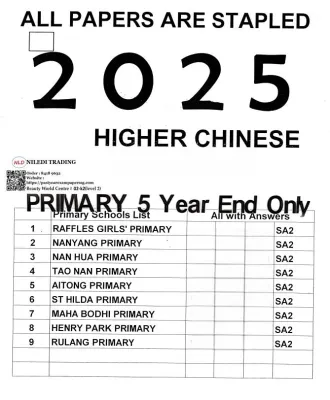
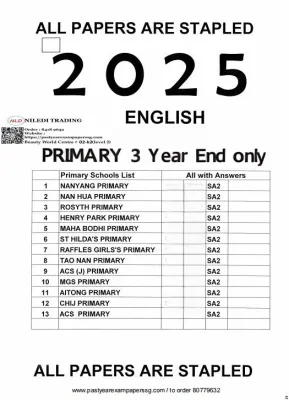
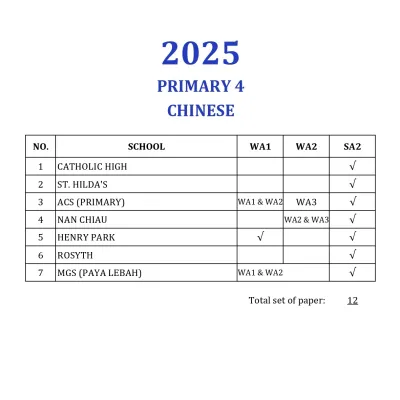
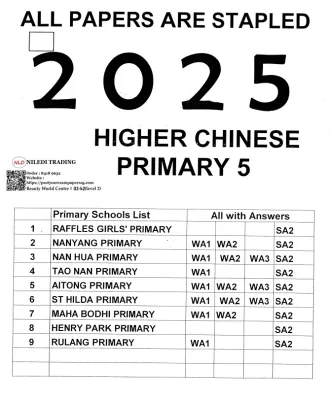
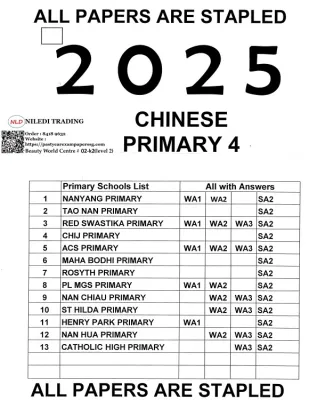
Prices are valid at publication and may change. Please refer to the product page for the latest price.
These recent papers are particularly valuable for capturing ongoing adjustments in the MOE syllabus. For instance, Primary 6 Science open-ended questions increasingly demand that students apply scientific concepts to unfamiliar, real-world scenarios rather than relying on rote-memorized answer templates. Similarly, Mathematics papers at both the primary and secondary levels continue to refine their emphasis on complex heuristics and multi-step problem sums. Using older compilations from five or ten years ago might expose your child to outdated question formats that no longer reflect these modern assessment priorities.
Furthermore, practicing with the most recent papers helps students build realistic time-management skills. The pacing, cognitive load, and stamina required to complete a 2025 paper match the current academic standard far better than older editions. By simulating exam conditions with these up-to-date materials, your child can accurately assess their speed and decision-making under pressure, reducing anxiety when they face their actual assessments.
Key Criteria for Choosing the Right Exam Paper Bundles
Subject and Academic Level
Before purchasing any exam bundle, it is vital to verify the exact academic level, stream, and subject code. For primary school students, this means distinguishing between Standard and Foundation subjects at the Primary 5 and Primary 6 levels. For secondary school students, the distinction is even more critical; you must ensure the papers match the specific curriculum stream—such as Express, Normal Academic, or Normal Technical—as well as the specific syllabus code (e.g., O-Level Elementary Mathematics vs. Syllabus G3 Mathematics). Purchasing a generic “Secondary Math” bundle without verifying these details can lead to your child practicing irrelevant topics or missing out on essential components of their specific syllabus.

Source of Papers
Parents must understand the fundamental difference between papers sourced from top-performing local schools and official national past-year papers. Compilations of preliminary exam papers from top-performing schools (often referred to as “top school papers”) are designed by experienced school teachers to stretch students’ capabilities. These papers frequently feature highly challenging, non-routine questions that test the upper limits of the syllabus. Conversely, official national past-year papers represent the standardized baseline of difficulty that every student across the country will face. Balancing these two sources is key to a well-rounded preparation strategy.
Quality of Answer Keys
The value of an exam paper set lies heavily in the quality of its answer key. Cheap or poorly compiled sets often provide only the final numerical answer or a brief, one-sentence summary. For subjects like Mathematics and Science, where methodology and structured explanations carry significant weight, these minimal answer keys are highly inadequate. Look for bundles that offer detailed, step-by-step worked solutions. In Mathematics, this means showing every algebraic step or model-drawing phase; in Science, it means highlighting the specific keywords and structural frameworks (such as the “Cause-and-Effect” or “Claim-Evidence-Reasoning” models) required to secure full marks.
Physical vs. Digital Formats
Choosing between physical booklets and digital PDF downloads involves weighing tactile benefits against convenience. Physical books are excellent for simulating real exam conditions. They force students to practice handwriting stamina, manage physical booklets, and flip back and forth between question texts and data sheets—a crucial skill for secondary Science and Geography exams. On the other hand, digital or printable formats are highly cost-effective and allow parents to print clean, unmarked copies of specific challenging sections. This enables students to re-attempt difficult questions multiple times without being influenced by their previous pencil markings.
Top Categories of Exam Paper Sets to Consider
Top School Preliminary Exam Compilations
These compilations aggregate the preliminary examination papers from highly regarded primary or secondary schools in Singapore. They serve as an excellent diagnostic tool for students who have already mastered their foundational textbooks and are aiming to secure top-tier grades (such as AL1/AL2 in the PSLE or A1/A2 in the O-Levels). Because these schools design their internal papers to prepare their own students for the absolute worst-case scenarios in national exams, the questions often require higher-order thinking skills (HOTS) and creative application of concepts.
However, parents must exercise caution when introducing these papers. Because of their elevated difficulty level, assigning them to a student who is still struggling with core concepts can be highly counterproductive. If a child is consistently scoring below 60% on standard school assessments, forcing them to complete top school prelim papers can severely damage their academic confidence and increase exam-related anxiety. These papers are best introduced selectively once foundational competence is firmly established.
National Past Year Paper Bundles
Often recognized in Singapore as the official Ten-Year Series (TYS) or yearly national compilations, these sets contain the actual exam papers administered by SEAB and MOE in previous years. They are considered the gold standard of exam preparation because they represent the exact difficulty level, formatting, and marking standard of the actual national exams. Every student preparing for a national milestone should make these bundles a core pillar of their revision routine.
One of the greatest advantages of national past-year bundles is that they allow students to become deeply familiar with the recurring patterns of the exams. While top school papers can sometimes be unpredictably difficult, national papers follow a highly structured distribution of easy, moderate, and challenging questions. This predictability helps students develop a reliable exam strategy, teaching them which questions to secure quickly and how to allocate their time effectively.
Subject-Specific Thematic Paper Sets
Rather than presenting full, timed exam papers, thematic paper sets organize past exam questions by topic or specific question type. For example, you can find bundles dedicated entirely to “Primary Science Open-Ended Questions,” “Math Heuristics,” or “O-Level Chemistry Practical Planning.” These sets are invaluable during the earlier phases of the academic year or during mid-year holidays when students have not yet covered the entire syllabus.
Using thematic papers allows for highly targeted remediation. If your child’s school progress reports indicate a persistent struggle with a specific topic—such as Fractions or Light and Shadows—you can use these topical compilations to provide concentrated, repetitive practice. This focused approach helps students master the specific vocabulary and conceptual frameworks of their weak areas before they attempt the cognitive multitasking required for full, mixed-topic exam papers.
Quick Comparison: Top School Prelims vs. National Past Papers
To help you determine which paper set best aligns with your child’s current academic needs and preparation phase, consider this structured comparison:
| Feature | Top School Prelim Compilations | National Past Year Papers |
|---|---|---|
| Difficulty Level | Generally high; emphasizes complex, non-routine, and higher-order thinking questions. | Standardized; represents the exact average difficulty of the national cohort. |
| Best Used For | Stretching high-achieving students and exposing them to novel problem-solving scenarios. | Establishing a baseline, understanding exam formats, and mastering official marking criteria. |
| Ideal Student Profile | Students consistently scoring 75% or higher who have mastered foundational concepts. | All students preparing for national exams, regardless of their current grade level. |
| Recommended Phase | Mid-year preparation to identify deep conceptual limits and build advanced problem-solving skills. | Final exam sprint (last 2 to 3 months) to simulate real exam pacing and build confidence. |
How to Verify Authenticity and Syllabus Alignment When Buying
When shopping for 2025 exam paper sets, especially on online marketplaces or third-party e-commerce platforms, verifying the authenticity and completeness of the product is essential. The market is frequently flooded with unauthorized, low-quality reproductions or outdated files repackaged with a new cover. To protect your purchase and ensure your child is studying the correct material, always check the publisher’s official credentials, the publication year, and the physical ISBN on the copyright page.
Avoid buying unauthorized PDF downloads or poorly printed, self-bound booklets from unverified online sellers. These unauthorized copies often suffer from several critical issues:
- Incomplete Content: Missing pages, omitted diagrams, or poorly scanned images that make scientific data or mathematical graphs unreadable.
- Inaccurate Answer Keys: Solutions that are riddled with errors, typos, or completely incorrect steps, which can severely confuse your child during self-grading.
- Outdated Material: Old syllabus questions presented as "new" 2025 content, leading to wasted study time on topics that are no longer examinable.
To guarantee authenticity, purchase your exam paper bundles from established physical educational bookstores in Singapore (such as Popular Bookstore), official publisher online portals, or verified flagship stores on major e-commerce platforms. Before finalizing your purchase, cross-reference the subject codes on the book cover with the official, current-year syllabus codes listed on the SEAB website. If you are buying a digital or hybrid resource, verify the file format, regional access restrictions, and device compatibility to ensure your child can access the digital answer portals or video explanations without technical issues.
Practical Tips for Integrating Exam Papers into Study Routines
Simulate Realistic Exam Conditions
To get the maximum educational value from a full exam paper, your child must attempt it under realistic exam conditions. This means sitting in a quiet, distraction-free environment, setting a strict timer matching the official duration, and removing all textbooks, notes, and mobile devices. Ensure they use only the stationery permitted in the actual exam, such as an approved scientific calculator, a 2B pencil for optical answer sheets, and a reliable ruler. Simulating these constraints builds the physical and mental stamina required to stay focused during the actual paper.
Implement a Structured Post-Paper Review
Simply completing and marking a paper is not enough to improve performance. The most critical step of the process is the post-paper review. Sit down with your child and categorize their mistakes into two distinct groups:
- Careless Mistakes: Errors caused by misreading the question, calculation slips, or poor time management. Address these by teaching your child active reading strategies, such as underlining key terms and command words.
- Conceptual Gaps: Errors caused by a genuine lack of understanding of the topic or the inability to structure an answer according to the marking scheme. Address these by returning to the textbook or topical worksheets to rebuild the foundational concept before attempting another full paper.
Prioritize Quality Over Quantity
Many parents fall into the trap of pushing their children to complete as many papers as possible, sometimes demanding multiple papers a week. This approach often leads to burnout and repetitive mistakes. It is infinitely more beneficial for a student to thoroughly analyze, correct, and understand one single exam paper than to blindly rush through five papers without review. Ensure your child rewrites the correct answers in full, paying close attention to the specific phrasing and keywords required by the detailed answer key. This deliberate practice is what ultimately bridges the gap between a near-miss and a top-tier score.
Frequently Asked Questions (FAQ)
Are 2025 exam papers still relevant for 2026 and beyond?
Yes, 2025 exam papers remain highly relevant for subsequent exam cycles. The MOE syllabus operates on multi-year cycles, meaning that major syllabus overhauls are infrequent and widely publicized well in advance. The core mathematical concepts, scientific principles, and linguistic skills tested in the 2025 papers will remain directly applicable to upcoming exams. These papers continue to serve as an excellent, modern benchmark for student preparation.
Should I buy physical books or digital PDF versions of exam papers?
For full-paper simulations, physical books are highly recommended because they replicate the tactile experience of the actual examination hall, helping students build handwriting stamina and paper-management skills. However, digital PDF versions are highly useful during the early and mid-year revision phases. They allow you to easily print specific, targeted sections or clean copies of challenging questions for repeated practice without requiring you to purchase multiple physical copies of the same book.
How early should my child start practicing with full exam paper sets?
Your child should avoid full exam paper sets early in the academic year, as they will not have covered the entire syllabus yet, which can lead to unnecessary frustration. Instead, focus on topical worksheets and thematic paper sets during the first half of the year. Transition to full, timed exam paper sets approximately three to four months before the actual national or school-level exams. This timeline provides ample opportunity to build exam endurance, refine time-management strategies, and patch remaining conceptual gaps.
Community discussion
Share your experience or ask a question. Comments are reviewed before publication.