
Selecting your first set of classical guitar strings can feel surprisingly complex, but focusing on a trusted brand like D’Addario simplifies the process. For most beginners, the ideal starting point is a normal-tension nylon set, with the D’Addario EJ27N serving as an excellent budget-friendly student option and the D’Addario EJ45 Pro-Arté standing as the industry standard for balanced tone and reliable intonation.
Nylon strings are fundamentally different from steel strings, offering a softer feel under the fingers and a warm, mellow acoustic voice. Because classical guitars lack adjustable truss rods to counteract high tension, choosing the correct nylon set is crucial not only for your playing comfort but also for the structural health of your instrument. By understanding how tension, materials, and manufacturing quality intersect, you can select a set of strings that supports your learning journey without causing unnecessary finger fatigue or tuning frustration.
Quick Picks: D'Addario Nylon Sets for Beginners
When you are just starting out, you want to avoid analysis paralysis and focus on strings that offer immediate playability, reliable tuning stability, and reasonable pricing. D’Addario offers two primary pathways for beginners, each tailored to different budgets and learning goals. These sets are widely available in local music shops and online marketplaces, making them easy to source whenever you need a replacement.
Products mentioned in this guide


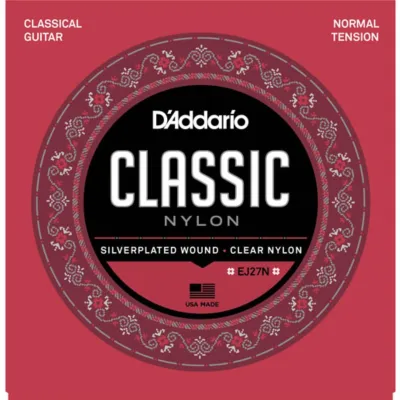
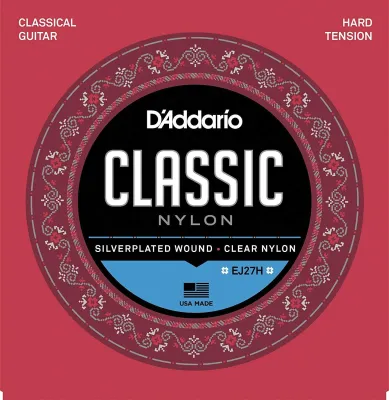
Prices are valid at publication and may change. Please refer to the product page for the latest price.
- D'Addario EJ27N Student Nylon (Normal Tension): This is the go-to choice for absolute beginners, classroom students, and players on a strict budget. It provides a comfortable, low-fatigue playing experience and reliable performance at an accessible price point, typically ranging from S$10 to S$15 in local retail environments.
- D'Addario EJ45 Pro-Arté Nylon (Normal Tension): This is the benchmark classical guitar set for serious students and intermediate players. It features laser-sorted treble strings for highly consistent intonation and a richer, more resonant tonal profile, making it ideal if you want to maximize the acoustic potential of your instrument.
While both of these sets are designed for standard full-sized classical guitars, your final choice should also account for your instrument’s scale length. If you are practicing on a fractional-sized guitar, such as a 1/2 or 3/4 scale model often used by younger learners, you will need to select the corresponding fractional version of the EJ27 series to ensure the strings reach the correct tension at standard pitch.
What Makes a Nylon String Set Suitable for Beginners
As a beginner, your hands and fingers are adapting to entirely new physical demands. The primary goal of your first string set is to minimize physical barriers to practice, allowing you to build finger strength and calluses gradually without experiencing debilitating pain or joint strain.

String tension is the most critical factor in this equation. Classical guitar strings are categorized by tension rather than numerical gauge thickness. Normal tension (sometimes called medium tension) is highly recommended for beginners because it requires less downward pressure to fret notes cleanly against the fingerboard. This lower resistance helps prevent hand cramping and allows you to focus on proper left-hand positioning and clean chord transitions during long practice sessions.
Material composition also plays a significant role in how a string feels and sounds. Traditional beginner sets utilize clear nylon for the three treble strings (G, B, and high E) and a multifilament nylon core wound with silver-plated copper wire for the three bass strings (E, A, and D). Clear nylon trebles offer a smooth, glossy surface that is gentle on soft fingertips, while silver-plated copper basses provide a warm, deep resonance that complements the classical repertoire.
Finally, consistent manufacturing tolerances are essential for proper intonation. If a string’s diameter varies along its length, it will not vibrate uniformly, causing notes to sound out of tune even when the guitar is perfectly tuned open. High-quality beginner sets ensure that the strings are extruded to precise, uniform gauges, allowing your entry-level classical guitar to play in tune across the entire fretboard.
Comparing Popular D'Addario Nylon String Series
D’Addario organizes its classical guitar strings into distinct product families designed for different stages of a player’s development. Understanding the structural differences between these series helps you match a set to your specific budget and commitment level rather than simply buying the most expensive option on the shelf.
For players living in humid tropical climates like Singapore, packaging is an often-overlooked factor. High humidity can accelerate the oxidation of silver-plated copper bass strings, causing them to tarnish and lose their brightness even before they are installed. D’Addario addresses this by sealing their strings in corrosion-resistant, modified-atmosphere packaging, ensuring that the strings remain fresh and pristine from the factory to your guitar.
Student and Entry-Level Sets (e.g., EJ27N Series)
The EJ27N series is specifically engineered to lower the barrier of entry for new classical guitarists. These strings utilize standard clear nylon trebles paired with silver-plated copper wound basses, delivering a classic, warm acoustic tone that is highly representative of the traditional classical guitar sound.
Because these sets are optimized for affordability, they are highly practical for the early stages of learning when you may need to change strings frequently due to improper installation practice or heavy initial wear. The primary trade-off is that they lack the advanced laser-sorting refinement of the premium lines, meaning they may exhibit slightly less tonal complexity and take a bit longer to stretch and settle into stable tuning when first installed.
Standard and Intermediate Sets (e.g., EJ45 Series)
The EJ45 set belongs to D’Addario’s renowned Pro-Arté line, which serves as the standard of comparison for classical guitarists worldwide. The defining feature of this series is the use of computer-controlled laser micrometer systems that measure each treble string thousands of times during production to verify its exact diameter and tension profile.
This extreme precision ensures near-perfect intonation and a highly balanced transition in volume and tone from the bass strings to the trebles. If you have a slightly larger budget or have already built basic finger strength, stepping up to the EJ45 series provides a noticeable improvement in acoustic resonance, sustain, and dynamic expression, helping you hear the subtle nuances of your touch as your technique improves.
Matching String Tension and Material to Your Playing Style
Once you have decided on a product series, you must select the specific tension and material variant that aligns with your physical capabilities and your guitar’s natural voice. D’Addario offers several options, but navigating them requires a clear understanding of their physical trade-offs.
Normal Tension: This is the universal starting point. It offers the lowest physical resistance, making it highly forgiving for weak or untrained fingers. It produces a warm, round tone with excellent sustain and is highly compatible with lightly braced, traditional classical guitars.
Hard Tension: Hard-tension strings require more physical effort to press down and bend. In return, they offer increased acoustic volume, a faster physical response to your right-hand attack, and a brighter, more projecting tone. They are suitable for beginners who already possess significant hand strength, or for guitars with very low action that are prone to string buzzing when played with normal-tension strings.
Extra-Hard Tension: These strings exert maximum physical pull on the guitar’s bridge and neck. They are generally not recommended for beginners, as the high tension can quickly cause hand fatigue and may put unnecessary structural stress on older or lightly built student instruments.
When reading D’Addario packaging, look for the specific color-coded labels and alphanumeric codes. For example, the EJ45 code denotes normal tension, while EJ46 indicates hard tension. Additionally, pay attention to the treble material options. While clear nylon is the standard for a smooth feel and bright, clear tone, some intermediate sets offer rectified nylon trebles. Rectified trebles undergo a centerless grinding process that gives them a very fine, textured matte finish; this texture provides a more secure grip for your fingertips and produces a warmer, more rounded tone, though some players find the textured surface slightly more abrasive during long practice sessions.
What to Check Before Buying and Installing Your Strings
Before you purchase a new set of D’Addario nylon strings, you must perform a few basic checks on your instrument to ensure compatibility and prevent damage during the installation process. Classical guitars require a completely different approach to maintenance than steel-string acoustic or electric guitars.
First, confirm that your guitar is actually a classical instrument designed for nylon strings. Look at the bridge: a classical guitar features a flat tie-block bridge where the strings must be physically looped and knotted, rather than bridge pins that hold ball-end strings in place. Additionally, verify the scale length of your instrument. If you are playing a fractional student guitar, purchasing a standard full-scale set will result in loose, floppy strings that cannot be tuned to pitch without buzzing.
Next, inspect the contact points on your guitar. Run a finger gently along the slots of the headstock nut and the top of the bridge saddle. These components should be smooth and free of sharp plastic or bone burrs. Because nylon is a relatively soft material, any sharp edge can easily slice through a treble string under tension or cause the silver-plated windings on the bass strings to unravel prematurely.
When you are ready to install the strings, follow a systematic winding and tying method to ensure tuning stability:
- The Bridge Knot: Thread the string through the bridge hole from the soundhole side, leaving a few centimeters of tail. Loop the tail behind the main length of the string, then tuck it under itself once for the wound bass strings, and two to three times for the slicker nylon treble strings. Ensure the final loop lies flat against the back of the tie-block before pulling the string tight.
- The Tuning Peg: Thread the string through the hole in the plastic roller of the tuning machine. Wrap the string over the roller and tuck the tail under the main length of the string to create a self-locking knot as you turn the peg. Keep the wraps neat and aligned to prevent the string from binding against the wood of the headstock slot.
- The Stretching Phase: Nylon strings are highly elastic and will stretch continuously for several days after installation. To speed up this process, tune the guitar to pitch, then gently lift each string a few centimeters away from the fretboard along its entire length. Retune the guitar and repeat this process several times until the pitch begins to stabilize.
If you notice that your guitar’s bridge is lifting away from the wooden soundboard, if the neck appears severely bowed, or if you feel uncomfortable performing the bridge knots yourself, stop immediately. Take your instrument to a qualified local luthier or guitar technician to ensure it is structurally sound and properly set up for your new D’Addario strings.
Frequently Asked Questions (FAQ)
How often should a beginner change their nylon strings?
A beginner should typically change their classical guitar strings every three to four months, though this depends heavily on how often you practice and the environmental conditions in your home. In humid climates, the silver-plated copper bass strings will oxidize and turn dark or black over time, resulting in a dull, muddy sound. You should also replace your strings immediately if you observe physical signs of wear, such as flat spots or deep grooves worn into the underside of the strings above the frets, fraying of the metal windings on the bass strings, or if the guitar becomes increasingly difficult to tune and keep in tune.
Can I use steel-string acoustic strings on a classical guitar?
No, you must never put steel strings on a classical guitar. Classical guitars are built with lightweight internal bracing and do not have an adjustable steel truss rod running through the neck to reinforce it against high tension. Steel strings exert more than double the physical tension of nylon strings. Installing them on a classical guitar will almost certainly warp the neck permanently, pull the bridge completely off the wooden soundboard, or crack the delicate top wood of the instrument. Always ensure you are purchasing dedicated nylon strings for your classical guitar.
Community discussion
Share your experience or ask a question. Comments are reviewed before publication.