
Choosing the right Primary 5 exam paper bundles in Singapore requires looking for materials that strictly align with the latest Ministry of Education (MOE) syllabus, offer comprehensive step-by-step answer keys, and accurately replicate the formatting of actual school examinations. High-quality bundles from established local educational publishers or curated compilations of top school papers are the most effective tools to help your child transition smoothly into this high-stakes academic year.
Primary 5 represents a significant milestone in a student’s primary school journey, serving as the critical foundation-building year before the Primary School Leaving Examination (PSLE). By selecting bundles that feature realistic layouts, progressive difficulty levels, and detailed marking schemes, you can help your child build exam stamina, master complex heuristics, and target specific learning gaps. This guide outlines the essential factors to consider when purchasing these practice papers, breaks down subject-specific requirements, and provides a structured framework for integrating them into a productive home study routine.
Why Primary 5 Exam Paper Bundles Are Essential for School Prep
Primary 5 is widely recognized in Singapore as a highly challenging transitional year. The academic curriculum undergoes a steep increase in complexity across all major subjects, introducing advanced conceptual frameworks and requiring students to demonstrate higher-order thinking skills. This sudden jump in difficulty can catch many students off guard, making consistent, structured preparation vital to maintaining academic confidence.
Products mentioned in this guide
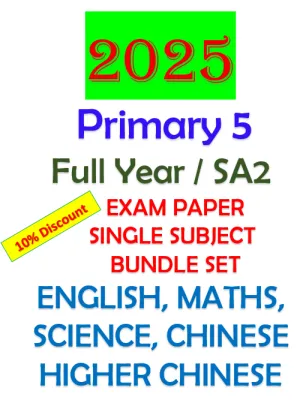
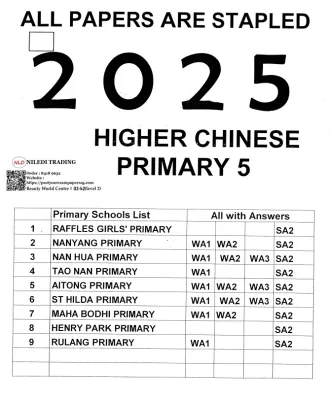
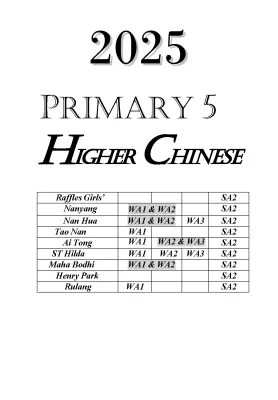
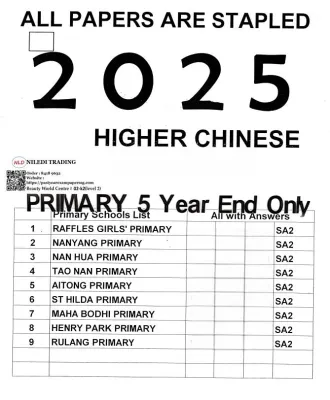
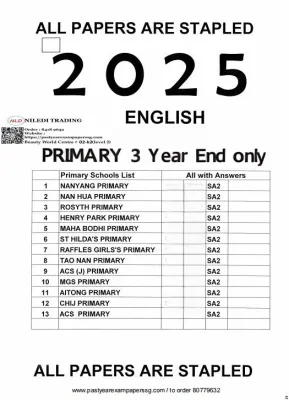
Prices are valid at publication and may change. Please refer to the product page for the latest price.
Using bundled exam papers offers distinct psychological and academic advantages over loose worksheets. Completing a full, structured paper helps students build the physical and mental stamina required to sit focus-intense papers that can last up to two hours. It also familiarizes them with the structural flow of formal assessments, teaching them how to manage their time effectively between quick-fire multiple-choice questions and lengthy, high-weightage open-ended sections.
While topical assessment books are highly valuable for initial concept reinforcement, they do not prepare a student for the cognitive switching required during an actual exam. Exam paper bundles force students to rapidly recall and apply diverse concepts from different chapters in a single sitting. This multi-topic integration is crucial for identifying hidden knowledge gaps that topical practices might fail to expose, making bundles an indispensable part of mid-year and end-of-year revision.
How to Choose the Best Primary 5 Exam Paper Bundles
MOE Syllabus Alignment
Before purchasing any exam paper bundle, you must verify that the content strictly reflects the latest MOE syllabus updates and examination formats. The Singapore educational curriculum undergoes periodic refinements to place greater emphasis on real-world applications and critical thinking. Using outdated papers can lead to your child practicing obsolete question formats or missing out on newly introduced topics, which wastes valuable study time.

Quality of Answer Keys
The usefulness of an exam paper bundle is heavily defined by the depth of its answer key. Avoid packages that only provide final numerical answers or basic letter options. A high-quality bundle features comprehensive, step-by-step solutions that explain the underlying logic of each question. For Mathematics, this means showing complete heuristic workings; for Science, it involves highlighting key scientific terms and marking rubrics; for English, it requires detailed explanations for grammar and synthesis choices.
Realism and Formatting
To effectively reduce exam-day anxiety, the practice papers must mimic the physical layout and formatting of actual school papers. Look for bundles that use realistic font sizes, line spacing, and margin widths, along with separate booklets for different sections where applicable. This structural realism helps students get used to writing their workings clearly within the designated spaces and teaches them to navigate standard instruction rubrics without confusion.
Progression of Difficulty
An effective exam preparation strategy relies on a progressive build-up of confidence and skill. The best bundles offer a balanced mix of papers, starting with foundational assessments that test basic recall and straightforward applications, before moving on to intermediate and highly challenging papers. This gradient allows students to consolidate their core knowledge before tackling complex, non-routine questions that test higher-order thinking skills.
Publisher Verification
When sourcing these materials, prioritize established local educational publishers known for their rigorous editorial standards and deep familiarity with the Singapore school system. Look for reputable names such as Singapore Asia Publishers (SAP), Shing Lee, Marshall Cavendish, and CPD Singapore Education. Always check the publication or revision date on the cover to ensure the bundle is fully updated for the current academic year, and purchase only from authorized bookshops or official publisher channels on online marketplaces.
What to Look for in Top-Rated Subject-Specific Bundles
Mathematics: Heuristics and Problem-Solving Focus
Primary 5 Mathematics introduces highly demanding topics such as ratio, percentage, rate, and speed, alongside complex fraction concepts. A top-tier Math exam bundle must feature a strong concentration of Paper 2 word problems that require the application of advanced heuristics. These include standard Singapore Math problem-solving methods such as model drawing, constant difference, excess and shortage, and working backwards.
To ensure comprehensive preparation, the papers should actively target common conceptual pitfalls and typical student misunderstandings. For example, questions should test whether a student can distinguish between a fraction of a remaining quantity versus a fraction of the original total, or if they can accurately calculate the volume of complex, composite three-dimensional shapes.
Furthermore, the answer keys must showcase alternative solving pathways rather than a single, rigid method. Because different schools teach different heuristic approaches, having access to both model-drawing and algebraic or unitary methods allows you to guide your child using the specific techniques they are most comfortable with, preventing unnecessary confusion.
Science: Application and Open-Ended Question Techniques
At the Primary 5 level, Science assessments shift dramatically away from simple factual recall toward the practical application of scientific concepts. High-quality Science bundles must prioritize data-based questions, requiring students to analyze experimental setups, interpret graphs, evaluate tables of results, and identify experimental variables such as independent, dependent, and constant factors.
An exceptional Science answer key is one that explicitly teaches structured answering techniques. Look for bundles that utilize established frameworks like the Claim-Evidence-Reasoning (CER) model to guide students through Section B open-ended questions. The solutions should clearly highlight mandatory scientific keywords and phrases that school examiners look out for during marking.
Additionally, you should verify that the bundle comprehensively covers all critical Primary 5 Science themes under the MOE syllabus. Ensure there is an equal and rigorous distribution of questions spanning the Systems theme (including human respiratory, circulatory, and plant transport systems) and the Cycles theme (focusing on the water cycle and reproduction in both plants and humans).
English: Grammar, Vocabulary, and Comprehension Alignment
A robust Primary 5 English exam bundle must mirror the exact structural components of the formal school paper. This includes updated formats for Grammar and Vocabulary Multiple-Choice Questions (MCQs), Vocabulary Cloze, and demanding Synthesis and Transformation tasks. Synthesis sections should heavily feature complex connectors and sentence structures typical of the P5 syllabus, such as nominalisation and active-to-passive conversions.
For the Comprehension Open-Ended section, look for papers that test deep inferential skills rather than simple, literal information retrieval. The questions should challenge students to analyze the characters’ motivations, explain the use of specific literary devices, and interpret the meanings of phrases in context. Visual text comprehension papers should also feature realistic, modern layouts like brochures, websites, or event flyers.
Finally, composition practice is highly dependent on quality prompts and guidance. The best bundles include situational and continuous writing tasks that align with current MOE themes, complete with structured planning frameworks, brainstorming mind maps, and high-scoring model essays that demonstrate excellent vocabulary usage and narrative flow.
All-in-One vs. Subject-Specific Bundles: Which Is Right for Your Child?
Deciding between an all-in-one multi-subject bundle and targeted, subject-specific packs depends largely on your child’s current academic standing, study schedule, and specific learning needs.
All-in-One Bundles
All-in-one bundles compile exam papers for all four major subjects—English, Mathematics, Science, and Mother Tongue—into a single package. These are highly cost-effective, typically ranging from S$15 to S$35, and offer a convenient, comprehensive solution for general revision. They are ideal for simulating a realistic mid-year or end-of-year exam week at home, helping students practice overall time management and transition smoothly between different academic disciplines.
However, all-in-one bundles may lack the sheer volume of practice questions required to master a particularly difficult subject. Because they aim to provide a balanced overview, they might only include a few papers per subject, which may not be sufficient for a student struggling with specific conceptual weaknesses.
Subject-Specific Bundles
Subject-specific bundles focus entirely on a single discipline, often containing 8 to 12 complete papers dedicated solely to that subject. These packages allow for deep, highly targeted practice and frequently include specialized topical indices that help you pinpoint and drill down into specific weak chapters.
The primary trade-off is the higher cumulative cost, as buying individual bundles for all four subjects can quickly add up. They also require more parental organization to schedule, as you will need to manually balance the practice sessions across different subjects to ensure your child maintains a well-rounded study routine.
Decision Framework
To help you choose the best format for your child’s preparation, consider the following comparison of features and suitability:
| Feature / Need | All-in-One Bundles | Subject-Specific Bundles |
|---|---|---|
| Best Suited For | Students maintaining steady, balanced grades who need general exam simulation. | Students with clear weak areas who require intensive, targeted intervention. |
| Practice Depth | Moderate; usually contains 2 to 4 papers per subject. | High; typically features 8 to 12 papers for a single subject. |
| Typical Price Band | S$15 – S$35 per bundle | S$8 – S$20 per subject bundle |
| Primary Goal | Time management, exam stamina, and broad diagnostic tracking. | Mastering complex heuristics, specific scientific concepts, or language rules. |
| Parental Effort | Low; easy to follow a pre-packaged multi-subject structure. | Moderate to High; requires planning to ensure balanced subject coverage. |
How to Use Practice Bundles Effectively at Home
Simulating Exam Conditions
To get the maximum value out of each exam paper, it is crucial to recreate a realistic exam environment at home. Set up a quiet, well-lit study space entirely free from distractions such as television, music, or mobile phones. Ensure that all reference materials, textbooks, and notes are put away before the practice session begins.
Strictly enforce the official time limits specified on the cover of each paper. Instruct your child to complete the paper independently, without asking for help during the session. This disciplined approach teaches them how to pace themselves, when to temporarily skip exceptionally difficult questions, and how to allocate time for final checking.
Strategic Reviewing
The true learning process happens after the paper is completed. Do not simply mark the paper, write down a score, and file it away. Spend adequate time reviewing the completed paper together with your child, using the detailed answer keys to dissect every mistake.
Help your child categorize their errors into “careless mistakes” (such as calculation errors or misreading the question) and “conceptual gaps” (where they genuinely did not understand the topic). For conceptual gaps, refer back to their school textbooks or assessment books to re-learn the core theory before attempting similar questions again.
Pacing and Frequency
Avoid the temptation to have your child complete multiple exam papers in a single weekend, especially during regular school terms. Cramming leads to mental fatigue and diminishing returns, which can cause academic burnout and a negative attitude toward learning.
Instead, adopt a sustainable pacing strategy. During the regular term, aim for one full paper per week, alternating between different subjects. As school exams approach, you can gradually increase this frequency to two papers per week, ensuring that there is always ample time between papers for thorough review, correction, and rest.
Error Logging
Encourage your child to maintain a dedicated mistake journal or folder. Whenever they get a challenging question wrong, cut it out or copy it into this journal, along with the correct step-by-step working and a brief note explaining why the mistake was made.
Before starting a new exam paper from the bundle, have your child review their mistake journal to refresh their memory on past pitfalls. Every few weeks, have them re-attempt the compiled questions in the journal on a blank piece of paper to verify that they have truly mastered the concepts and can solve them independently.
Frequently Asked Questions (FAQ)
Are free online Primary 5 exam papers as effective as printed bundles?
While free online exam papers are highly accessible, they often suffer from formatting inconsistencies, low-resolution diagrams, and missing pages. More importantly, they frequently lack reliable, error-free, and detailed step-by-step answer keys. Professionally printed bundles from established local publishers offer curated progression, accurate formatting, and comprehensive marking schemes that ensure highly productive study sessions.
How many exam paper bundles should a Primary 5 student complete per term?
Quality of practice is far more important than sheer quantity. Completing one to two high-quality exam papers per subject each month, combined with deep error analysis and thorough corrections, is significantly more effective than rushing through multiple complete bundles without proper review. Focus on ensuring your child fully understands the concepts behind every mistake they make.
Community discussion
Share your experience or ask a question. Comments are reviewed before publication.