
Choosing your first instrument is a critical milestone in your musical journey. For complete beginners, Roland offers some of the most reliable, technologically advanced, and highly regarded digital pianos and keyboards on the market. To make the right choice, you must balance key action, sound quality, physical space, and your long-term learning goals.
For most beginners, the Roland FP-30X or the entry-level Roland FP-10 represents the ideal starting point. These models feature fully weighted keys that closely mimic the feel of an acoustic piano, making them perfect for developing proper finger strength and technique. However, if space is exceptionally limited or your budget is tight, the ultra-portable Roland GO series provides a highly accessible alternative, while the Roland RP series offers a permanent furniture-style setup for dedicated home practice.
Key Features to Prioritize in a Beginner Roland Instrument
When evaluating different Roland models, it is easy to get distracted by an abundance of buttons, digital sounds, and production features. For a beginner, the primary focus must always be on how closely the instrument supports the physical and cognitive demands of learning to play. Prioritizing the core specifications below will ensure you select an instrument that aids your progress rather than hindering it.
Products mentioned in this guide
![Roland FP10 FP30X Portable Digital Piano 88 Keys Weighted Keyboard FP-10 FP-30X FP 10 30 [LIMITED STOCK]](https://img.lazcdn.com/g/p/42b9e7a7f49d113c2a0dc023dc6d5a14.jpg_400x400q80.jpg_.webp)
![Roland FP10 Portable Digital Piano Keyboard 88 Keys PHA-4 FP-10 Wooden Stand Sustain Pedal FP 10 The Music Works [LIMITED STOCK]](https://img.lazcdn.com/g/p/0df154e46f8f59780663ee1b7ed17e13.jpg_400x400q80.jpg_.webp)
![Roland E-X20 E-X30 E-X50 Portable Arranger Keyboard 61 Keys Velocity Sensitive EX20 EX30 EX50 with Power Adapter EX 20 30 50 [LIMITED STOCK / PREORDER]](https://img.lazcdn.com/g/p/50c60fa066b8426f27d568cb2ea6e2de.jpg_400x400q80.jpg_.webp)
Prices are valid at publication and may change. Please refer to the product page for the latest price.
Key Action and Touch
The physical response of the keys is the single most important factor in a beginner’s development. Keyboards generally fall into three categories: unweighted, semi-weighted, and fully weighted.
Unweighted keys offer no resistance and are typically found on budget synth-style keyboards. Semi-weighted keys use springs to add a small amount of resistance, which is acceptable for casual playing but inadequate for building classical piano technique.
Fully weighted keys use actual counterweights to simulate the mechanical hammers of an acoustic piano. Roland’s PHA-4 Standard keyboard action is the benchmark for entry-level digital instruments. It features progressive hammer action—meaning the lower keys feel slightly heavier than the higher keys, just like on an acoustic grand piano—and includes an escapement mechanism that replicates the subtle “click” felt when gently pressing an acoustic key. This tactile feedback is essential for learning dynamic control and expression.
Sound Engine and Polyphony
A digital piano’s sound engine determines how realistic and inspiring the instrument sounds. Roland utilizes its proprietary SuperNATURAL sound technology in most of its entry-level and mid-range instruments. Unlike basic digital keyboards that simply play back a single static recording of a piano note, SuperNATURAL technology uses complex physical modeling to recreate the organic, shifting interactions of an acoustic piano’s strings, soundboard, and cabinet. This results in a rich, expressive tone that responds naturally to how hard or soft you strike the keys.
In tandem with the sound engine, you must consider polyphony, which is the maximum number of individual notes or voices the instrument can produce simultaneously. When you play a chord and hold down the sustain pedal, every note continues to ring out. If your instrument has low polyphony, older notes will be abruptly cut off to make room for new ones. For complete beginners, a minimum of 64-note polyphony is acceptable, but 128-note or 256-note polyphony is highly recommended to ensure your playing remains seamless as your repertoire becomes more complex.
Form Factor Choices
You must decide between a portable “slab” style and a fixed “console” style instrument. Portable digital pianos are lightweight, compact, and can be placed on a temporary stand or desk, making them excellent for smaller living spaces, shared apartments, or students who need to transport their instrument. Fixed console or cabinet-style digital pianos are built into a wooden frame, resembling a traditional upright piano. They are heavier, have a permanent footprint, and are designed to serve as a piece of furniture in a dedicated practice space.
Beginner-Friendly Technology
Modern digital instruments offer several integrated tools that can accelerate your learning process. Look for a built-in metronome, which is indispensable for developing a steady sense of rhythm. Integrated recording functions allow you to record your practice sessions and listen back critically to identify areas that need improvement.
Furthermore, Bluetooth MIDI and audio connectivity are incredibly valuable. Bluetooth MIDI allows you to connect wirelessly to educational software on your tablet or smartphone, such as the Roland Piano App, which offers interactive lessons, sheet music, and practice diaries. Bluetooth audio lets you stream backing tracks or instructional videos directly through your piano’s speakers or headphones, allowing you to play along in real time.
Portable Options: Roland GO and FP Series Explained
Roland’s portable lineup is divided into two distinct families: the GO series, designed for casual play and ultimate portability, and the FP series, designed for serious piano study. Understanding the structural differences between these two lines is crucial for matching the instrument to your daily routine.

The GO Series (e.g., GO:PIANO)
The Roland GO series, particularly the GO:PIANO (GO-61P), is engineered for maximum portability and ease of use. Weighing less than 4 kg and capable of running on battery power, these instruments are incredibly easy to move around. The GO:PIANO features 61 full-sized keys, which is sufficient for learning basic melodies, pop songs, and early-stage music theory.
However, the primary trade-off with the GO series lies in the key action. The keys are semi-weighted, meaning they lack the realistic hammer weight of a true digital piano. While this makes the instrument highly accessible, lightweight, and perfect for casual hobbyists, young children, or music producers with severe space constraints, it is not suitable for students who plan to sit for formal classical piano examinations, as it will not build the finger stamina required for acoustic instruments.
The FP Series
The Roland FP series represents the gold standard for portable, high-quality digital pianos. Models like the FP-10 and FP-30X feature a full 88-key layout with the highly praised PHA-4 Standard weighted action. This ensures that from day one, you are practicing on an action that behaves exactly like a traditional acoustic piano.
- Roland FP-10: This is the most compact and affordable 88-key digital piano in Roland's catalog. It features the SuperNATURAL piano sound engine, PHA-4 Standard action, built-in speakers, and Bluetooth MIDI. It is an exceptional value for beginners who want a no-frills, authentic piano experience without paying for extra sounds or advanced connectivity.
- Roland FP-30X: Positioned as the step-up model, the FP-30X upgrades the experience with a more powerful speaker system, higher polyphony (256 notes versus the FP-10's 96 notes), dedicated stereo outputs for connecting to external PA systems, and the addition of Bluetooth Audio. This makes it a highly future-proof investment that can transition from home practice to small performances.
Use Cases
For residents in dense urban environments like Singapore, where living space is often at a premium, the FP series offers a brilliant compromise. An FP-10 or FP-30X can easily sit on a sturdy stand in a bedroom or living room corner and be tucked away if necessary. Their compact depth allows them to fit comfortably into typical HDB flats or condominium layouts without dominating the room, while still providing the uncompromising touch of a full-size acoustic piano.
Home Console Options: Roland RP and HP Series Explained
If you have a dedicated space in your home and want an instrument that looks and feels like a traditional piano, Roland’s home console lines—specifically the RP and HP series—are the ideal categories to explore.
The RP and HP Series
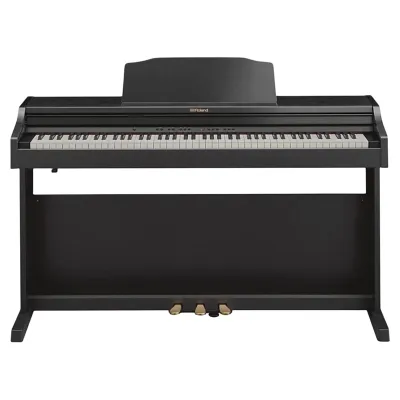
These cabinet-style digital pianos are designed to remain in a fixed location. The Roland RP series (such as the RP107 or RP701) is aimed squarely at families and beginner-to-intermediate students seeking an attractive, traditional look at an accessible price point. The HP series (such as the HP702 or HP704) represents Roland’s premium home lineup, featuring more sophisticated cabinet designs, advanced speaker arrays, and upgraded key actions.
Unlike portable slab pianos, console models feature integrated wooden stands and a fixed three-pedal unit (damper, soft, and sostenuto). They also house larger acoustic cabinets and multi-speaker systems, which project sound downward and outward to mimic the physical resonance and air movement of an acoustic piano’s soundboard.
Ergonomics and Technique
Practicing on a stable, fixed console piano provides significant ergonomic benefits for beginners. Portable keyboards on cheap, single-braced stands can wobble during vigorous playing, which can cause subconscious tension in your wrists and shoulders. A fixed cabinet ensures the keyboard is always at the mathematically correct height from the floor.
Additionally, having the pedals permanently fixed in place prevents them from sliding away from your foot during practice. This stability is essential for developing accurate pedaling habits, such as half-pedaling techniques, which are difficult to master on loose, lightweight plastic switch pedals.
Limitations to Consider
Before purchasing a console piano, you must evaluate the practical limitations. These instruments require a larger initial financial investment, typically starting around S$1,200 and rising significantly for premium HP models.
They are also heavy, often weighing between 35 kg and 60 kg, meaning they cannot be easily moved by a single person. If you live in a rented apartment or anticipate moving homes frequently, the logistics of transporting a heavy console piano can be challenging. Furthermore, you must ensure your living room or bedroom has the permanent wall space to accommodate an instrument that is roughly 1.4 meters wide.
Quick Guide: Matching Roland Series to Your Learning Goals
To help you synthesize this information, the table below maps different learning goals, space constraints, and commitment levels to the most appropriate Roland series.
| Learning Goal & Lifestyle | Space Constraint | Commitment Level | Recommended Roland Series | Key Model Example |
|---|---|---|---|---|
| Casual Hobbyist / Travel | Very High (Needs to pack away easily) | Casual / Exploring | Roland GO Series | GO:PIANO (GO-61P) |
| Traditional Piano Student | Moderate (Needs compact footprint) | Dedicated / Long-Term | Roland FP Series | FP-10 or FP-30X |
| Family Instrument / Classic Look | Low (Has dedicated room space) | High / Multi-User | Roland RP Series | RP107 or RP701 |
| Premium Home Practice | Low (Wants a statement piece) | Very High / Advanced | Roland HP Series | HP702 or HP704 |
The "Sweet Spot" Recommendation
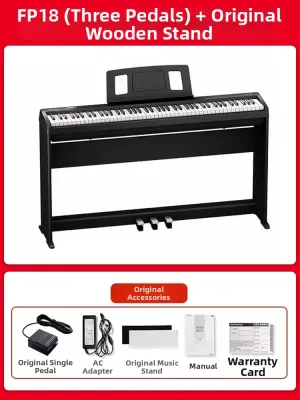
For the vast majority of beginners, the Roland FP-30X is the absolute sweet spot. It strikes an impeccable balance between professional-grade playability and home-friendly practicality. With its PHA-4 Standard weighted action, 256-note polyphony, and upgraded Bluetooth features, it provides everything a student needs to progress from a complete novice to an advanced player without needing an upgrade for several years. It fits comfortably within mid-range budgets (typically around S$900 to S$1,100 depending on local retailer packages in Singapore) and can be paired with an optional matching wooden stand (KSC-70) and three-pedal unit (KPD-70) if you eventually want to convert it into a sleek, semi-permanent console.
Future-Proofing
While saving money on a cheap 61-key non-weighted keyboard is tempting, it often proves to be a false economy. Within six to twelve months of regular lessons, most students will encounter pieces that require the expressive range of weighted keys and the physical span of an 88-key layout. Buying an 88-key weighted instrument from the beginning prevents the hassle and financial loss of having to trade in an entry-level keyboard early in your learning journey.
Essential Accessories and Setup Tips for New Players
To get the most out of your new Roland instrument, you must configure your physical playing environment correctly. Proper ergonomics prevent fatigue and long-term strain, while the right accessories ensure you can practice productively at any time of day.
Stands and Benches
If you choose a portable model like the FP-10 or FP-30X, avoid using cheap, single-braced “X-stands,” which are prone to wobbling and do not allow sufficient legroom. Instead, invest in a heavy-duty, double-braced X-stand, a table-style Z-stand, or the custom-matching wooden stand designed specifically for your model.
Pair your stand with a height-adjustable bench. Your bench height should allow your elbows to rest slightly above the keyboard level when your shoulders are relaxed, with your feet flat on the floor. This posture prevents carpal tunnel syndrome, repetitive strain injuries, and lower back pain during extended practice sessions.
Headphones for Silent Practice
One of the greatest advantages of a digital piano is the ability to practice silently. In dense residential areas, such as Singapore’s HDB estates or apartments, practicing late at night or early in the morning can easily disturb your family or neighbors.
Invest in a high-quality pair of over-ear, closed-back studio monitor headphones. Standard earbuds or consumer noise-canceling headphones often artificially boost bass frequencies, which distorts the natural acoustic modeling of Roland’s SuperNATURAL sound engine. Closed-back studio headphones provide an accurate, flat frequency response, ensuring you hear the true tone of your piano while physically blocking sound from leaking out into your room.
Pedal Upgrades
Many portable digital pianos, including the FP-10, ship with a basic, flat plastic foot-switch pedal. These switches only detect whether the pedal is fully pressed or fully released, acting like an on/off light switch.
To develop proper pedaling technique, upgrade to a physical, piano-style sustain pedal, such as the Roland DP-10. The DP-10 features a heavy metal construction, a slip-resistant rubber plate that extends under your heel to keep it from sliding, and supports half-damper control. This allows for intermediate pedaling techniques where the virtual dampers only partially touch the strings, creating a more controlled, subtle sustain.
Device Connectivity and App Integration
To maximize your learning, take advantage of your instrument’s digital connectivity. When setting up your piano, download the official Roland Piano App on your tablet or smartphone.
If your chosen model supports Bluetooth, pair the device by opening your tablet’s Bluetooth settings and selecting your piano model. If your model does not support Bluetooth, or if you experience audio latency, you can establish a highly stable wired connection using a standard USB-B to USB-C (or Lightning) cable. This connection allows you to use interactive learning apps, display digital sheet music that turns pages automatically as you play, and keep a digital log of your daily practice hours.
Before finalizing any digital piano purchase, always verify the exact regional voltage requirements and the type of power adapter supplied by your local authorized retailer to ensure safe operation in your home.
Frequently Asked Questions (FAQ)
Do I need 88 keys to start learning piano?
While you can learn basic music theory and simple five-finger melodies on a 61-key or 76-key instrument, a full 88-key keyboard is highly recommended for anyone serious about learning the piano. Traditional piano repertoire quickly expands beyond the range of smaller keyboards. Furthermore, almost all 88-key instruments feature fully weighted key actions, which are essential for developing the finger strength, hand posture, and physical coordination required to play an acoustic piano.
Is a Roland digital piano better than an acoustic piano for a beginner?
For most modern beginners, a Roland digital piano offers substantial practical advantages over an acoustic piano. Digital pianos require zero maintenance—they never need to be tuned, which is a significant cost-saving benefit in humid climates like Singapore where temperature and moisture fluctuations cause acoustic pianos to slip out of tune rapidly. Additionally, digital pianos offer volume control, headphone jacks for silent practice, a much smaller physical footprint, and built-in learning tools, making them far more versatile for modern home environments.
Can I use my tablet or phone with a Roland digital piano?
Yes, most modern Roland digital pianos are designed to integrate seamlessly with tablets and smartphones. Through Bluetooth MIDI or a wired USB connection, you can connect your mobile device to the Roland Piano App or popular third-party educational software. This integration allows you to access interactive lessons, view digital sheet music, play along with backing tracks, and record your performances directly to your device for easy sharing and progress tracking.
Community discussion
Share your experience or ask a question. Comments are reviewed before publication.