
Selecting the right Secondary 3 exam paper bundles requires matching a student’s specific subject combination, stream, and learning pace with resources that mirror the current Ministry of Education (MOE) syllabus. The transition from Lower Secondary to Upper Secondary represents a major leap in cognitive demand, making targeted practice essential. To secure the best academic outcomes, the ideal bundles are those that feature detailed, step-by-step worked solutions rather than simple answer keys, offer a clear progression from foundational to higher-order questions, and precisely target the distinct requirements of subjects like Mathematics, Sciences, and English.
By focusing on high-quality compilations, students can bridge the gap between understanding a concept in class and reproducing high-scoring answers under exam conditions. This guide breaks down the essential criteria for selecting Secondary 3 exam paper bundles, highlighting what to look for in each core subject to ensure revision time translates directly into academic success.
Core Criteria for Choosing Sec 3 Exam Paper Bundles
When evaluating Secondary 3 exam paper bundles, the first and most critical filter is syllabus alignment. The Singapore MOE syllabus undergoes periodic reviews to ensure the curriculum remains relevant to global academic standards. Purchasing older compilations or secondhand bundles from previous syllabus cycles risks exposing students to obsolete topics, outdated question formats, or missing critical new concepts. Always check the publication or compilation year and look for explicit indicators that the material aligns with the current syllabus codes for the year 2026.
Products mentioned in this guide
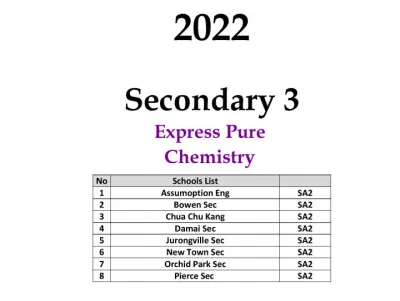
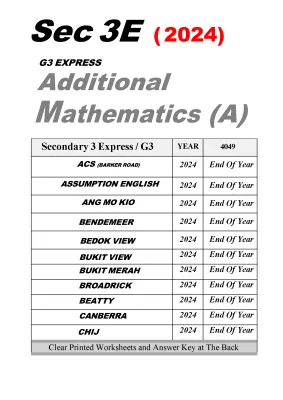
Prices are valid at publication and may change. Please refer to the product page for the latest price.
Understanding the structural differences between the main types of compilations will help you tailor your purchase to the student’s current revision phase:
- Topical Assessment Books: These compilations organize questions by chapter or concept. They are highly effective for parallel learning throughout the academic year, allowing students to reinforce what was taught in school immediately after each unit.
- Full-Year Exam Papers: These bundles simulate actual exam conditions by compiling complete, multi-paper assessments. They are designed for the final months leading up to the end-of-year examinations, helping students build time-management skills and stamina.
- School-Specific Paper Bundles: These are compilations of actual past-year papers from various top-performing secondary schools in Singapore. They offer invaluable exposure to a wide variety of question styles, challenging students with diverse testing methodologies.
The presence of a comprehensive, detailed answer key is often what separates an average bundle from an outstanding one. Avoid compilations that only provide final numerical answers or brief one-sentence summaries. Effective revision relies on self-directed learning, which is only possible when a bundle includes step-by-step worked solutions, detailed marking schemes, and explanations of why certain methods are preferred. This level of detail allows students to diagnose their own errors, understand the logic behind complex steps, and learn how marks are allocated.
Finally, a high-quality bundle must feature a balanced difficulty progression. It should start with foundational questions that reinforce basic concepts and build confidence, before gradually transitioning to non-routine, higher-order thinking questions. This progression ensures that students are not discouraged early on, while still preparing them for the challenging application questions that distinguish top-tier grades in major examinations.
What to Look for in Secondary 3 Secondary Mathematics Bundles
The transition to Secondary 3 Mathematics introduces a dramatic shift in both volume and complexity. Students are no longer just solving straightforward arithmetic or basic algebraic equations; they are expected to synthesize multiple mathematical concepts to solve complex, multi-step problems. For many, this is also the year they must balance two distinct mathematical subjects: Elementary Mathematics (E-Math) and Additional Mathematics (A-Math). Consequently, any effective math bundle must address this increased cognitive load by providing structured, logical pathways through the curriculum.

To facilitate deep learning, look for math bundles that emphasize error analysis and alternative solving methods. Mathematics is rarely a single-path discipline; a single problem can often be solved using different algebraic, geometric, or graphical approaches. High-quality answer keys should showcase these alternative methods, helping students develop flexible problem-solving strategies. Additionally, the inclusion of “common mistake” warnings within the worked solutions is incredibly valuable, as it alerts students to frequent pitfalls—such as sign errors, premature rounding, or incorrect formula applications—before they make them in the exam hall.
Elementary Mathematics (E-Math) Focus
For E-Math revision, prioritize bundles that place a heavy emphasis on real-world application questions and data analysis. The current syllabus focuses on testing a student’s quantitative reasoning in practical scenarios, such as personal finance, utility bills, statistical representations, and geometric properties of real-world structures. These questions are often lengthy and require students to extract relevant mathematical data from dense text or complex diagrams.
Furthermore, ensure the compilation includes detailed breakdowns of how method marks are awarded. In E-Math, a minor calculation error at the beginning of a long question does not have to result in zero marks. Bundles that clearly show where intermediate method marks are earned teach students the importance of writing down clear, logical steps, ensuring they secure maximum partial credit even if their final numerical answer is incorrect.
Additional Mathematics (A-Math) Focus
Additional Mathematics requires a completely different analytical mindset, focusing heavily on abstract reasoning, algebraic manipulation, calculus basics, and complex trigonometry. The formulas introduced in Sec 3 A-Math are highly technical, and the proofs demand absolute logical rigor. When choosing an A-Math bundle, look for materials that offer extensive, repetitive practice on core algebraic structures, quadratic functions, and trigonometric identities to build muscle memory.
The worked solutions in an A-Math bundle must be exceptionally meticulous. Every single step of algebraic manipulation—from expanding complex brackets to applying trigonometric proofs—must be clearly laid out. A-Math grading schemes are highly unforgiving of logical gaps; therefore, practicing with bundles that demonstrate the exact flow of a formal mathematical proof is essential for students aiming to master this demanding subject.
Selecting the Right Science Compilations for Sec 3
Secondary 3 is the year where Science branches into specialized tracks, with students taking either Pure Sciences (Physics, Chemistry, Biology) or Combined Sciences (e.g., Physics/Chemistry or Chemistry/Biology). Because the depth of content and the exam formats differ significantly between these tracks, it is crucial to purchase the exact bundle that matches the student’s specific subject combination. Buying a Pure Chemistry bundle for a Combined Chemistry student will lead to unnecessary cognitive fatigue over topics they do not need to know, while the reverse will leave a Pure Science student underprepared.
Regardless of the track, look for science bundles that prioritize the mastery of precise scientific keywords and structured open-ended responses. Singapore science examinations do not award marks simply for having a general understanding of a concept; students must use specific terminology to secure marks. For example, using terms like “thermal equilibrium,” “limiting reactant,” or “turgidity” in the correct context is often the deciding factor in whether an answer receives full credit. The model answers in your chosen bundle should highlight these key terms clearly, demonstrating how to integrate them into concise, logical explanations.
Pure Science vs. Combined Science
For Pure Science students, look for bundles that offer deep-dive topical questions and complex data interpretation exercises. Pure Science papers often present unfamiliar experimental data, graphs, or biological diagrams, requiring students to apply their theoretical knowledge to novel scenarios. The practice papers should challenge their ability to analyze variables, draw valid conclusions, and explain anomalies.
For Combined Science students, the focus of the compilation should be on core concepts and cross-disciplinary application. The questions in these bundles should help students build a solid foundation in the fundamental principles of each science branch without bogging them down in the highly specific mathematical derivations or niche biochemical pathways that are exclusive to the Pure Science syllabus. Look for books that emphasize clear conceptual links between topics.
Practical and Structured Question Prep
An often-overlooked aspect of Secondary 3 Science is the practical component. While students cannot easily perform laboratory experiments at home, they must still sit for written practical assessments or plan experiments on paper. Excellent science bundles include dedicated sections for practical preparation, covering experimental design, variable identification, error analysis, and safety precautions. This written practice helps demystify the practical exam and builds confidence in handling laboratory data.
Additionally, ensure the structured questions in the compilation are accompanied by clear, point-by-point marking rubrics. A student needs to know exactly what a three-mark question requires compared to a one-mark question. Compilations that break down the model answers into bulleted points matching the mark allocation teach students how to structure their writing efficiently, preventing them from writing long paragraphs that fail to address the core marking criteria.
Finding the Best English Exam Papers for Sec 3
Unlike STEM subjects, where revision often follows a linear path of formula application and concept recall, English language proficiency is highly skill-based and multi-dimensional. A single, generic “exam paper” bundle may not provide the targeted practice a student needs to improve. Because English is tested across four distinct areas—Paper 1 (Writing), Paper 2 (Comprehension), Paper 3 (Listening), and Paper 4 (Oral)—the most effective revision strategy involves seeking out specialized bundles or comprehensive sets that address these components individually.
For Paper 1 (Writing and Composition), avoid bundles that merely list past essay prompts. Instead, look for compilations that feature high-quality model essays representing various writing styles, including narrative, descriptive, argumentative, and situational writing. The best resources do the following:
- Annotate the Model Essays: They highlight the structural choices, paragraph transitions, and stylistic devices used by the writer.
- Provide Vocabulary Banks: They extract sophisticated words and idiomatic expressions from the model essays, explaining their meaning and showing how students can incorporate them into their own writing.
- Offer Plot and Argument Outlines: They break down the brainstorming process, showing students how to plan a coherent narrative arc or construct a persuasive, evidence-based argument.
For Paper 2 (Language Use and Comprehension), the value of a bundle lies almost entirely in its answer key. Comprehension questions often test subtle nuances of language, tone, and inference. A basic answer key that only provides the correct response does little to help a struggling student. Look for bundles where the answer key explains the deduction process step-by-step. The solutions should point directly to the clues in the passage, explain why certain vocabulary choices imply specific meanings, and provide concrete rules for summary writing—such as how to identify key points and paraphrase them effectively without losing the original meaning.
What to Verify Before Buying Exam Prep Bundles
Before finalizing your purchase of Secondary 3 exam prep bundles, it is essential to run through a quick verification checklist. This step protects you from spending money on materials that are incomplete, outdated, or poorly matched to the student’s learning preferences. Whether shopping at local bookstores, specialized academic distributors, or online marketplaces, keeping these verification points in mind will ensure you get the best value.
Edition and Year Always double-check the publication or compilation date. The Singapore curriculum is dynamic, and even minor syllabus adjustments can affect exam formats and topic weightings. Ensure the product description explicitly states that the bundle is updated for the latest syllabus changes. If the cover or description is vague, cross-reference the table of contents with the official MOE syllabus guidelines online.
Completeness Verify that the answer booklet is included and complete. Some bundles sold on online marketplaces or secondhand platforms may have the answer key missing, sold separately, or incomplete. Ensure that the solutions cover every single paper in the bundle and that the question numbers in the answer key align perfectly with those in the test booklet.
Format and Medium Consider the format that best suits the student’s study habits. Physical exam paper bundles are highly recommended because they allow students to write directly on the pages, simulating the tactile experience of a real exam. However, if the student prefers digital note-taking on a tablet, verify if the publisher offers authorized digital downloads or interactive online portal access codes. Avoid unauthorized PDF scans, which are often poorly formatted, illegible, or incomplete.
School-Specific Caveats If you are purchasing compilations of past-year papers from specific top schools, be aware of their unique limitations. These papers are excellent for high-level exposure, but because they are compiled by third-party publishers, they do not come with official, school-sanctioned marking schemes. Verify that the publisher has hired qualified educators to write highly detailed, accurate worked solutions. Additionally, check for legibility, as some compiled school papers feature low-quality printing or missing diagrams due to formatting errors during compilation.
Frequently Asked Questions (FAQ)
Are school-specific exam paper bundles better than standard assessment books?
School-specific exam paper bundles and standard publisher assessment books serve different, complementary purposes. School-specific papers are excellent for exposing students to a wide variety of challenging, non-routine questions and diverse testing styles from different academic departments across Singapore. They are ideal for high-achieving students who want to test their limits. Standard assessment books, on the other hand, are highly structured, focus on systematic topical coverage, and generally offer much more reliable, detailed, and pedagogically sound worked solutions, making them far superior for foundational learning and systematic revision.
Should I buy topical or full-year exam papers for Sec 3?
The choice between topical and full-year exam paper bundles depends entirely on the student’s current stage of revision. Topical bundles should be purchased at the start of the academic year. They allow students to practice and master individual concepts immediately after they are taught in class, preventing learning gaps from snowballing. Full-year exam paper bundles are best introduced in the final months leading up to the end-of-year examinations. These comprehensive papers help students build crucial exam stamina, practice effective time management, and learn how to transition smoothly between different topics under timed conditions.
Community discussion
Share your experience or ask a question. Comments are reviewed before publication.