
Quick Answer: Should You Choose a Besta Dictionary?
Deciding whether to invest in a Besta electronic dictionary or opt for modern alternatives depends entirely on your study environment, learning habits, and budget. A dedicated electronic dictionary is highly suitable if you require reliable offline access, distraction-free study sessions, and specific exam-aligned databases. These devices provide a self-contained ecosystem that keeps you focused on vocabulary acquisition without the interruptions of the modern web.
Conversely, smartphone dictionary apps are the practical choice if you prioritize everyday convenience, instant camera-based translations, and frequent, cloud-based content updates. Traditional paper dictionaries remain unmatched for learners who prefer deep, tactile reading, etymological exploration, and zero screen time. By identifying where and how you study, you can easily determine which format aligns with your educational goals.
Define Your Language Learning Goals and Environment
Before comparing hardware specifications or software interfaces, you must clarify your primary language learning objectives. A student preparing for standardized national examinations faces vastly different requirements than a business professional aiming for conversational fluency or a traveler navigating daily interactions. For academic preparation, the ability to access authorized, comprehensive databases without an internet connection is often a strict requirement.
Products mentioned in this guide
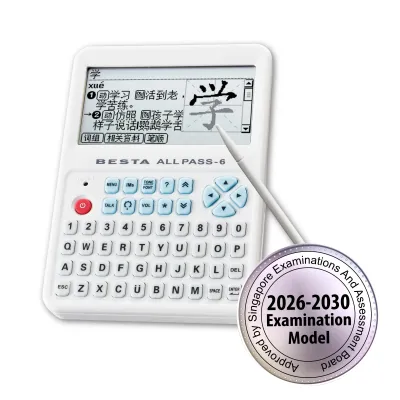
Prices are valid at publication and may change. Please refer to the product page for the latest price.

Your physical study environment plays an equally critical role in this decision. Many classrooms, lecture halls, and examination venues strictly prohibit smartphones and internet-enabled devices to prevent distractions and maintain academic integrity. In these restricted settings, a dedicated offline tool is often the only permissible electronic aid. If you primarily study during a daily commute on public transit, a compact, highly portable solution may take priority over a larger device.
Furthermore, you must identify your required language pairs and check for specific regional variations. Some learners require specialized technical jargon, localized business terminology, or specific regional dialects that generic translation tools might misinterpret. Ensuring your chosen tool supports these linguistic nuances is a vital first step before making any financial commitment.
What to Expect from a Besta Dictionary
A Besta electronic dictionary is designed as a single-purpose learning device, prioritizing utility over multi-functional entertainment. One of its primary advantages is the physical keyboard, which allows for rapid, tactile typing of phonetic inputs, strokes, or characters. This physical interface is often paired with a stylus for handwriting recognition, making it easier to look up unfamiliar characters by drawing them directly on the screen.
The software environment is entirely distraction-free, meaning you will not be interrupted by social media notifications, text messages, or web-browsing temptations during your study sessions. Many models feature built-in, licensed academic dictionaries and specialized databases tailored for language learners. Audio features are another cornerstone of these devices, typically offering native-speaker voice recordings and phonetic breakdowns to help you master pronunciation and tone accuracy.
However, these dedicated devices come with distinct trade-offs. They require a higher upfront financial investment, often ranging from a hundred to several hundred S$, compared to free or low-cost mobile apps. They also present a bulkier form factor than a slim smartphone and do not receive the frequent, automatic software and vocabulary updates common to cloud-based platforms. Understanding these characteristics helps establish a realistic baseline for comparison.
Besta vs. Apps, Paper, and Other Electronic Dictionaries
Evaluating your options across practical decision-making dimensions reveals how each format performs under real-world study conditions.
Besta vs. Smartphone Dictionary Apps
When comparing a dedicated electronic dictionary to smartphone apps, the primary trade-offs center on reliability, battery life, and cognitive focus. Smartphone apps are highly portable and constantly updated, but they rely heavily on battery power and internet connectivity for advanced features. A dedicated electronic dictionary operates entirely offline, ensuring you can study in remote areas, during flights, or in signal dead zones.
Its battery life is typically optimized for long study sessions, lasting days or even weeks on a single charge or set of batteries. Most importantly, a dedicated device eliminates the digital distractions of a smartphone. Without the constant temptation to check notifications, you can maintain deeper cognitive focus and achieve longer, more productive study intervals.
Besta vs. Other Electronic Dictionaries
If you are comparing Besta to other electronic dictionary brands, you should focus on build quality, user interface design, and the specific language pairs offered. Different brands cater to different regional markets and language combinations. For instance, some brands specialize heavily in Japanese-English databases, while others focus on Chinese-English or European languages.
You must compare the physical construction, screen readability (such as color touchscreen versus monochrome displays), and the inclusion of specialized academic or technical dictionaries that align with your specific curriculum. Look for models that offer robust casing and responsive keys if you plan to carry the device daily in a school bag.
Besta vs. Paper Dictionaries
The choice between an electronic dictionary and a traditional paper volume involves balancing search speed against linguistic depth. Paper dictionaries are unmatched for etymological exploration, allowing you to see surrounding words and gain a broader contextual understanding of how a language is structured. They require zero power and cause no eye strain from screens.
However, searching for words in a paper dictionary is a slow, manual process, especially for character-based languages that require counting strokes or identifying radicals. An electronic dictionary offers near-instantaneous search results, handwriting recognition, and cross-referencing capabilities, making it highly efficient for rapid reading and high-volume vocabulary acquisition.
What to Verify Before You Buy
Before finalizing your purchase, there are several critical specifications and conditions you must verify to ensure the device meets your needs.
- Language Databases: Check the exact language pairs and the specific editions of the dictionaries pre-loaded onto the device. Look for specialized databases, such as idiom dictionaries, technical glossaries, or exam-specific syllabi, to ensure you are not missing essential vocabulary.
- Audio and Connectivity: Verify the supported audio formats and output options. Check whether the device features a standard 3.5mm headphone jack, built-in speakers, or wireless connectivity. If you plan to study in public libraries or quiet classrooms, a reliable headphone connection is indispensable.
- Warranty and Local Support: Confirm the warranty terms and return policies. Since electronic dictionaries are specialized hardware, check if there is an authorized local service center or distributor in Singapore to handle repairs, screen replacements, or battery servicing.
- Power Source: Review the device's battery specifications. Determine whether it uses standard replaceable batteries (such as AAA) or a built-in rechargeable lithium-ion battery. Consider your daily usage patterns and whether you prefer the convenience of USB charging or the reliability of carrying spare physical batteries.
Frequently Asked Questions (FAQ)
Do I still need a dedicated dictionary if I have a translation app?
Yes, a dedicated dictionary serves a fundamentally different educational purpose than a quick translation app. Translation apps are designed for rapid, situational communication—such as reading a menu or asking for directions—and often rely on machine translation that lacks grammatical context. A dedicated dictionary encourages active learning and deeper cognitive retention.
By manually inputting words and reading comprehensive definitions, example sentences, and grammatical notes, you engage in active recall. Furthermore, dedicated devices are essential in restricted environments like examination halls, schools, or areas with poor cellular connectivity where smartphones are prohibited or unusable.
How do I ensure a Besta dictionary supports my specific exam syllabus?
To ensure compatibility with a specific academic syllabus, you must perform a thorough verification process before purchasing. Start by checking the official product packaging, user manual, or the manufacturer’s official website for a list of pre-loaded dictionaries and their publication years.
Cross-reference these titles with the approved reference materials list provided by your school or the relevant educational authority in Singapore. If you are preparing for national examinations, verify if the specific model number is explicitly permitted in the exam hall. Additionally, check if the manufacturer offers downloadable content updates or expansion cards to keep the vocabulary aligned with the latest syllabus changes.

Community discussion
Share your experience or ask a question. Comments are reviewed before publication.