
Quick Answer: Is the Casio S110 Right for Your First Keyboard?
The Casio S110 is an exceptional match if you are an absolute beginner, a casual hobbyist, or a player with limited space who values a highly portable instrument with a clean, distraction-free interface. Its lightweight footprint makes it highly practical for modern living environments, such as compact apartments in Singapore, where space is at a premium and easy storage is essential.
However, if your primary musical objective is to build formal classical piano technique, perform classical repertoire, or leverage advanced auto-accompaniment features, other keyboard categories will serve you better. A standard 61-key non-weighted keyboard cannot replicate the physical resistance of an acoustic piano, which is critical for developing hand strength and finger independence.
This comparison guide evaluates the physical and technical features of the Casio S110 against alternative beginner instrument categories. By examining key action, sound quality, portability, and connectivity, you can make an informed choice that aligns with your budget, space constraints, and musical aspirations.
Products mentioned in this guide
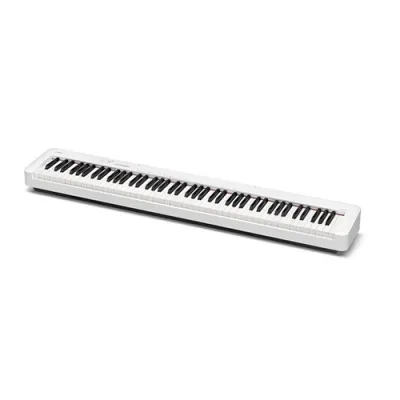
![CASIO CT-S200 (White) Keyboard [FREE: X-stand] Compact portable lightweight Casiotone keyboard 61 keys with carry handle optional power by batteries ( CTS200 / CTS 200 )](https://img.lazcdn.com/g/p/76d9e4511d23fdeebe542705ebc514db.jpg_400x400q80.jpg_.webp)
Prices are valid at publication and may change. Please refer to the product page for the latest price.
Key Features That Matter Most to Beginners
Key Action and Touch Response
The physical feel of the keys is the most critical factor when selecting your first keyboard. Entry-level keyboards generally fall into three categories: basic synth-action keys, touch-sensitive keys, and fully weighted hammer-action keys. Synth-action keys offer little to no resistance and are ideal for electronic music or casual play, but they do not prepare a student for the physical demands of an acoustic piano.

Touch-sensitive keys, also known as velocity-sensitive keys, alter the volume of the sound based on how hard or soft you strike the key. This capability is essential for expressive playing, allowing you to convey emotion through dynamics. When evaluating the Casio S110, you must verify the product’s official specifications to confirm whether touch response is built into the model. If a keyboard lacks touch sensitivity, every note will sound at the exact same volume regardless of your finger pressure, which can hinder the development of proper dynamics and expressive habits.
Fully weighted hammer-action keys replicate the actual hammer mechanism of an acoustic piano. These are typically found on larger, heavier 88-key digital pianos. If you plan to take formal classical lessons, starting on a weighted keyboard is highly recommended to avoid having to relearn finger techniques later.
Sound Quality and Polyphony
Sound quality determines how engaging your practice sessions will be. A key metric to look for is polyphony, which represents the maximum number of individual notes or voices a keyboard can produce at the exact same time. For beginners, a low polyphony count can cause notes to drop out abruptly, particularly when you use a sustain pedal or play complex chords with backing accompaniments.
Standard entry-level arranger keyboards often provide between 32 and 48 notes of polyphony, which is sufficient for basic melodies but can feel restrictive as you progress. You should check the Casio S110 packaging or official documentation to verify its specific polyphony limits and speaker output wattage. A higher polyphony count (such as 64 notes or more) ensures that sustained notes decay naturally without cutting off.
Speaker wattage also plays a significant role in sound projection. Small, low-wattage speakers (such as 1.5 to 2.5 watts per side) are adequate for personal practice in a quiet room, but they may lack depth and bass response. If you want a richer, more room-filling sound, you may need to look for models with larger speakers or plan to use high-quality headphones.
Portability and Power Options
For many players, especially those living in compact urban homes, the physical dimensions of the keyboard are just as important as its musical features. A heavy, bulky instrument is difficult to move and may require a dedicated stand that permanently occupies valuable floor space. Portable keyboards that measure under 10 centimeters in depth and weigh less than 5 kilograms can easily be stored in a closet, under a bed, or on an existing desk when not in use.
Power flexibility is another key consideration. Keyboards that can run on standard AA batteries in addition to an AC power adapter offer excellent portability. This dual-power capability allows you to practice in rooms without accessible wall outlets or take the instrument outdoors for casual gatherings.
However, ultra-slim designs often involve a trade-off. To achieve a compact chassis, manufacturers must use smaller speaker cones and consolidate physical controls. You must decide whether the convenience of a space-saving design outweighs the potential loss of physical buttons and acoustic resonance.
Built-in Learning Tools and Connectivity
Modern beginner keyboards offer a variety of integrated tools designed to accelerate your learning curve. A built-in metronome is a fundamental tool for developing a steady sense of rhythm. Additionally, many entry-level models feature onboard lesson functions that guide you through built-in songs by indicating which keys to press.
Connectivity options are crucial if you plan to use digital learning aids. A standard 3.5mm or 6.35mm headphone jack is essential for silent practice, allowing you to play late at night without disturbing family members or neighbors.
You should also verify the presence of a USB MIDI port (often labeled USB-to-Host) or Bluetooth connectivity. These interfaces allow you to connect the keyboard to a computer, tablet, or smartphone. This connection enables you to use interactive learning apps, such as Casio Music Space, or basic digital audio workstations (DAWs) to record your playing. Without USB MIDI, your ability to integrate the keyboard with modern educational software will be severely limited.
Evaluating the Casio S110: Strengths and Trade-offs
The Slimline Advantage
The defining characteristic of the Casiotone S-series is its ultra-slim, lightweight chassis. The Casio S110 is designed with extreme portability in mind, featuring a highly compact profile that is exceptionally easy to handle. It often includes an integrated carrying handle built directly into the molded body, making it simple to transport with one hand.
For players in Singapore, where residential space is highly optimized, this design allows the keyboard to fit comfortably on narrow study desks or temporary folding tables. When you finish practicing, you can easily slide the instrument into a wardrobe or place it upright in a corner, keeping your living area clutter-free.
Interface Simplicity
Many beginner keyboards are cluttered with hundreds of buttons, dials, and small LCD screens displaying complex menus. While these features offer variety, they can easily overwhelm a new player who simply wants to turn on the instrument and practice. The Casio S110 addresses this by utilizing a highly minimalist control panel.
By focusing on a streamlined layout, the S110 encourages a straightforward ‘plug-and-play’ experience. You can access primary sounds and basic functions with minimal effort, reducing distractions and allowing you to focus entirely on your finger placement and timing. This simplicity is particularly beneficial for younger students who might otherwise spend their practice time cycling through sound effects rather than learning notes.
Trade-offs to Verify
While the slimline design offers clear lifestyle benefits, it requires physical compromises that you must carefully evaluate before purchasing. Because the chassis is incredibly thin, the built-in speakers are necessarily smaller than those found on bulkier, traditional portable keyboards. You should verify the speaker placement and listen to the audio output to determine if the bass response feels thin or if the sound distorts at higher volumes.
For critical listening or a more immersive experience, you may find it necessary to pair the keyboard with a good set of studio headphones or external active speakers. This adds an extra item to your setup, which is an important factor to consider if you prefer a completely self-contained solution.
Feature Limitations
To maintain its clean aesthetic and compact form factor, the Casio S110 omits several features that are standard on larger arranger keyboards. For example, it typically lacks a physical pitch-bend wheel, which is used to slide between notes when playing synth or guitar sounds. It also features a more limited selection of built-in rhythms and auto-accompaniment styles compared to dedicated arranger models.
If your goal is to produce complex pop arrangements, experiment with electronic music production, or perform live with a full virtual backing band, these limitations may feel restrictive within a few months of starting. However, if your primary interest is learning basic chords, playing simple melodies, or using the keyboard as a straightforward practice tool, this focused feature set is a major asset that eliminates unnecessary complexity.
How the Casio S110 Compares to Other Entry-Level Categories
Casio S110 vs Standard 61-Key Portable Arrangers
Traditional 61-key portable arrangers are designed as comprehensive musical entertainment centers. These instruments typically feature a much deeper chassis, larger built-in speakers, and an extensive library of hundreds of instrument voices, drum rhythms, and automated accompaniment styles. They often include dedicated physical buttons for every major function, allowing you to change settings rapidly during a performance.
When compared to the Casio S110, standard portable arrangers generally offer more features and sound variety for a similar price point. However, this extra functionality comes at the cost of physical size and weight. A traditional arranger keyboard occupies a significantly larger footprint on your desk and is much more cumbersome to pack away or transport. If you have a dedicated music space and enjoy experimenting with diverse musical genres and full-band backings, a standard arranger is an excellent option. If space optimization and simple operation are your priorities, the S110 remains the more practical choice.
Casio S110 vs Entry-Level Digital Pianos
It is crucial to distinguish between a casual portable keyboard like the Casio S110 and an entry-level digital piano. Digital pianos are specifically designed to replicate the acoustic piano experience as closely as possible. They feature a full 88-key keyboard layout and utilize fully weighted hammer-action keys that mimic the physical resistance of a traditional piano’s key mechanism.
The Casio S110, by contrast, features 61 non-weighted or semi-weighted keys. While the keys may offer touch sensitivity to reflect your playing dynamics, they do not provide the heavy physical feedback required to build proper finger strength and classical technique. If you or your child are taking formal piano lessons aimed at classical exams, an 88-key weighted digital piano is an absolute necessity. However, if you are playing casually, learning pop songs by ear, or need an affordable, lightweight instrument to test your interest before committing to a larger purchase, the S110 is a much more accessible and cost-effective starting point.
Casio S110 vs Smart or App-Dependent Keyboards
In recent years, ‘smart’ keyboards have become increasingly popular. These instruments often feature built-in light-up keys to guide your fingers and rely heavily on a connected tablet or smartphone to function. Many of these models have almost no physical buttons, offloading sound selection, lesson navigation, and settings adjustment entirely to a proprietary mobile app.
The Casio S110 offers a completely different, standalone user experience. It does not require an external device or an active internet connection to access its core features, providing an immediate, screen-free playing environment. This design is highly effective for reducing screen time and minimizing digital distractions during practice. While app-dependent keyboards offer highly interactive, gamified learning experiences and expandable sound libraries, they can become obsolete if the manufacturer stops updating the app. The S110 represents a more traditional, reliable instrument that will continue to function independently for years to come.
Final Decision Framework: Which Keyboard Should You Buy?
To finalize your decision, you should evaluate your personal space, musical goals, and preferred learning style against the following clear scenarios:
Choose the Casio S110 if:
- Space Constraints: You live in a compact home, such as a typical Singapore HDB flat, where space is highly limited and easy storage is a top priority.
- Extreme Portability: You want a lightweight, highly portable instrument that you can easily carry to different rooms or store away in a closet.
- Minimalist Interface: You prefer a clean, minimalist interface that allows you to start playing instantly without navigating complex menus.
- Casual Playing: You are learning casually for personal enjoyment, focusing on basic chords, pop melodies, or simple songwriting.
Choose a standard portable arranger keyboard if:
- Sound Variety: You want access to a massive library of diverse instrument sounds, drum beats, and automatic backing styles to play along with.
- Physical Controls: You prefer having dedicated physical buttons on the control panel for quick, real-time adjustments.
- Dedicated Space: You have a dedicated desk or stand where the keyboard can remain permanently set up.
Choose an entry-level digital piano if:
- Classical Training: Your primary goal is to study classical piano and progress through formal graded examinations.
- Weighted Keys: You require the authentic feel of 88 fully weighted, hammer-action keys to develop correct finger strength and technique.
- Dedicated Setup: You have a dedicated, permanent space in your home to accommodate a larger, heavier instrument.
Verify before purchasing:
- Retailer Stock: Before making your final purchase, check with local authorized Singapore music retailers (such as Swee Lee, Cristofori, or City Music) to confirm current stock availability and local warranty coverage.
- Box Contents: Carefully inspect the product contents listed on the box or retailer website to see what accessories are included. Many entry-level keyboards include only a power adapter and a basic sheet music rest. You may need to purchase a sturdy keyboard stand, a comfortable bench, high-quality headphones, and a compatible sustain pedal separately.
- Warranty Terms: Confirm the warranty terms offered by the local distributor to ensure you are covered against any manufacturing defects.
Frequently Asked Questions (FAQ)
Can I connect the Casio S110 to a computer for music production?
Yes, you can connect the Casio S110 to a computer or mobile device, provided you use the correct cable and interface. You must check the back panel of the keyboard to locate the USB port, which is typically a USB Micro-B or USB Type-B ‘To Host’ port. By connecting this port to your computer using a compatible USB data cable, the keyboard can transmit MIDI data. This allows you to use the S110 as a MIDI controller to play virtual instruments inside a Digital Audio Workstation (DAW) or to interact with educational software. If the keyboard only features a standard analog auxiliary output (such as a headphone jack), it can only transmit audio signals, not digital MIDI data, so verifying the specific USB port is essential before purchase.
Do I need to buy a separate sustain pedal for beginner keyboards?
Yes, in most cases, you will need to purchase a sustain pedal separately. Entry-level keyboards like the Casio S110 typically include only the essential power adapter and a basic plastic music rest in the box to keep the initial purchase price affordable. To use a sustain pedal, you must first verify that the back panel of the keyboard features a standard 1/4-inch jack labeled ‘Sustain’ or ‘Pedal.’ If this port is present, the keyboard is compatible with most universal sustain pedals available on the market. Using a sustain pedal is highly recommended as soon as you progress past basic single-note exercises, as it allows notes to ring out smoothly and is essential for playing intermediate piano pieces.
Community discussion
Share your experience or ask a question. Comments are reviewed before publication.