
To accurately check the low-pitch reeds of a bass harmonica, you need a chromatic tuner with high-precision low-frequency detection, a fast refresh rate, and robust overtone filtering. Standard vocal or guitar tuners often fail to register the deep fundamental pitches of a bass harmonica, which can drop well below 100 Hz. By selecting a tuner that specifically supports sub-bass frequencies and pairing it with an appropriate contact pickup or isolation microphone, you can reliably monitor reed pitch without interference from ambient noise or higher harmonics.
Why Standard Tuners Fail on Bass Harmonica Reeds
Standard tuners are designed primarily for mid-range instruments like guitars, ukuleles, or the human voice. These devices utilize simplified pitch-detection algorithms optimized for frequencies above 80 Hz. When presented with the extremely low frequencies of a bass harmonica, these algorithms often fail to identify the fundamental pitch because the signal cycle is too long for the tuner’s sampling window to process quickly.
At the lower end of a bass harmonica’s range, a single sound wave cycle can take upwards of 30 milliseconds to complete. To calculate an accurate pitch, a digital tuner must capture and analyze multiple consecutive cycles of this wave. Because standard tuners use short sampling windows to maintain a fast response time for higher notes, they simply do not gather enough data to identify these long, low-frequency waveforms.
Products mentioned in this guide
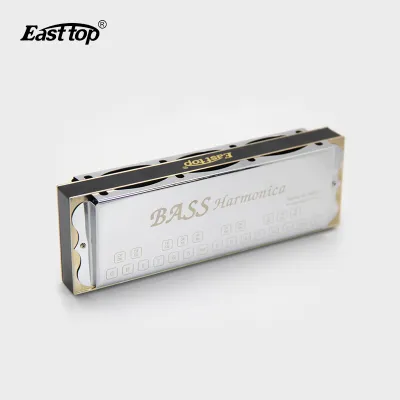
Prices are valid at publication and may change. Please refer to the product page for the latest price.
Another major obstacle is overtone confusion, which occurs due to the complex physical behavior of free reeds. A bass harmonica reed produces a highly complex waveform rich in upper harmonics rather than a pure, simple tone. Because the fundamental frequency of a low reed is relatively quiet compared to its strong second and third harmonics, standard tuners frequently lock onto these higher frequencies instead. This causes the display to jump erratically or register a pitch that is an octave or a twelfth higher than the actual note being played.
Furthermore, the physical characteristics of large bass reeds affect how sound is captured by standard microphones. These heavy brass or bronze reeds require a significant volume of air to initiate vibration, resulting in a slow acoustic attack and a highly pressurized release. Standard microphones built into basic tuners often lack the sensitivity or dynamic range to capture this low-frequency acoustic energy accurately, leading to dropped signals or inconsistent readings during a sustained test.
Key Tuner Specifications for Low-Pitch Reeds
When evaluating a tuner for bass harmonica maintenance, you must verify the manufacturer’s technical specifications rather than relying on generic product labels. The most critical specification is the lower limit of the frequency detection range. Look for a tuner with a specified range that extends down to at least E0 (approximately 20.6 Hz) or C1 (approximately 32.7 Hz) to ensure it can comfortably register the lowest notes on a standard double-bass or utility bass harmonica.

Cent accuracy and display resolution are equally vital for precise reed adjustments. A cent is a logarithmic unit of measure for relative pitch intervals, representing one-hundredth of a semitone. For professional reed work, a tuner should offer an accuracy of at least plus-or-minus 1 cent, though high-precision strobe models often achieve accuracy levels of plus-or-minus 0.1 cents. This level of resolution allows you to observe minute pitch drifts before they become audible as sour notes during ensemble play.
Because low-frequency notes have very small physical frequency gaps between adjacent pitches, high resolution is indispensable. For example, the difference between C1 (32.7 Hz) and C#1 (34.6 Hz) is less than 2 Hz. A tuner with poor resolution cannot distinguish between a reed that is slightly flat and one that is perfectly in tune at these lower limits. High-resolution displays ensure that even the smallest deviations are visible to the technician.
Finally, pay close attention to the display refresh rate and needle damping settings. Because low-frequency reeds take longer to settle into a stable pitch, a tuner with an overly fast, undamped display will flicker or jump wildly. Look for devices that offer adjustable response times or dedicated “bass mode” settings. These features damp the virtual needle’s movement, averaging the input signal over a slightly longer window to present a stable, readable measurement of the fundamental pitch.
Selecting the Best Pickup Method for Isolation
Isolating the sound of a single reed is essential for an accurate reading, especially when working in environments with ambient noise. A clip-on piezo pickup is one of the most effective tools for this task. By clipping the piezo sensor directly onto the harmonica comb or cover plates, the tuner detects physical vibrations rather than airborne sound waves. This direct vibration transfer bypasses room acoustics and rejects external noises, allowing you to test reeds even in a busy workshop.
While contact pickups excel at noise rejection, external microphones remain valuable for evaluating the natural acoustic response of the instrument. A high-quality condenser or dynamic microphone placed close to the chamber captures the full acoustic profile of the reed, including how it interacts with the air column inside the comb. When using an external microphone, you must perform the test in a quiet, treated space to prevent reflections and background hum from distorting the tuner’s pitch analysis.
Using an external microphone also requires careful placement to manage the proximity effect. When a directional microphone is placed very close to a sound source, it naturally boosts the lower frequencies. While this can sometimes help a tuner detect a weak fundamental pitch, excessive bass boost can also overload the tuner’s input stage, causing distortion that interferes with pitch tracking. Finding the right balance of distance and input gain is key to obtaining a clean signal.
To connect a contact pickup or external microphone to your tuner, you must ensure proper impedance matching. Most dedicated instrument tuners feature a standard 6.35 mm (quarter-inch) input jack designed for high-impedance signals. If you are using a professional studio microphone, you may need an external preamplifier or an audio interface to convert the low-impedance XLR signal to a level the tuner can process. Always check the input specifications of your tuning device to avoid signal loss or excessive noise.
Tuner Types That Handle Sub-Bass Frequencies
Strobe tuners represent the gold standard for high-precision woodwind and brass maintenance. Unlike digital needle tuners that estimate pitch using software approximation, true mechanical or high-definition virtual strobe tuners display the relative phase of the input signal in real time. This visual feedback appears as a rotating pattern that stops moving when the input pitch perfectly matches the target frequency. Strobe displays are exceptionally responsive to low frequencies, allowing you to see subtle pitch variations that standard displays miss.
Virtual strobe tuners utilize high-speed graphics to emulate the behavior of physical spinning discs. Because they do not rely on a single calculated pitch value to update a needle, they provide instantaneous feedback. This allows you to observe how the pitch of a bass reed changes from the moment you initiate breath pressure to the moment the reed fully settles. This real-time phase monitoring is highly effective at bypassing the overtone confusion that plagues standard digital tuners.
High-end chromatic pedal tuners, originally engineered for multi-string bass guitars, are another excellent option for harmonica players. These pedals are built to withstand heavy use and feature robust internal processors optimized for tracking low-frequency fundamentals. Many of these pedals include dedicated bass tracking modes that adjust the internal filtering to prioritize the fundamental pitch over higher harmonics, making them highly reliable for checking low-register reeds.
When choosing between a dedicated bass tuner and a general chromatic model, look closely at the internal processing architecture. A standard chromatic tuner may technically cover the low-frequency range on paper, but its processing speed may slow down significantly at the bottom of the scale. A tuner with a dedicated bass setting or a high-performance digital signal processor (DSP) is specifically programmed to handle the longer waveforms of sub-bass notes, ensuring rapid tracking and stable readings across the entire range of your instrument.
Workflow for Checking and Reading Bass Reeds
To check the pitch of your bass harmonica reeds safely, you must establish a consistent and controlled testing workflow. Begin by isolating the individual reed you wish to measure. You can achieve this by using precise breath control to direct air into a single chamber, or by physically blocking adjacent chambers with low-tack painter’s tape or a specialized blocking tool. Ensuring that only one reed vibrates at a time prevents acoustic interference and keeps the tuner from becoming confused by multiple pitches.
When blowing or drawing to test a reed, maintain a steady, natural breath pressure. Bass harmonica reeds are highly sensitive to breath dynamics; blowing too hard will temporarily bend the pitch flat, while blowing too softly may fail to initiate a stable vibration. Observe the cent display only after the reed has fully spoken and the pitch has stabilized. Note the deviation from the target pitch, keeping in mind that a reed’s pitch under normal playing pressure may differ slightly from its pitch when tested on a specialized tuning bench.
It is also important to test the reed at different volume levels to understand its dynamic range and pitch stability. A healthy reed should maintain a relatively consistent pitch across a reasonable range of breath pressures. If the pitch drops dramatically with only a slight increase in air pressure, the reed may be suffering from structural fatigue or improper gapping. Documenting these observations helps you identify problematic reeds before they fail completely during a performance.
Know when to stop and seek professional assistance. If a reed requires significant physical adjustment, is completely unresponsive, produces a dull rattling sound, or shows visible signs of metal fatigue, do not attempt to file or scrape the reed yourself unless you have specialized training. Filing a bass reed incorrectly can permanently damage its structural integrity or alter its response profile. If you encounter these issues, consult a qualified harmonica technician who possesses the specialized tools and experience required to safely tune and repair heavy bass reeds.
Frequently Asked Questions (FAQ)
Can I use a standard guitar tuner for a bass harmonica?
A standard guitar tuner is generally not recommended for a bass harmonica. Most basic guitar tuners are optimized for the frequency range of a standard six-string guitar, which only goes down to about 82 Hz (E2). The lowest notes on a bass harmonica can drop well below this range, often reaching down to C1 (around 33 Hz) or lower. A standard tuner will struggle to detect these low frequencies, resulting in erratic readings, slow tracking, or a complete failure to register the note.
Do I need to disassemble the harmonica to tune the reeds?
Yes, checking and adjusting the reeds accurately usually requires removing the cover plates of the harmonica. This disassembly exposes the reed plates, allowing you to isolate individual reeds and observe their physical behavior. When handling the internal components, you must exercise extreme caution to avoid bending the reeds, damaging the windsavers (valves), or introducing dust and debris into the chambers. Always work on a clean, well-lit surface and use the correct screwdrivers to avoid stripping the casing screws.
What does it mean if the tuner cannot detect the lowest reeds at all?
If your tuner fails to register the lowest reeds, it is typically due to either the hardware limitations of the tuner or an issue with the reed itself. First, verify that your tuner’s technical specifications officially support frequencies down to at least 30 Hz. If the hardware is capable, the issue may stem from insufficient breath pressure, a misaligned reed, or a damaged windsaver that is leaking air. Ensure you are using a steady, controlled airstream, and consider using a contact pickup to help the tuner detect the physical vibrations of the instrument.
Community discussion
Share your experience or ask a question. Comments are reviewed before publication.