
Selecting the right exam preparation book bundles for the 2025 academic year is a critical decision that directly impacts a student’s revision efficiency and confidence. With numerous publishers releasing updated titles annually, parents and students must look beyond attractive cover designs and “2025” stickers to evaluate the actual substance, syllabus alignment, and pedagogical value of these resources. The most effective exam prep bundle is not necessarily the thickest or the most expensive option on the shelf. Instead, it is a carefully curated set of materials that matches the student’s current academic standing, targets their specific conceptual gaps, and mirrors the exact format of the national papers. Because the Ministry of Education (MOE) and the Singapore Examinations and Assessment Board (SEAB) periodically update subject syllabi, verifying the publication details and structural design of any bundle before purchase is essential to avoid wasting valuable study time on outdated content.
Key Criteria for Evaluating 2025 Exam Prep Bundles
To ensure an exam prep bundle is genuinely updated for the 2025 academic year, buyers must perform a systematic check of the publication details. Many publishers reprint older editions with minor cosmetic changes or simply add a “2025 Edition” sticker to the outer packaging without updating the internal content. To verify authenticity, open the books to the copyright page and inspect the edition number, publication year, and reprint history. A genuine 2025 edition should explicitly state the revision year and reference the current syllabus code issued by SEAB.
Syllabus alignment is the single most critical factor when evaluating prep materials. For instance, if a subject has undergone a recent syllabus change—such as updates to the Science practical requirements or changes in the Humanities essay formats—older assessment books will fail to prepare students for these specific components. Parents and students should cross-reference the table of contents in the prep books with the official syllabus documents available on the SEAB website. Look for explicit mentions of the active syllabus codes to ensure the practice questions reflect the current assessment objectives.
Products mentioned in this guide
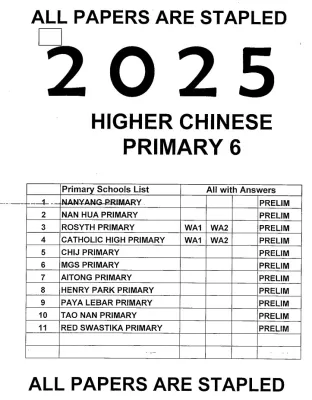
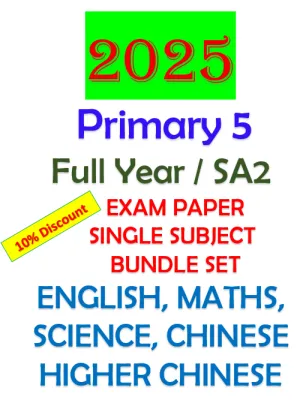
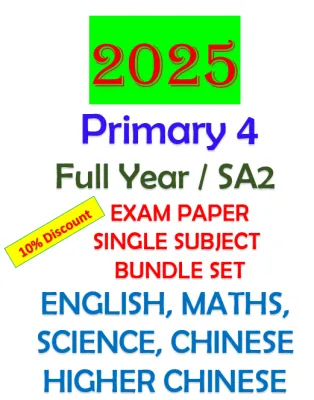
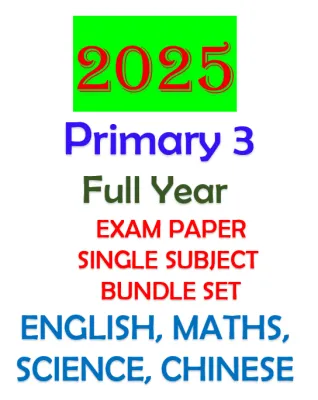
Prices are valid at publication and may change. Please refer to the product page for the latest price.
A well-structured exam prep bundle must also offer a balanced mix of learning and assessment styles. A bundle consisting solely of full-length mock papers can overwhelm a student who has not yet mastered the foundational concepts. Conversely, a bundle that only contains topical worksheets will not help a student build the stamina required for a three-hour examination. The ideal bundle should feature a clear progression: starting with concise conceptual summaries, moving into topical practice questions with varying difficulty levels, and concluding with full-year simulated papers that replicate the actual exam conditions.
Selecting PSLE Prep Bundles for Primary Students
For primary school students preparing for the PSLE, the transition to a high-stakes national exam can be academically and emotionally challenging. When selecting a PSLE prep bundle, parents should look for comprehensive coverage across the core subjects: English, Mathematics, Science, and Mother Tongue. It is important to ensure that the bundle addresses all components of each subject. For example, an English bundle should not only focus on grammar and synthesis but should also include dedicated sections for continuous writing, listening comprehension, and oral communication.

The pedagogical approach of the bundle must align with the cognitive development of primary school students. Look for materials that offer a guided progression from structured, step-by-step conceptual learning to independent problem-solving. In Mathematics, for instance, a good bundle will illustrate the model drawing method alongside algebraic methods, allowing students to visualize complex word problems before attempting them independently. Science bundles should emphasize the application of structured answering techniques for open-ended questions, which are common areas where students lose marks.
Supplementary materials included within the bundle can significantly enhance its overall value. Parents should check if the bundle features practical revision aids such as vocabulary lists for Mother Tongue, formula sheets for Mathematics, or bite-sized science concept cards. These tools are highly effective for quick revision sessions during daily commutes or in the weeks leading up to the examination. Additionally, look for bundles that provide access to online audio recordings for oral exam practice, as hearing proper pronunciation and pacing is crucial for the English and Mother Tongue oral components.
Choosing O-Level Study Bundles for Secondary Students
Secondary school students face a diverse range of subject combinations and academic streams, making the selection of O-Level study bundles highly individualized. Before purchasing any bundle, students must map the materials directly to their specific subject combinations, such as Express or Normal (Academic) pathways, Pure Sciences versus Combined Sciences, and elective Humanities options. Purchasing a generic “Science Bundle” that combines physics and chemistry may result in redundant or missing topics if the student is actually taking Pure Physics and Pure Chemistry as separate subjects.
A key differentiator of high-quality O-Level bundles is the depth and accuracy of their answer keys. Students should prioritize bundles that feature fully worked, step-by-step solutions rather than simple answer keys that only list the final numerical value or letter option. For Mathematics and Sciences, detailed solutions should explain the intermediate steps, formula applications, and common pitfalls to avoid. In Humanities subjects like History, Geography, or Social Studies, the answer keys should provide model essays, source-evaluation frameworks, and clear marking rubrics that show how to structure high-scoring responses.
Subject-specific features are also vital for O-Level preparation. For Humanities, look for bundles that include dedicated sections on Source-Based Questions (SBQ) and Structured Essay Questions (SEQ), complete with annotated source documents to help students practice critical analysis. For Sciences, the bundle should feature practical laboratory guides or planning question templates. Since the O-Level Science practical exam requires students to design experiments, having a prep book that outlines experimental setups, variable identification, and safety precautions is an invaluable asset that standard topical worksheets often omit.
Picking A-Level Revision Bundles for Junior College Students
The GCE A-Level examinations demand an exceptionally high level of critical thinking, data synthesis, and academic rigor. When selecting revision bundles for Junior College (JC) students, the first step is to verify strict alignment with the specific subject levels: H1, H2, or H3. Because the depth of content and the exam formats differ vastly between these levels, using an H1 revision guide for an H2 subject will leave a student severely underprepared. Furthermore, students must check for recent curriculum shifts, such as changes in the structure of the General Paper (GP) or updates to the H2 Mathematics syllabus.
At the A-Level stage, simple rote memorization is insufficient for achieving top grades. Therefore, revision bundles must balance concise content summaries with high-order application questions. The ideal bundle should feature comprehensive mind maps or summary notes for quick content recall, followed immediately by complex, multi-part questions that require students to integrate concepts from different topics. For instance, an H2 Chemistry bundle should challenge students to apply organic chemistry mechanisms to unfamiliar biological molecules, mimicking the novel scenarios presented in the actual SEAB papers.
Another critical component of an effective A-Level bundle is the inclusion of preliminary examination papers from various top junior colleges. These “prelim papers” are widely regarded as excellent preparation tools because they are often designed to be slightly more challenging than the actual A-Level papers, pushing students to refine their time management and problem-solving strategies. A bundle that compiles these papers, complete with detailed examiner reports or marking schemes that highlight common student errors, provides JC students with a realistic benchmark of their performance against the national cohort.
Purchasing Channels and Pre-Checkout Verification
Acquiring the correct 2025 exam prep bundles requires careful selection of purchasing channels to avoid counterfeit or outdated materials. Authorized educational bookstores and official publisher storefronts on major online marketplaces are the most reliable sources for authentic editions. While general e-commerce platforms may offer attractive discounts, buyers must exercise caution. Read seller reviews, check the seller’s verification status, and avoid listings with blurry cover images or vague product descriptions that do not explicitly state the publication year.
Before finalizing a purchase, perform a thorough pre-checkout verification of the bundle’s completeness. Ensure that all components advertised—such as separate answer booklets, supplementary digital access codes, or multi-volume sets—are explicitly included in the package. Some online listings may sell the main textbook and the accompanying workbook or answer key separately, which can lead to unexpected additional costs if not checked beforehand. If the bundle includes digital resources, verify that the access codes are unused and compatible with local educational platforms.
Finally, review the retailer’s return and exchange policies, especially when ordering online. Because syllabus codes and subject combinations are highly specific, it is easy to accidentally purchase the wrong edition or level. A flexible return policy ensures that you can exchange an incorrect book without hassle. When budgeting, factor in the total cost including shipping fees, which are typically calculated in S$. Many local educational retailers offer free shipping for orders above a certain threshold, making bulk purchases of complete bundles a more cost-effective option than buying individual books over time.
Frequently Asked Questions (FAQ)
Are digital exam prep bundles as effective as physical books?
Digital exam prep bundles offer convenience, portability, and instant access to updates, but their effectiveness depends heavily on the student’s learning style and the subject matter. For subjects requiring extensive mathematical derivations, scientific diagrams, or essay drafting, physical books are generally superior. Writing by hand on paper aids cognitive retention and closely replicates the actual exam environment, where digital devices are not permitted. Furthermore, physical books eliminate screen fatigue and the potential digital distractions associated with tablets or laptops. However, digital bundles can serve as excellent supplementary tools for quick reference, vocabulary drills, or accessing audio files for oral exam practice.
Should I buy individual assessment books or a complete bundle?
The decision between buying individual assessment books and a complete bundle depends on the student’s current academic proficiency and revision goals. Complete bundles are highly cost-effective and provide a structured, comprehensive curriculum coverage that ensures no topic is missed, making them ideal for early-stage revision or general subject mastery. On the other hand, if a student is already performing well overall but struggles with a specific topic—such as organic chemistry or geometry—purchasing targeted individual assessment books focusing solely on those weak areas is more efficient. Assess the student’s diagnostic test results first to determine whether they need broad-based reinforcement or highly specialized practice.
Community discussion
Share your experience or ask a question. Comments are reviewed before publication.