
Preparing for the Singapore-Cambridge GCE O-Level examinations requires a highly strategic approach to practice materials. While the official Ten-Year Series (TYS) provides essential exposure to national exam standards, integrating 2024 prelim papers from various secondary schools offers a critical competitive edge. These papers serve as excellent diagnostic tools, simulating the unpredictable nature of actual exam questions and bridging the gap between basic textbook mastery and high-stakes performance.
By working through these materials, you can familiarize yourself with the latest testing methodologies and identify specific areas of weakness before the actual examinations. Choosing the right compilations, however, requires understanding what makes a bundle effective for your unique learning style and academic goals.
Why Recent 2024 Prelim Papers Matter for Your O-Level Prep
Preliminary examination papers from top Singapore secondary schools are widely recognized for their rigorous design. School teachers collaborate to draft these papers, often aiming to predict potential trends and question types for the upcoming national exams. Because these papers are set just months before the actual O-Levels, they represent the most contemporary interpretation of the current syllabus guidelines.
Products mentioned in this guide
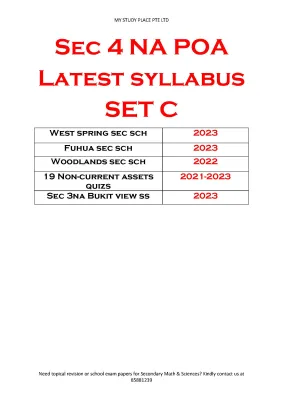
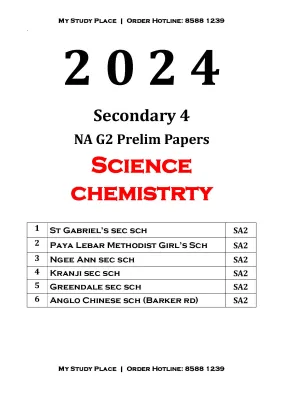
Prices are valid at publication and may change. Please refer to the product page for the latest price.
These papers are intentionally calibrated to be slightly more challenging than the actual O-Level papers. This intentional difficulty buffer helps you build resilience and adaptability. When you practice with papers that push the boundaries of conceptual application, the actual national examination often feels more manageable and less intimidating.
Furthermore, practicing with recent papers helps you transition from topical revision to cumulative, mixed-topic assessment. Standard textbook exercises usually isolate concepts by chapter, which can create a false sense of security. Prelim papers force you to quickly identify which mathematical formula, scientific concept, or historical event is required to solve a multi-disciplinary question under time pressure.
Using these papers also allows you to establish a reliable baseline of your current academic standing. By attempting these papers under realistic conditions, you can pinpoint persistent knowledge gaps and address them systematically. This targeted remediation ensures that your subsequent study sessions are highly efficient and focused on high-yield topics.
What to Look for When Choosing a Prelim Paper Bundle
Selecting the right compilation is not simply a matter of buying the thickest book available. To maximize your study efficiency, you must evaluate several key dimensions of any prelim paper bundle before making a purchase.

Syllabus Alignment
The Singapore Examinations and Assessment Board (SEAB) periodically updates subject syllabi to reflect modern educational standards. When purchasing a compilation, you must verify that the papers align precisely with the active syllabus codes for your exam year. Utilizing outdated papers can lead to unnecessary stress over topics that are no longer examinable, or worse, cause you to miss critical new content areas that have been recently introduced.
Quality of Worked Solutions
A compilation is only as good as its solutions. Basic answer keys that merely list the final numerical value or a single-letter multiple-choice option offer very little educational value when you are stuck. Look for compilations that feature detailed, step-by-step worked solutions. For mathematics and sciences, these solutions should show the algebraic transitions, chemical equations, and logical deductions clearly. For languages and humanities, look for sample essays, structural outlines, and detailed marking rubrics that explain how content marks and language marks are awarded.
School Selection and Diversity
A well-rounded preparation strategy requires exposure to various school styles. Different schools have distinct philosophies when setting papers; some focus heavily on complex mathematical manipulation, while others emphasize novel real-world application questions. Ensure your chosen bundle includes a balanced mix of papers from Independent Schools, Autonomous Schools, and Government Neighborhood Schools. This diversity prevents you from becoming overly accustomed to a single school’s testing style and prepares you for any question format Cambridge might present.
Physical Format and Layout
The physical presentation of the papers can significantly impact your mock exam experience. Standard O-Level booklets are printed with generous spacing and designated writing areas. Some budget compilations compress the layout to save paper, resulting in cramped text and insufficient space for working out complex steps. Opt for high-quality prints that replicate the actual exam booklet format as closely as possible. Additionally, consider whether you prefer bound books, which are easier to keep organized, or loose-leaf sets, which allow you to pull out individual papers for isolated timed practice.
Types of Prelim Compilations and Who They Are For
Local bookstores and online marketplaces offer several formats of prelim paper compilations. Understanding these categories will help you choose the format that aligns with your current preparation stage and revision goals.
Subject-Specific Compilations
These bundles focus entirely on a single subject, such as Additional Mathematics, Pure Physics, or English Language. They typically contain 10 to 15 full papers from various schools, accompanied by highly detailed solutions. These are ideal for students who have identified a specific weak subject that requires intensive, repetitive practice to master.
Top School Collections
These curated collections feature papers exclusively from historically high-performing schools. The questions in these papers are often highly conceptual, requiring deep lateral thinking and the synthesis of multiple topics. This format is best suited for high-achieving students who have already mastered foundational concepts and are aiming to secure an A1 distinction.
Comprehensive Multi-Subject Bundles
Designed as all-in-one revision packages, these bundles contain a smaller selection of papers (usually 3 to 5 papers) across a broad range of core subjects. They are highly effective for general diagnostic testing and for practicing overall time management across a typical exam week schedule.
| Bundle Type | Target Audience | Depth of Practice | Typical Page Count | Best Used For |
|---|---|---|---|---|
| Subject-Specific Compilations | Students targeting specific weak subjects or aiming for top grades | High (10–15 full papers for one subject) | 250–400 pages | Intensive thematic practice and mastering complex topic variations |
| Top School Collections | High-achieving students aiming for A1/A2 distinctions | Very High (Challenging, non-routine questions) | 200–350 pages | Stretching problem-solving limits and preparing for worst-case exam scenarios |
| Comprehensive Multi-Subject Bundles | Students seeking balanced revision across multiple subjects | Moderate (3–5 papers across 4–6 subjects) | 400–600 pages | Full-scale mock exam simulations and time-management practice |
How to Verify Edition Accuracy and Syllabus Alignment
Before finalizing your purchase of any exam preparation bundle, it is crucial to perform a few quality checks. This prevents the common mistake of buying outdated or incorrect editions.
First, inspect the cover and the copyright page of the compilation. Ensure that the year “2024” is explicitly printed as the publication or paper year, rather than just a generic “latest edition” label. Some older compilations are repackaged with minor cover updates but contain identical content from previous years.
Second, match the subject codes listed on the compilation with your official SEAB exam registration slip. For example, ensure that a science compilation matches the specific combination you are taking, such as Physics/Chemistry (Syllabus 5076) rather than Chemistry/Biology (Syllabus 5078). Similarly, verify whether the mathematics papers are for the Express stream or the Normal Academic stream, as the depth and scope of topics differ significantly.
Third, verify the source of the compilation. Reputable educational publishers and authorized local school distributors are the safest sources. If you are purchasing from online marketplaces, read the product descriptions carefully to confirm the exact number of papers included and check customer feedback regarding print quality and solution accuracy.
Finally, check if the publisher provides online errata sheets. Because prelim papers are compiled quickly after the school exams conclude, first-edition prints can occasionally contain typographical errors or minor calculation mistakes in the answer keys. A responsible publisher will make corrections available on their official website.
How to Integrate 2024 Prelim Papers into Your Study Plan
Simply owning a stack of exam papers will not improve your grades; how you utilize them determines their effectiveness. Implementing a structured approach to your practice will yield the best results.
Timed Simulation
To build exam stamina and manage time pressure, you must simulate realistic exam conditions. Find a quiet study space, remove all digital distractions, and set a strict timer corresponding to the official paper duration. Do not refer to your textbook or solutions during this time. This practice trains your brain to pace itself, helping you avoid the common pitfall of spending too much time on difficult early questions and leaving high-value structured questions incomplete.
Error Logging and Analysis
Once you complete a paper, dedicate ample time to marking and reviewing your work. Use the detailed worked solutions to identify exactly where your logic diverged from the model answer. Maintain a dedicated error log where you record the question, the mistake you made, the correct step-by-step solution, and the core concept you need to revise. Reviewing this log regularly before your next practice run prevents you from repeating the same mistakes.
Phased Practice Approach
Divide your revision into distinct phases. In the early stages of your preparation, use the papers in an untimed, open-book manner to build confidence and master complex problem-solving steps. As the exam date approaches, transition fully to closed-book, timed simulations. Start with papers from standard neighborhood schools to reinforce foundational concepts, and gradually progress to papers from highly competitive schools to sharpen your critical thinking and adaptability.
Frequently Asked Questions (FAQ)
Are 2024 prelim papers still relevant for the 2026 O-Level exams?
Yes, they remain highly relevant. While the absolute latest papers reflect the most immediate exam cycle, the core concepts of the O-Level syllabus remain stable over several years. The 2024 papers provide an excellent pool of high-quality, challenging questions that help build robust problem-solving skills, provided there have been no major syllabus overhauls in those specific subjects.
Should I buy compilations with worked solutions or just answer keys?
If you are studying independently, you should always opt for compilations with detailed, step-by-step worked solutions. These solutions act as a silent tutor, explaining the methodology and showing you how to structure your answers to secure maximum marks. Basic answer keys are only suitable if you have regular access to school teachers or private tutors who can explain the steps behind the final answers.
How many prelim papers should I complete per subject?
Quality of practice and deep analysis are far more important than sheer volume. A highly effective baseline is to complete and thoroughly review 5 to 8 full papers per subject. This volume is generally sufficient to expose you to the most common question formats and testing angles. Focus on fully understanding every error you make on these papers rather than rushing through dozens of papers without deep reflection.
Community discussion
Share your experience or ask a question. Comments are reviewed before publication.