
Finding the right English grammar book for Primary School Leaving Examination (PSLE) preparation in Singapore is not about searching for a single, universally perfect title. Instead, the most effective book is one that matches your child’s current mastery level and directly aligns with the rigorous demands of the Ministry of Education (MOE) syllabus. Because the PSLE tests grammar through both direct questions and complex contextual applications, parents must evaluate assessment books based on structural design, explanation clarity, and targeted practice formats. Selecting the appropriate resource requires a clear understanding of how grammar is assessed and a systematic approach to evaluating the options available in local bookstores.
Understanding the PSLE English Grammar Syllabus
The MOE English Language syllabus focuses heavily on the practical application of grammar rather than the mere memorisation of abstract rules. In the primary school curriculum, grammar is not treated as an isolated subject but as a foundational tool that enables clear, accurate, and effective communication. This pedagogical approach means that the national examination evaluates a student’s ability to recognize and apply grammatical structures in various contexts, ranging from single-sentence transformations to full-length reading passages.
In the actual PSLE English Paper 2, grammar is explicitly tested in the Grammar Multiple-Choice Questions (MCQ) section (10 marks) and the Editing for Spelling and Grammar section (12 marks). The MCQ section tests knowledge of tenses, prepositions, connectors, pronouns, and subject-verb agreement. The Editing section requires students to identify and correct grammatical errors in a continuous text, demanding a keen eye for tense consistency and word forms.
Products mentioned in this guide
![[SG STOCK] Primary English Grammar in Use P1-P6 PSLE Assessment for P1 P2 P3 P4 P5 P6 Grammar books Grammar Workbooks Grammar Textbooks](https://img.lazcdn.com/g/p/76f20cae23f0743272a6a7aedb86f362.png_400x400q80.png_.webp)
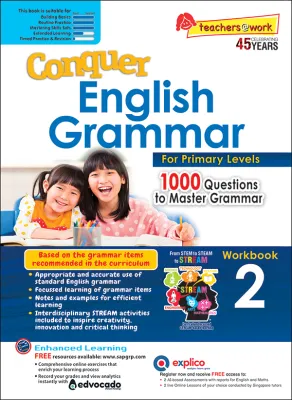
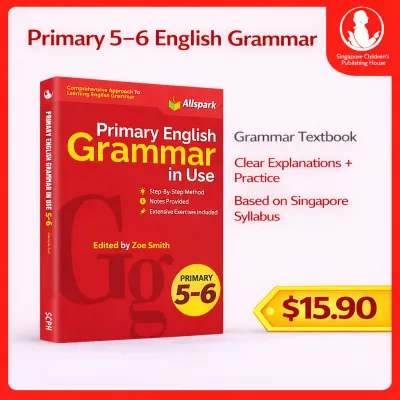
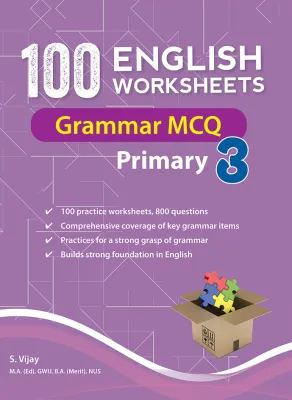
Prices are valid at publication and may change. Please refer to the product page for the latest price.
Another critical area is the Synthesis & Transformation section, worth 10 marks. This component requires students to combine two sentences into one or rewrite a sentence without changing its original meaning. Success depends entirely on a student’s grasp of complex grammatical structures, such as active and passive voice, direct and indirect speech, conditional clauses, and nominalisation. Beyond these specific sections, sound grammar is essential for securing high marks in the writing components of Paper 1, where grammatical accuracy directly influences the language score.
Key Criteria for Evaluating an English Grammar Book
When browsing assessment books in Singapore, parents should use a structured set of criteria to evaluate potential purchases. The first and most critical criterion is strict alignment with the latest PSLE question formats and marking schemes. A high-quality grammar book must feature exercises that mirror the exact layout, phrasing, and difficulty level of the national examination. Books using outdated testing styles or non-standard question formats can confuse students and lead to inefficient study sessions.

Secondly, evaluate the quality of explanations and worked examples. A beneficial grammar book does not simply list rules; it explains how those rules operate in different scenarios. Look for books that highlight common pitfalls and typical mistakes made by Singaporean students, such as tense sequencing in indirect speech. These worked examples should serve as a step-by-step guide, showing students how to analyze a question systematically before writing their answers.
Another essential feature is a progressive difficulty structure. The book should build a student’s confidence step by step, beginning with topical exercises focusing on individual grammatical components like modal verbs or relative clauses. Once these are mastered, the book should transition to mixed, non-topical practices and exam-style papers. This progression is crucial because the actual PSLE does not label questions by topic, requiring students to identify the tested grammatical concept independently.
Finaly, pay close attention to the answer key. A simple answer sheet that only provides the correct option letter is of limited educational value. The best grammar books feature detailed, explanatory answer keys that explain the grammatical reasoning behind the correct answer and why alternative options are incorrect. This level of detail allows students to self-correct and learn independently, reducing their reliance on constant parental or tutor supervision.
Matching Books to Your Child's Current Proficiency Level
Every student has unique strengths and weaknesses, meaning that a book highly recommended for one child may be entirely unsuitable for another. Before purchasing any assessment book, it is essential to establish your child’s current baseline proficiency. You can achieve this by reviewing their recent school exam papers, such as the Primary 5 end-of-year paper or Primary 6 CA1 results. Analyze where they consistently lose marks—whether it is basic tense agreement in MCQs or complex sentence structures in Synthesis & Transformation.
Avoiding the common trap of buying overly difficult books is vital for maintaining your child’s motivation. While it may be tempting to purchase advanced, high-difficulty workbooks in the hope of accelerating progress, doing so prematurely can cause intense frustration and a dislike for the subject. Conversely, buying books that are too simple will waste valuable revision time and fail to prepare them for the actual rigours of the PSLE. As your child progresses through Primary 5 and into the intensive preparation phase of Primary 6, their study materials should be adjusted to match their growing capabilities.
Foundational Learners: Building Core Rules
For students who struggle with basic grammar concepts and consistently score below the passing mark in grammar-focused sections, the primary goal is to build a solid foundation. The ideal grammar book for these learners should focus on clear, bite-sized rule explanations accompanied by visual aids, simple tables, and highlighted key terms. Visual representations of tenses on a timeline, for instance, can help struggling students grasp abstract temporal concepts much more easily than dense blocks of text.
At this foundational stage, the book should offer a high volume of basic, repetitive drills. These exercises are designed to build cognitive muscle memory for fundamental rules, such as subject-verb agreement, basic pronoun usage, and common prepositions. Repetition helps internalize these rules so that they become second nature. It is wise to avoid books containing complex synthesis or advanced cloze passages until these core rules are thoroughly mastered, as attempting advanced application too early will only hinder progress.
Intermediate Learners: Application and Exam Techniques
Intermediate learners are students who generally understand basic grammatical rules when tested topically but struggle to apply them correctly in mixed exam papers or continuous writing. For these students, the focus must shift from rote learning to application and exam techniques. The ideal assessment book should feature mixed exercises that require students to identify the relevant grammar rules within unseen passages, simulating the unpredictable nature of the actual exam.
To help intermediate students bridge the gap to higher scores, look for books that include dedicated “common pitfalls” and “trick questions” sections. These chapters teach students to read questions carefully and identify subtle grammatical clues that dictate the correct answer. Furthermore, the book should provide structured, step-by-step strategies for Synthesis and Transformation. Breaking down complex sentences into clauses and teaching specific formulas for converting active voice to passive voice will give intermediate students the systematic approach they need to secure these challenging marks.
Advanced Learners: Complex Structures and Speed
Advanced learners are high-achieving students who already possess a strong grasp of grammar rules and are aiming for top achievement bands. For these students, standard topical drills offer little benefit. Instead, they require books that focus on high-difficulty Synthesis & Transformation exercises and advanced Comprehension Cloze passages. These materials should expose them to complex sentence structures, subjunctive mood, nominalisation, and nuanced vocabulary that test the absolute limits of the primary school syllabus.
In addition to conceptual difficulty, advanced learners must focus on speed and mental stamina. The ideal books for this level should include time-bound exam simulations and full-length practice papers. Practising under timed conditions teaches students to manage their time effectively, ensuring they can complete the paper with sufficient time left to review their answers thoroughly. This targeted practice helps eliminate careless mistakes, which are often the primary reason high-achieving students miss out on top marks.
Essential Pre-Purchase Checks for PSLE Assessment Books
Before purchasing, parents should perform several essential checks to ensure the assessment book is a worthwhile investment. First, verify the publication year and the specific edition. The Singapore education system undergoes periodic syllabus updates, and assessment books must reflect these changes. Check the cover or copyright page for explicit statements confirming alignment with the latest MOE syllabus. An outdated book may contain question formats or grammatical terms no longer relevant to the current PSLE.
Second, consider the publisher’s reputation and the source of the book. Established local educational publishers are generally the most reliable sources for PSLE-aligned materials. Be cautious when purchasing digital copies or printed workbooks from unauthorized sellers on online marketplaces. These unverified copies often suffer from poor print quality, missing pages, formatting errors, or incorrect answer keys, which can severely disrupt your child’s learning process.
Third, evaluate the physical layout and format of the book. While digital learning tools have their place, physical assessment books remain highly recommended for exam preparation. Writing answers by hand helps build the physical muscle memory required for the actual written examination. When reviewing a physical book, look for a clean, uncluttered layout with generous spacing and clear fonts. A book that crams too many questions onto a single page can be visually overwhelming.
Finally, review the table of contents and sample pages. A well-structured book has a logical flow, starting with clear topical chapters, followed by progressive review exercises, and ending with complete practice papers. The presence of a comprehensive index and a clear marking scheme in the answer key is also a strong indicator of a well-designed educational resource.
Maximizing the Value of Your Chosen Grammar Book
Simply purchasing a high-quality grammar book is not enough to guarantee academic improvement; how the book is used in daily study sessions determines its value. To get the most out of the resource, implement a system of spaced repetition. Instead of completing a chapter once and never looking at it again, schedule periodic reviews of challenging topics. For instance, if your child struggles with relative pronouns, have them revisit those specific exercises two weeks later to ensure retention.
Another highly effective strategy is maintaining a dedicated error log. Encourage your child to write down every grammar mistake they make during practice sessions, along with the correct answer and a brief note explaining the rule they forgot. This personalized log becomes an invaluable revision tool in the weeks leading up to the PSLE, allowing the student to focus final revision on specific areas of weakness rather than re-reading rules they have already mastered.
When using the book for exam preparation, it is crucial to simulate actual exam conditions. Have your child complete mixed practices or simulated papers in a quiet environment, using a timer to enforce realistic time limits. Teach them to resist looking at the answer key immediately; struggling to find the answer independently is a vital part of the learning process that builds critical thinking skills. Finally, if a specific grammatical concept remains consistently misunderstood despite the book’s explanations, do not hesitate to consult their school teacher or a qualified tutor.
Frequently Asked Questions (FAQ)
Is it necessary to buy multiple grammar books for PSLE preparation?
It is generally not necessary, nor is it advisable, to buy a large number of grammar books. Mastering a single, high-quality, comprehensive grammar guide is far more effective than skimming through multiple books without fully understanding the concepts. Purchasing too many books can overwhelm your child and lead to fatigue. However, if your child has a specific, persistent weakness—such as struggling exclusively with Synthesis & Transformation—it can be highly beneficial to pair one general grammar guide with a single specialized workbook dedicated to that specific component.
How can I tell if a grammar book is updated for the current PSLE format?
To verify if a grammar book is updated, start by checking the copyright page for the publication date and look for explicit labels on the cover indicating alignment with the latest MOE syllabus. Next, examine the internal structure of the book. The Grammar MCQ section should consist of exactly 10 questions, and the Synthesis & Transformation exercises should use the current connector formats prescribed by schools. Finally, you can consult recent reviews or seek recommendations from local parenting communities and educators in Singapore to confirm that the book’s content aligns with recent school exam papers.
Community discussion
Share your experience or ask a question. Comments are reviewed before publication.