
Selecting the right Marshall Cavendish math assessment books for your child’s Primary School Leaving Examination (PSLE) preparation requires a clear understanding of their current academic standing and specific learning needs. Because the publisher offers a wide range of titles—spanning basic topical worksheets to advanced heuristic guides—buying books at random often leads to academic frustration or redundant practice. By matching your child’s current school performance and error patterns to the appropriate book category, you can build a targeted study plan that reinforces weak concepts and stretches problem-solving capabilities.
Understanding Your Child's Current Math Proficiency
To make an informed purchase, you must first diagnose where your child stands on the mathematical spectrum. Reviewing recent weighted assessments and mid-year examination papers is the most reliable way to start. Look beyond the final score and examine the specific sections where marks were lost.
Identify whether your child struggles with foundational concepts or advanced application. If they consistently lose marks in Section A (multiple-choice questions) or the straightforward short-answer questions in Section B, the primary issue is likely a weak grasp of core mathematical concepts or basic computational errors. In contrast, if they perform well in the early sections but struggle with the high-weightage structured questions in Paper 2, their foundation is likely solid, but they lack the heuristic tools needed to unpack complex, multi-step word problems.
Products mentioned in this guide
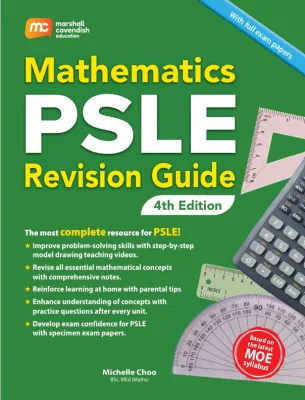
Prices are valid at publication and may change. Please refer to the product page for the latest price.
Distinguishing between careless mistakes and conceptual misunderstandings is crucial for selecting the right supplementary material. Careless mistakes, such as transfer errors or simple calculation slips, suggest a need for timed practice and better exam stamina rather than remedial content. Conceptual misunderstandings, where a child misapplies a formula or fails to recognize a mathematical relationship, require topical books that offer step-by-step explanations and guided examples.
Setting realistic target Achievement Levels (AL) also helps narrow down your choices. The PSLE scoring system ranges from AL 1 (the highest) to AL 8. If your child is currently scoring in the AL 5 to AL 7 range, your immediate priority should be securing foundational books that target basic competency and standard problem types to move them toward AL 4. If your child is already scoring at AL 2 or AL 3 and aims for AL 1, your focus should shift almost entirely to books specializing in non-routine questions, advanced heuristics, and challenging word problems.
Matching Marshall Cavendish Series to Learning Needs
Marshall Cavendish Education is the primary publisher of school textbooks in Singapore, meaning their assessment books are closely aligned with the school curriculum. However, their supplementary titles are structured into distinct categories, each serving a different purpose in a student’s preparation journey. Understanding these categories prevents parents from buying overlapping resources that overwhelm the student.

The publisher’s math resources generally fall into three tiers: topical practice books, specialized heuristic or problem-solving guides, and full-length mock examination papers. Topical books are designed for year-round reinforcement, helping students keep pace with classroom teaching. Heuristic guides are best introduced once a topic is fully understood, teaching students how to dissect complex word problems. Mock papers are reserved for the final months leading up to the PSLE to build exam endurance and time management skills.
Matching the book’s intended use case to your child’s daily study routine is essential for maintaining motivation. An advanced heuristic book is highly counterproductive if used as a daily homework tool for a struggling student, as it can lead to math anxiety and burnout. Conversely, a basic topical drill book will fail to challenge an advanced student, leading to boredom and a false sense of security.
Books for Building Core Foundations
For students who need to secure their basic mathematical concepts, foundational topical books are the ideal starting point. These books are structured to mirror the school syllabus unit by unit, allowing students to practice specific topics immediately after they are taught in school. This immediate reinforcement helps transfer new knowledge from short-term to long-term memory.
A key feature of these foundational books is the inclusion of step-by-step worked examples at the beginning of each chapter. These examples serve as a visual guide, demonstrating the correct mathematical working and logical flow required to secure full marks in exams. The subsequent practice questions typically follow a graduated difficulty scale, starting with simple recall questions and progressing to basic word problems.
Repetitive drills in these books are highly beneficial for building computational fluency and confidence. By solving multiple variations of the same problem type, students internalize standard procedures and reduce the cognitive load required for basic calculations. This frees up mental energy for more complex problem-solving later on.
You can determine if your child is ready to transition from foundational drills to more complex applications by monitoring their accuracy and speed. Once a student can complete topical exercises with an accuracy rate of 85% or higher without referring to the worked examples, they have demonstrated sufficient mastery. At this stage, you can gradually introduce intermediate problem-solving books to stretch their capabilities.
Books for Mastering Heuristics and Problem Sums
As students progress toward the PSLE, they will encounter complex, multi-step word problems that cannot be solved using simple arithmetic or rote memorization. Specialized problem-solving and heuristics books are designed specifically to address these high-weightage questions, which often make the difference between a mid-tier and a top-tier AL score.
These books focus heavily on teaching specific heuristic strategies, such as model drawing, working backward, systematic listing, and identifying patterns. Rather than just presenting questions, they teach students how to identify clues within a word problem that indicate which heuristic strategy to apply. For instance, learning when to draw a comparison model versus a part-whole model is a critical skill emphasized in these guides.
Higher-order thinking skills are developed through non-routine questions that require students to combine concepts from different topics, such as geometry and percentage. These books encourage students to think flexibly and approach a single problem from multiple angles, which is a hallmark of the PSLE math paper.
These specialized books are ideal for students who already possess a strong grasp of basic formulas and standard procedures. If your child can easily solve straightforward calculations but gets stuck when a problem is presented in an unfamiliar context, a heuristics-focused book will provide the structured framework they need to break down and solve these challenging questions.
Key Features to Check Before Purchasing
Before finalizing your purchase at a bookstore or on an online marketplace, there are several critical features you must verify to ensure the books are suitable and effective. The first and most important check is the publication year and syllabus alignment. The Ministry of Education (MOE) periodically updates the primary school mathematics syllabus to refine learning outcomes. Ensure the book cover explicitly states alignment with the latest MOE syllabus, as using outdated materials can lead to practicing topics that have been phased out or missing new concepts that are now examinable.
Next, examine the quality of the answer key and solutions section. A high-quality assessment book should provide more than just a list of final numerical answers. Look for books that offer fully worked solutions, complete with model drawings, step-by-step algebraic workings, and explanatory notes. This is particularly important for Paper 2 questions, where marks are awarded for the correct method and logical progression. Detailed solutions allow parents to guide their children effectively and enable independent students to self-correct and understand exactly where their logic faltered.
Additionally, check if the book includes practical features like tear-out mock exam papers or diagnostic tests. Tear-out papers are highly convenient for simulating real exam conditions, as they allow you to remove the paper from the book, set a timer, and have your child complete it at a clean desk without the temptation to peek at other pages. Diagnostic tests at the beginning of chapters are also valuable for quickly identifying which sub-topics require the most attention.
Finally, do not overlook the physical layout and readability of the book. Children often experience visual fatigue during long study sessions, which can lead to careless mistakes and a loss of concentration. Opt for books that feature clean layouts, generous spacing between questions, and a clear, legible font size. Avoid books that cram too many questions onto a single page, as this can feel overwhelming and leave insufficient space for students to write out their workings clearly.
Creating a Sustainable PSLE Math Study Plan
Purchasing the right assessment books is only the first step; integrating them into a balanced, sustainable study routine is what ultimately drives academic improvement. To prevent burnout and maintain a positive attitude toward learning, it is crucial to establish a structured schedule that balances different types of practice throughout the week.
A successful study plan typically balances daily topical practice with weekly timed mock papers. On weekdays, focus on short, targeted sessions of 20 to 30 minutes using topical or heuristic books to reinforce current school lessons. On weekends, allocate a longer, uninterrupted block of time to complete a full-length mock paper under exam conditions. This combination builds both conceptual depth and the physical stamina required for the actual PSLE papers.
Setting achievable daily page limits is far more effective than assigning large chunks of work sporadically. For instance, completing two pages of high-quality problem-solving questions daily is much more beneficial than forcing a child to complete an entire chapter over the weekend. Encourage your child to use the answer key actively for self-correction, guiding them to analyze their own mistakes rather than simply copying down the correct working.
Maintaining a dedicated error log is a highly effective strategy for tracking progress and adjusting your study focus. Have your child cut out or copy down questions they answered incorrectly and paste them into a notebook, along with the correct worked solution and a brief note explaining why they made the mistake. In the weeks leading up to the PSLE, reviewing this error log allows your child to quickly revise their personal weak points without having to flip through multiple thick assessment books.
Frequently Asked Questions (FAQ)
Do I need to buy both the textbook and the assessment book?
While school textbooks are excellent for introducing new mathematical concepts and explaining the underlying theory, they are rarely sufficient on their own for comprehensive PSLE preparation. Textbooks are designed for classroom instruction and often lack the volume and variety of practice questions needed to build exam fluency. Assessment books bridge this gap by providing targeted application practice, exposing students to a wider range of question formats, and offering exam-conditioned papers that prepare them for the rigors of the actual national exam.
How early should I start using PSLE assessment books?
Introducing PSLE-specific assessment books too early can be counterproductive and lead to unnecessary academic stress. Generally, the transition to PSLE-style practice should begin gradually in Primary 5, as this is when the complexity of word problems increases significantly and many core PSLE topics are introduced. In the earlier primary years, focus on building a strong foundation using standard topical workbooks. Look for signs of academic readiness, such as consistent high scores in school assessments and a strong grasp of basic multiplication tables, before introducing high-stakes exam preparation materials.
Community discussion
Share your experience or ask a question. Comments are reviewed before publication.