
Choosing a first delay pedal is an exciting milestone that opens up a vast world of spatial textures, rhythmic echoes, and ambient depth. For a beginner guitarist, a practical first pedal balances simplicity, affordability, and versatility, allowing you to explore these creative dimensions without getting lost in complex menus or overwhelming sub-parameters. Instead of chasing the most expensive or feature-heavy unit on the market, your focus should be on finding an intuitive interface and a sonic character that complements your current playing style. By starting with a straightforward, reliable pedal, you can master the core concepts of time-based effects and build a solid foundation for your overall guitar tone.
Understanding Delay Types: Which Sound Suits Your Playing?
To make an informed choice, it is helpful to understand the primary categories of delay pedals available, as each offers a distinct sonic character. The most common type you will encounter is the digital delay. Digital delay pedals use digital signal processing to create exact, pristine copies of your guitar signal. The repeats are clean, precise, and articulate, sounding almost identical to the original notes you played. This makes digital delay highly suitable for modern genres, pop, contemporary worship music, and rhythmic styles where note clarity is paramount. If you want your echoes to stand out sharply in a dense mix, digital is an excellent starting point.
In contrast, analog delay pedals offer a completely different tonal flavor. Traditionally utilizing bucket-brigade device analog chips, these pedals produce repeats that gradually degrade and lose high-frequency clarity with each successive echo. This results in a warm, dark, and organic sound that sits gently behind your dry guitar signal rather than competing with it. Analog delay is highly favored in classic rock, blues, and jazz, where it adds a subtle sense of space and depth without cluttering your playing. The natural roll-off of treble in the repeats ensures that your live playing remains the focal point of the performance.
Products mentioned in this guide
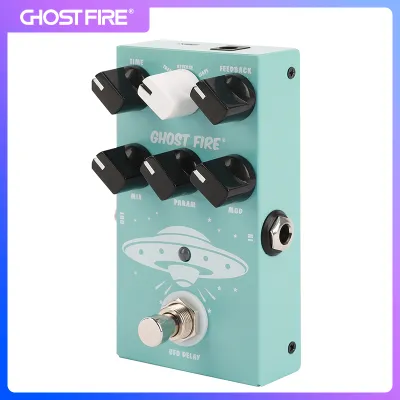
Prices are valid at publication and may change. Please refer to the product page for the latest price.
Another popular category is tape delay emulation. These pedals use digital technology to recreate the vintage warmth, mechanical imperfections, and subtle pitch fluctuations of old tape echo machines. The repeats often feature a gentle modulation, sometimes described as wow and flutter, along with a mild saturation that adds character to your tone. Tape emulation is highly effective for retro rock, ambient soundscapes, and atmospheric indie styles, offering a bridge between the precision of digital and the warmth of analog.
For most beginners, starting with either a standard digital delay or a versatile analog-emulation pedal is the most practical path. Digital delays often feature longer delay times, giving you more room to experiment with slow, dramatic echoes. Meanwhile, analog-style pedals are incredibly forgiving, as their darker repeats naturally blend into your amplifier’s tone even if your timing is slightly off. Choosing between them comes down to whether you prefer the crisp, modern precision of digital repeats or the warm, vintage cushion of analog echoes.
Essential Controls and Features for a Beginner-Friendly Pedal
When evaluating your first delay pedal, the layout of the control interface is just as important as the sound itself. A beginner-friendly pedal should feature a simple, hands-on interface that encourages experimentation. The vast majority of standard delay pedals rely on three core knobs to shape the effect. The first is the Time control, which determines the duration of the gap between the original note and the repeat. This is usually measured in milliseconds, and adjusting it allows you to transition from quick, slapback echoes to long, sweeping delays.

The second essential control is Feedback, sometimes labeled as repeats or regeneration. This knob dictates how many times the delayed signal repeats before fading into silence. Setting this control low will give you a single echo, while turning it up increases the number of repeats, creating a continuous trail of sound. The third core control is the Mix or Level knob, which adjusts the volume of the delayed repeats relative to your dry, unaffected guitar signal. This allows you to blend the effect subtly into the background or make the echoes as loud as the original notes.
For a beginner, a simple, single-function layout is far superior to a pedal with multi-function menus, hidden secondary parameters, or deep editing screens. When you are learning how delay interacts with your playing, you want to see exactly what each knob is doing at a glance. Complex pedals with digital screens and deep sub-menus can easily lead to option paralysis, distracting you from actual practice and playing. A straightforward pedal allows you to make quick adjustments on the fly and intuitively understand how changing one parameter affects the overall sound.
As you compare different models, you may also encounter optional but highly useful features like tap tempo. Tap tempo allows you to set the delay time in real-time by tapping a dedicated footswitch to the beat of the music, which is incredibly helpful for keeping your echoes synchronized with a band or a metronome. Additionally, you will want to consider the switching mechanism, specifically the difference between true bypass and buffered bypass. True bypass completely removes the pedal’s circuitry from your signal chain when turned off, preserving your pure guitar tone. Buffered bypass, on the other hand, uses an active buffer circuit to strengthen your signal, which helps prevent high-frequency loss if you are running long cables or a large chain of pedals.
Setting a Realistic Budget for Your First Delay Pedal
Navigating the financial aspect of buying your first guitar pedal requires balancing quality with affordability. In the local market, entry-level and mid-range delay pedals generally fall into a few distinct price tiers. You can expect to find reliable, basic delay pedals starting around S$50 to S$100. In this entry-level tier, you will find compact, straightforward pedals that offer excellent sound quality and durable metal enclosures without unnecessary bells and whistles. This is often the sweet spot for beginners who want to explore the effect without making a massive financial commitment.
Moving up to the S$100 to S$250 mid-range tier introduces pedals from established, globally recognized manufacturers. These models often include additional features such as tap tempo, multiple delay modes (such as analog, digital, and tape emulations in a single unit), and stereo outputs. While these features are not strictly necessary for a beginner, they offer more room to grow as your playing style evolves.
It is generally wise to avoid ultra-cheap, unbranded pedals found on generic online marketplaces. While a low price tag might seem tempting, these units often suffer from poor build quality, noisy switching mechanisms, and high background hiss that can ruin your practice experience. Investing in a reliable, standard model from a recognized brand ensures better component quality and shielding. Furthermore, established brands tend to hold their resale value remarkably well. If you eventually decide to upgrade your rig or find that a different style of delay suits you better, you can easily sell a reputable pedal on the local secondhand market to recoup a significant portion of your initial investment.
Building Your Shortlist: Matching the Pedal to Your Musical Needs
To narrow down your options, it is highly effective to match the pedal’s capabilities to the specific genres of music you enjoy playing. If your goals involve playing in cover bands, pop, or modern rock, you should prioritize versatile digital delays. Look for models that offer clear, articulate repeats and, if possible, the ability to save a few presets. This allows you to quickly switch between a tight slapback delay for a classic rock solo and a precise, dotted-eighth-note delay for a modern pop anthem without having to manually turn knobs between songs.
If your musical tastes lean toward blues, indie, or classic rock, an analog or analog-modeled pedal is likely the best fit. You will want to look for a pedal that offers warm, organic modulation and a natural decay on the repeats. This type of delay blends seamlessly with overdrive and distortion, adding a rich, three-dimensional quality to your guitar solos and rhythm parts without making your overall sound muddy or chaotic.
For those interested in ambient music, shoegaze, or post-rock, the requirements are slightly different. You will want to look for a delay pedal that offers longer maximum delay times, typically exceeding 800 milliseconds, and the ability to handle high feedback settings without immediately oscillating into harsh noise. Pedals that feature built-in modulation, such as a chorus or vibrato effect applied specifically to the repeats, are highly valuable for creating lush, swirling soundscapes and atmospheric textures.
Once you have identified a few candidate categories, the best way to make a final decision is to test them in person. Visit local music stores in Singapore and ask to try your shortlisted options. When testing a pedal, try to play it through an amplifier that is similar to your own practice setup at home. This ensures that the sounds you hear in the store will translate accurately to your home environment. If testing in person is not possible, look for high-quality online video demonstrations that showcase the pedal being played with your specific style of guitar and amplifier, paying close attention to how the controls behave across their entire range.
Pre-Purchase Checks: Power, Compatibility, and Setup
Before finalizing your purchase, performing a few technical checks will save you from unexpected setup issues or additional costs. The first and most critical check is the power supply requirement. Most modern delay pedals operate on a standard 9V DC power supply with a center-negative polarity. However, delay is a time-based digital effect, which means it typically requires a higher current draw, measured in milliamperes (mA), than simple overdrive or distortion pedals. Always check the manufacturer’s specifications to ensure your power supply can deliver the required mA. Running a high-draw digital pedal on a dying 9V battery or an underpowered daisy-chain adapter can result in weak performance, unwanted digital hum, or the pedal failing to turn on entirely.
Next, consider the physical space on your pedalboard or practice area. Guitar pedals come in various enclosure sizes, ranging from standard-sized enclosures to ultra-compact mini formats. While mini pedals are excellent for saving space on a crowded board, they rarely have room for an internal 9V battery, meaning they must be powered by an external adapter. Ensure you measure your available space and plan your layout accordingly, keeping in mind that you will also need room for patch cables and power jacks to plug into the sides or top of the pedal.
Finally, understand where the delay pedal fits within your overall signal chain. To maintain a clean, organized sound, delay pedals are traditionally placed near the end of your effects chain, usually after overdrive, distortion, and modulation pedals (like chorus or phaser), but before your reverb pedal. Placing delay after your dirt pedals ensures that your clean echoes are repeating a distorted sound, rather than distorting a series of clean echoes, which can quickly sound muddy and chaotic. If your amplifier features an effects loop, running your delay pedal through the loop rather than directly into the front input can provide an even cleaner, more defined echo, especially when using the amplifier’s built-in distortion.
Frequently Asked Questions (FAQ)
Do I need a stereo delay pedal as a beginner?
A mono output is entirely sufficient for the vast majority of standard guitar amplifiers and beginner practice setups. Stereo delay pedals are designed to split the delayed signal across two separate channels, creating a wide, immersive spatial effect. However, to experience this, you must run your signal into two separate amplifiers, use a specialized stereo effects loop, or record directly into a stereo audio interface. For home practice and learning the basics, a standard mono connection keeps your setup simple, reliable, and easy to troubleshoot.
Can I use a delay pedal with an acoustic guitar?
Yes, you can absolutely use a delay pedal with an acoustic guitar, provided you are plugging the instrument into an acoustic amplifier, a dedicated acoustic preamp, or a PA system. Delay can add a beautiful, ambient depth to acoustic fingerpicking and solo performances. When using delay with an acoustic guitar, it is generally best to keep the mix and feedback controls set relatively low. This prevents the repeats from overpowering the natural, resonant wood tones of the acoustic instrument and keeps your performance sounding clean and articulate.
Why does my delay pedal make a popping sound when I turn it on?
A popping sound when engaging a pedal is a common issue, often associated with true bypass switching mechanisms. This occurs due to a sudden buildup of static voltage on the switch contacts when the pedal is inactive. When you step on the switch, this voltage discharges instantly into your signal chain, resulting in an audible pop. You can often minimize this by clicking the switch a few times before turning on your amplifier to discharge any residual static. Alternatively, ensuring your cables are fully inserted, using a buffered bypass pedal, or checking for stable power connections can help eliminate the noise.
Community discussion
Share your experience or ask a question. Comments are reviewed before publication.