
Choosing your first guitar stand is just as important as selecting your instrument, as a secure stand keeps your guitar safe, accessible, and ready to play. For most beginners, the choice comes down to three primary designs: the compact A-frame, the highly stable tripod, and the space-saving multi-guitar rack. An A-frame stand is a low-profile, highly portable option that cradles the bottom of the guitar body. A tripod stand features a three-legged base and an extended neck collar that holds the guitar upright from the top. A multi-guitar rack is a sturdier, rectangular frame designed to hold several instruments side-by-side like books on a shelf.
As a general rule of thumb, a single tripod stand is the safest and most reliable choice for a beginner with one guitar, offering excellent stability against accidental bumps. If you live in a compact apartment or need to pack your gear frequently, an A-frame provides unmatched portability. For those who already own or plan to acquire multiple instruments, a multi-guitar rack is the most efficient way to maximize floor space while keeping your collection organized.
Understanding the Three Main Guitar Stand Types
When evaluating guitar stands, understanding how their physical structure interacts with your living space and your instrument is crucial. Each design approaches stability, portability, and footprint differently, creating distinct trade-offs that affect daily usability. The physical footprint refers to the actual floor area the stand occupies when fully deployed, which directly impacts where you can safely place it in a room.
Products mentioned in this guide


Prices are valid at publication and may change. Please refer to the product page for the latest price.
Folding mechanisms also vary significantly across these categories. Some stands fold down into flat, highly packable shapes, while others remain relatively bulky even when collapsed. This portability factor is essential if you plan to take your guitar to lessons, jam sessions, or local gigs.
The core stability of any stand relies heavily on its base geometry. A two-legged base, typical of A-frame designs, relies on a low center of gravity and the weight of the guitar itself to maintain balance. In contrast, a three-legged tripod base distributes weight across three distinct points, creating a wider pyramid of support. This structural difference determines how well the stand can resist tipping when subjected to lateral forces, such as an accidental nudge from a passerby or a curious pet.
A-Frame Stands
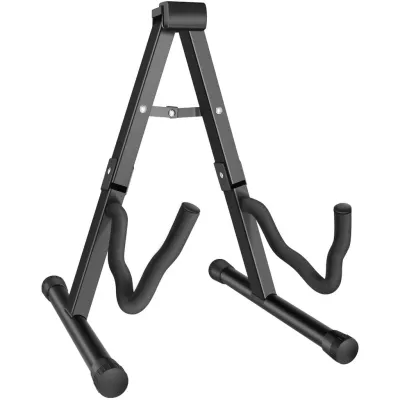
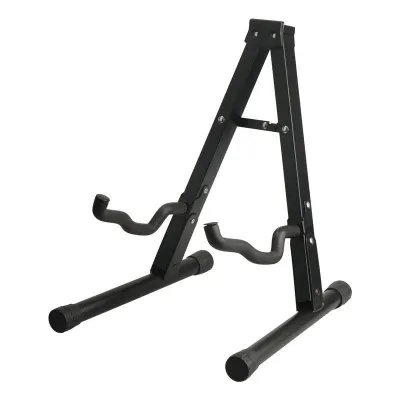
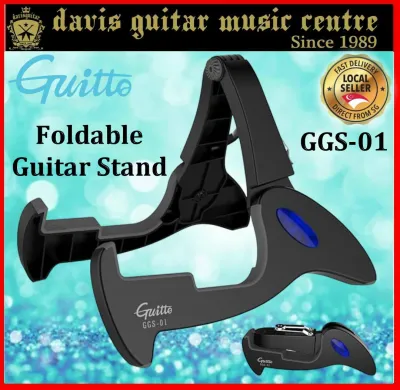
A-frame stands are named for their characteristic “A” shape when viewed from the front. These stands are designed to be exceptionally low-profile and lightweight, making them a popular choice for musicians who value minimalism and portability. Because they lack an upright neck support column, they can fold down into a highly compact, flat configuration that easily fits into a gig bag pocket or a small storage drawer.
The primary advantage of an A-frame stand is its convenience. It takes up very little visual space in a room, allowing your guitar to remain the center of attention. It is also incredibly easy to set up and tear down, requiring only a single unfolding motion to be ready for use. This makes it an excellent companion for traveling players or those practicing in multi-purpose rooms where gear must be packed away after every session.
However, this compact design comes with inherent safety trade-offs. Because an A-frame stand supports the guitar solely by its lower body bout, the instrument’s neck remains completely free and exposed. Without an upper neck cradle to secure the top half of the instrument, the setup has a higher center of gravity. A moderate bump to the headstock or neck can easily cause the guitar to twist or tip sideways out of the stand, potentially leading to costly headstock fractures or finish chips.
Tripod Stands
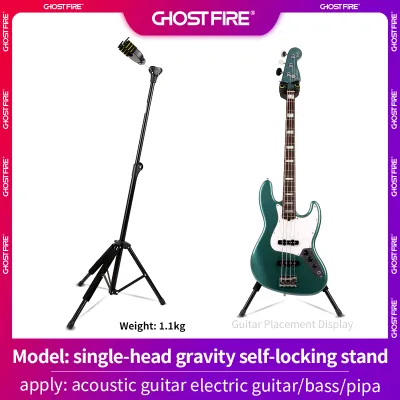
Tripod stands are the traditional workhorses of the music world, easily recognized by their three-legged base and tall vertical neck column. This design is engineered to provide maximum physical security for a single instrument by supporting it at two distinct points: the lower body and the upper neck. The three legs spread outward to create a wide, stable foundation that resists tipping in almost every direction.
The standout benefit of a tripod stand is its superior stability. By securing the neck in a dedicated cradle or yoke, the stand prevents the guitar from rotating or sliding out of place. Many tripod models feature a safety strap, a gravity-activated gate, or a locking mechanism at the neck cradle to ensure the instrument cannot fall forward even if the stand is tilted. This makes the tripod stand the preferred choice for busy households, classrooms, and stage environments where physical activity is common.
The trade-off for this enhanced security is a larger physical footprint and reduced portability. The three legs require a significant amount of floor space, which can make placement tricky in tight corners or narrow hallways. Additionally, while the legs and neck column usually fold down, the overall collapsed size is still much longer and more awkward to transport than a flat-folding A-frame stand.
Multi-Guitar Racks
Multi-guitar racks, often referred to as multi-stands or boat stands, are designed for players who own more than one instrument or plan to expand their collection quickly. These structures feature a rectangular base frame with padded slots for the guitar bodies, paired with a high horizontal bar containing individual neck cradles. This layout allows guitars to be lined up side-by-side, either perpendicular or at a slight angle to the frame.
The primary benefit of a multi-guitar rack is its incredible space efficiency. Storing three, five, or seven guitars on individual tripod stands would consume an enormous amount of floor space and create a cluttered, hazardous environment. A single rack consolidates these instruments into a neat, organized footprint that is only slightly larger than a single tripod stand’s base. This makes it much easier to keep all your instruments within arm’s reach in a home studio or practice corner.
Despite their efficiency, racks require careful management. They have a large, heavy footprint that cannot be easily moved once loaded with instruments. You must also pay close attention to the spacing between the individual slots. If you store wide-bodied acoustic guitars next to electric guitars, or if your instruments have wide headstocks, they can easily bump into one another when being inserted or removed. Verifying the clearance between slots is essential to prevent accidental cosmetic damage.
How to Match a Stand to Your Guitar and Space
Selecting the right stand requires a careful analysis of your specific instrument’s physical dimensions and the environment where it will live. Acoustic, electric, and bass guitars have vastly different structural designs, and a stand that works perfectly for one may be entirely unsuitable for another.

Acoustic guitars feature deep, hollow bodies with wide lower bouts. To hold an acoustic securely, a stand must have lower support arms that are deep enough to cradle the entire thickness of the body without letting it slide forward. Electric guitars, on the other hand, are much thinner but significantly heavier. An electric guitar stand needs robust construction to handle the concentrated weight, and the lower cradle must be narrow enough to prevent the thin body from slipping through the gap. Bass guitars present a unique challenge due to their extended scale lengths and heavy headstocks, which create a high center of gravity. A bass requires a tall tripod stand with an adjustable neck column to ensure the body rests securely in the lower cradle while the neck is properly supported.
Asymmetrical or unconventional body shapes demand extra attention. Guitars with offset waists, such as Jazzmasters, or radical body shapes like Flying Vs and Explorers, will not sit evenly on standard symmetrical lower support arms. If you own an offset or asymmetrical guitar, look for a stand with self-adjusting or pivoting lower cradles that can adapt to the uneven contours of the body. Alternatively, a neck-hanging tripod stand, which suspends the guitar from its headstock rather than resting it on its base, is often the safest choice for unconventional shapes.
Your physical environment is the final piece of the puzzle. Before purchasing a stand, measure the available floor space in your practice area. Consider the traffic flow of the room: is the stand going to sit in a quiet corner behind a desk, or will it be placed in a lively living room where family members, guests, or pets frequently walk past? In high-traffic areas, a wide-base tripod stand with a neck-locking gate is almost mandatory to prevent accidental tip-overs. If space is extremely limited, such as in a small bedroom or a shared study, you might need to opt for an A-frame stand that can be folded and tucked under the bed when not in use, or invest in a wall hanger if permanent mounting is an option.
Key Features to Check Before Buying
When browsing online marketplaces or visiting a local music shop in Singapore, it is easy to get overwhelmed by the sheer variety of stands available. To ensure you get a high-quality product that protects your investment, there are several critical hardware and material specifications you must verify before making a purchase.
First and foremost, inspect the padding material used on all contact points where the stand touches your guitar. The most common padding materials are foam, rubber, and silicone. If your guitar has a nitrocellulose lacquer finish—which is common on high-end, vintage, or heritage-style instruments—you must ensure the padding is explicitly labeled as “nitro-safe.” Standard rubber and low-grade foam can undergo a chemical reaction with nitrocellulose, causing the lacquer to melt, discolor, or become permanently stained. For guitars with standard polyurethane or polyester finishes, most modern padding materials are perfectly safe, but choosing high-quality, non-reactive silicone or soft foam is always the safest bet.
Next, evaluate the adjustability of the stand. A good tripod stand should feature an adjustable vertical column that allows you to raise or lower the neck cradle to match the exact scale length of your guitar. This ensures the neck rests comfortably in the yoke without putting upward pressure on the headstock or leaving the body unsupported. The lower arms should also have some degree of adjustability, such as pivoting cradles, to accommodate different body depths and angles.
Finally, closely examine the locking mechanisms and structural joints. A stand is only as safe as its weakest joint. Look for stands with robust metal locking pins, secure friction collars, or heavy-duty bolts rather than cheap plastic snap-locks. When you remove your guitar from the stand, the frame should remain completely rigid and stable; it should not wobble, slide, or begin to collapse under its own weight. If you are choosing a tripod stand, check if the neck yoke features a security strap or an automatic gravity gate that locks the neck in place when the instrument’s weight is applied.
Common Beginner Mistakes to Avoid
Many new guitarists learn the hard way that a poor stand choice or improper placement can lead to catastrophic damage to their instrument. By understanding and avoiding these common pitfalls, you can keep your guitar pristine and avoid costly trips to a repair technician.
One of the most frequent mistakes is using cheap, unverified stands on guitars with delicate finishes. Many budget stands use inexpensive vulcanized rubber padding that contains plasticizers. Over time, these chemicals migrate into the guitar’s finish, leaving unsightly black marks or sticky patches at the neck joint and lower bouts. Always read the product specifications carefully, and if you are unsure about your guitar’s finish type, err on the side of caution by using a stand with medical-grade silicone or wrapping the contact points with a soft cotton cloth.
Another critical error is placing lightweight, unstable stands in high-traffic zones. It can be tempting to set your guitar right next to your couch or near a doorway so it is always within reach. However, these areas are prime zones for accidents. A wagging dog tail, a vacuum cleaner, or a misplaced step can easily send a lightweight A-frame stand crashing to the floor. Always position your stand in a low-traffic corner of the room, away from swinging doors, direct sunlight, and air conditioning vents, which can cause rapid temperature and humidity fluctuations.
Lastly, avoid overloading multi-guitar racks or mismanaging their weight distribution. Racks have strict weight limits and capacity ratings. Trying to squeeze an extra instrument into a rack that is not designed for it increases the risk of the guitars knocking against each other, leading to scratches, dents, and broken tuning pegs. Furthermore, always place heavier instruments, such as solid-body electric basses, toward the center of the rack rather than on the outer edges. Placing a heavy bass on the very edge of a lightweight rack can make the entire structure top-heavy and prone to tipping sideways.
Frequently Asked Questions (FAQ)
Is it safe to hang a guitar by its neck on a stand?
Yes, hanging a guitar by its neck on a properly designed stand is entirely safe and is actually preferred by many professionals. High-quality neck-hanging stands suspend the instrument from the headstock, allowing gravity to pull the guitar straight down. This design eliminates lateral pressure on the neck and ensures the body does not twist or slip. The weight of a standard guitar is not nearly enough to cause structural damage to a healthy, solid wood neck joint.
However, there are a few exceptions to keep in mind. If you own a vintage instrument with a repaired headstock crack, a highly modified guitar with non-standard neck dimensions, or an instrument with an exceptionally fragile neck joint, you should consult the manufacturer’s guidelines. For the vast majority of modern electric, acoustic, and bass guitars, neck-hanging stands offer excellent security and stability.
Do I need a special stand for an acoustic guitar versus an electric guitar?
While specialized stands exist for specific instrument types, you do not necessarily need to buy separate stands if you choose a universal model. Many modern tripod and A-frame stands are designed with adjustable, universal cradles that can accommodate both the deep body of an acoustic guitar and the slim profile of an electric guitar. These universal models are highly cost-effective for beginners who might switch between instruments as they learn.
However, specialized stands are highly recommended in certain scenarios. If you play a classical guitar, which typically has a wider neck and a flat fingerboard, or an acoustic bass with an exceptionally deep body, a standard electric stand will not provide a secure fit. In these cases, purchasing a stand specifically tailored to the instrument’s dimensions ensures proper weight distribution and prevents the guitar from slipping out of the cradle.

Community discussion
Share your experience or ask a question. Comments are reviewed before publication.