
Selecting your first instrument is a pivotal step in your musical journey, and finding an Ibanez electronic guitar (often searched as an ibamez electronic guitar) that aligns with your physical comfort and learning goals can make all the difference. For complete beginners, the ideal model is not necessarily the most expensive one, but rather one that minimizes physical barriers to practice. Ibanez offers several entry-level series, most notably the Gio range, designed specifically to provide high playability, stable tuning, and versatile tones at an accessible price point. By focusing on key physical specifications—such as neck thickness, body weight, and bridge design—you can select an instrument that feels natural in your hands and keeps you motivated to practice every day.
What Makes an Electronic Guitar Beginner-Friendly?
The neck profile is the primary point of contact for your fretting hand and plays a critical role in early progress. A beginner-friendly neck should be relatively thin and narrow, allowing players with smaller hands or undeveloped finger flexibility to reach chords comfortably. Ibanez is widely recognized for its slim neck profiles, which reduce the muscle strain often associated with chunkier, traditional guitar necks during long practice sessions.
String action, which refers to the distance between the strings and the fretboard, is another vital factor to consider. If the action is too high, pressing down on the strings requires excessive force, leading to rapid finger fatigue and physical discouragement. A high-quality beginner guitar must feature an easily adjustable bridge so that a technician or the player can lower the action to a comfortable level without causing unwanted fret buzz.
Products mentioned in this guide

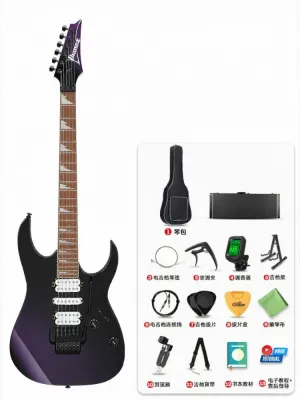
Prices are valid at publication and may change. Please refer to the product page for the latest price.
Weight distribution and body contours also impact how long you can comfortably practice. A heavy, blocky guitar can cause shoulder and back fatigue, especially for younger players or those practicing while standing. Beginner-friendly models typically feature contoured bodies with ergonomic cutaways that fit snugly against the player’s torso, whether sitting on a practice chair or standing with a strap. Lightweight tonewoods or thinner body profiles help sustain longer, more comfortable practice sessions.
While traditional electric guitars do not feature built-in digital screens or metronomes, a beginner-friendly setup often integrates seamlessly with external practice tools. Choosing a guitar with straightforward controls—such as a single volume knob, a tone knob, and a simple pickup selector—prevents beginners from getting distracted by complex electronics. This simplicity allows new players to focus entirely on timing, finger placement, and basic exercises.
Key Specifications to Evaluate in Ibamez Models
Scale length is the distance between the nut and the bridge saddle, and it directly affects string tension. Standard Ibanez electronic guitars typically feature a 25.5-inch scale length, which provides standard string tension and clear note definition. However, for younger players or those with smaller hands, Ibanez also produces short-scale models (often designated as “miKro” or GRGM models) with a 22.2-inch scale length. Shorter scales reduce string tension, making strings much easier to bend and press down.

The fretboard radius refers to the curvature of the fingerboard from side to side. A flatter fretboard (indicated by a larger radius number, such as 400mm or 15.7 inches, common on many Ibanez models) is highly suited for single-note runs and modern playing styles. A slightly rounder radius can make traditional barre chords easier to grip. Beginners should compare these specifications on official product sheets to find a balance that suits their preferred musical genres.
Pickups convert string vibrations into electrical signals, and their configuration determines the guitar’s tonal versatility. Beginners will encounter configurations like HH (two humbuckers) or HSS (one humbucker and two single-coils). Humbucking pickups are excellent for rock and metal because they cancel out electrical hum, while single-coil pickups offer a brighter, twangier sound suitable for pop, funk, and blues. An HSS configuration is often highly recommended for beginners because it offers the widest variety of tonal options on a single instrument.
One of the most critical decisions for a beginner is choosing between a fixed bridge (hardtail) and a tremolo bridge (whammy bar). While tremolo systems look exciting, budget-friendly tremolos can make tuning unstable and complicate the string-changing process significantly. For a frustration-free introduction to the instrument, beginners are strongly advised to select a model with a fixed bridge, which keeps the guitar in tune much longer and simplifies basic maintenance.
Checking Device Compatibility and Practice Setup
Every standard Ibanez electronic guitar features a 6.35mm (1/4-inch) output jack. To connect the guitar to a standard amplifier, you will need a high-quality instrument cable with matching 6.35mm plugs. If you plan to practice silently using standard consumer headphones (which typically use a 3.5mm plug), you cannot plug them directly into the guitar without an active preamp, a dedicated headphone amplifier, or an audio interface.
Many modern beginners prefer using interactive learning applications or computer-based software rather than traditional amplifiers. To do this, you must connect your guitar to an external USB audio interface. This device converts the analog signal from your guitar into a digital format that your computer, tablet, or smartphone can process, allowing you to use virtual amplifiers, effects, and recording software.
If your practice setup includes active accessories—such as a pocket-sized headphone amplifier, a wireless transmitter system, or a portable mini-amplifier—you must verify their power requirements. Some devices run on standard 9V batteries, while others feature internal lithium-ion batteries rechargeable via USB. Ensuring you have the correct power adapters or charging cables on hand prevents unexpected interruptions during your scheduled practice time.
Building Your Shortlist Based on Learning Goals
If you live in a high-density residential area, such as an apartment or HDB flat in Singapore, managing volume is a primary concern. Your shortlist should prioritize a setup that supports high-quality headphone monitoring. Pairing a comfortable, lightweight Ibanez guitar with a dedicated headphone amplifier or a multi-effects pedal with a headphone output allows you to practice at any hour of the day or night without disturbing family members or neighbors.
If your goal is to join a school band, play at community events, or jam with friends in a rehearsal studio, you will need a setup capable of projecting sound. While the guitar itself remains the same, you should ensure your chosen model has passive pickups that interface cleanly with high-wattage solid-state or tube amplifiers. Look for models with robust output jacks and reliable tuning machines that can withstand the physical demands of transport and live playing.
For students who need to commute to music lessons or players with limited storage space at home, physical dimensions are a major factor. A compact or short-scale electronic guitar fits more easily into public transport, car trunks, and small closets. While headless guitars are another space-saving option, they often carry a higher price tag; therefore, a short-scale or slim-bodied traditional model remains the most practical choice for budget-conscious beginners on the move.
Pre-Purchase Verification and Safe Buying Practices
To ensure you are purchasing a genuine Ibanez instrument backed by a manufacturer’s warranty, always buy from authorized physical music retailers or official online brand stores in Singapore. Avoid purchasing from unverified third-party sellers on general online marketplaces, as counterfeit guitars or instruments with severe manufacturing defects are common in the unauthorized market.
When comparing options, check the official packing list to see what accessories are included in the box. Some entry-level packages bundle the guitar with a gig bag, a strap, an electronic tuner, and adjustment wrenches. If these are not included, you will need to budget separately for them, as a protective gig bag and a reliable tuner are essential from day one.
A new guitar often requires a professional setup to play its best, especially after traveling through different climates to reach Singapore’s humid environment. Verify that your purchase includes a local warranty and ask if the retailer offers a complimentary initial setup. A professional adjustment of the neck relief, bridge height, and intonation ensures the guitar is as easy to play as possible right out of the box.
Frequently Asked Questions (FAQ)
Do I need a separate amplifier for an electronic guitar?
Yes, an electronic guitar requires some form of external amplification to be heard clearly, as its solid body does not amplify string vibrations acoustically. While a traditional practice amplifier is the most common choice, you can also use a pocket-sized headphone amplifier, a dedicated multi-effects processor, or a USB audio interface connected to a computer or mobile device running amp-simulation software.
How often should a beginner change the strings on an electronic guitar?
As a general rule, beginners should change their guitar strings every 3 to 6 months, or sooner if they notice signs of wear. In warm, humid climates like Singapore’s, sweat and moisture from your hands can cause strings to oxidize, rust, and lose their bright tone quickly. Wiping down the strings with a clean, dry cloth after every practice session will significantly extend their lifespan and maintain tuning stability.
Community discussion
Share your experience or ask a question. Comments are reviewed before publication.