
For anyone starting their musical journey, the initial hurdle of pressing down on nylon strings can feel surprisingly painful and frustrating. A ukulele chord presser—sometimes searched as a ukelele chord presser—promises an instant solution to this discomfort. By clamping onto the neck of your instrument, this mechanical accessory allows you to play full chords simply by pressing color-coded buttons.
While the promise of instant playability is highly appealing, these devices are rarely a necessary purchase for the average beginner. For most players, a chord presser acts as a temporary crutch that actually hinders long-term skill development and limits your musical freedom. However, there are specific circumstances, such as physical limitations or casual recreational goals, where the tool serves a genuine purpose.
Deciding whether to buy a chord presser or learn chords normally depends on your physical needs, your musical aspirations, and how much time you want to invest in mastering the instrument. Understanding how these tools function and how they affect your learning trajectory will help you make the right choice for your musical path.
Products mentioned in this guide
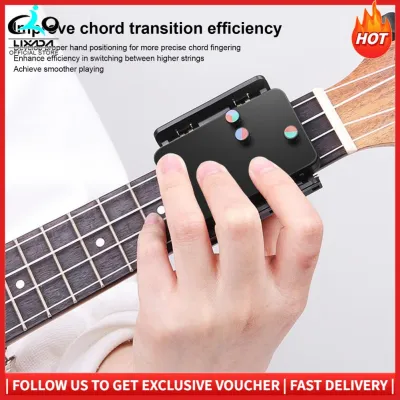
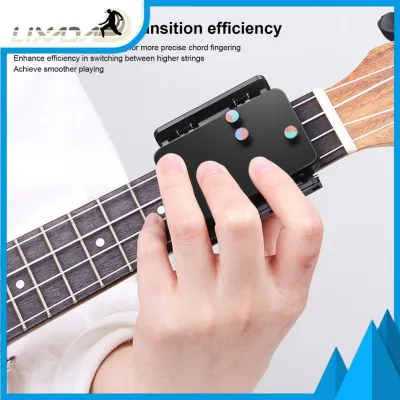
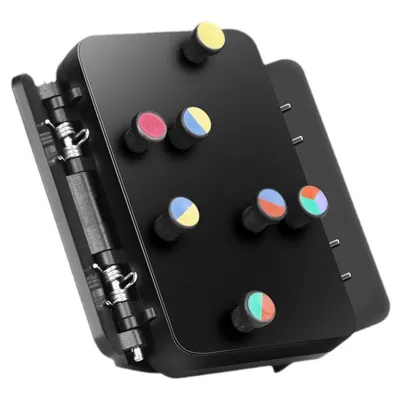


Prices are valid at publication and may change. Please refer to the product page for the latest price.
What Is a Ukulele Chord Presser and How Does It Work?
A ukulele chord presser is an external, mechanical accessory designed to fit over the first few frets of a ukulele neck. It is not a built-in feature of the instrument, nor does it permanently alter the ukulele. Instead, it is a removable clamp-on device equipped with several spring-loaded buttons or levers.
When you press one of these buttons, the device mechanically activates small rubber pads on the underside. These pads press down on specific strings and frets simultaneously to form a complete chord, such as C major, G major, A minor, or F major. Instead of using your individual fingertips to fret multiple strings, you press a single button with one finger.
These devices are typically designed for standard soprano, concert, or tenor ukuleles tuned to standard G-C-E-A tuning. Because the spacing of the frets and the width of the neck vary between different instrument sizes, these tools rely on precise physical alignment. They bypass the physical demand of manual finger placement, allowing you to strum recognizable songs immediately without learning traditional finger shapes.
Signs a Ukulele Chord Presser Might Be Right for You
While purists often dismiss mechanical learning aids, a ukulele chord presser is highly beneficial for specific groups of players. For these individuals, the tool is not a shortcut to avoid practice, but rather an accessibility device that makes music physically possible.

- Severe Physical Limitations: Individuals living with chronic joint conditions like arthritis, carpal tunnel syndrome, or severe finger injuries often find standard fretting impossible. A chord presser reduces the required grip strength and finger dexterity, allowing those with limited hand mobility to enjoy the therapeutic benefits of playing music.
- Temporary Finger Weakness or Young Children: Very young children, typically under the age of six, often lack the fine motor skills and hand strength required to press down strings cleanly. A chord presser can keep young learners engaged and excited about rhythm and song structure before their hands are physically mature enough for standard chord shapes.
- Strictly Casual or Recreational Goals: If your only goal is to strum a few simple holiday songs or lead a sing-along at a casual gathering, you may not want to commit to weeks of finger exercises. For occasional players who do not intend to study music deeply, the device offers a low-effort way to participate in social music-making.
- Occupational Therapy and Rehabilitation: For patients recovering from strokes or hand surgeries, pressing large, tactile buttons can serve as an excellent intermediate step in occupational therapy. It provides immediate auditory feedback, which can boost morale during physical rehabilitation.
Signs You Should Skip the Presser and Learn Normally
If you are physically able to press the strings and have goals that extend beyond strumming three or four basic songs, you should skip the chord presser entirely. For the vast majority of aspiring musicians, the device quickly becomes a source of frustration rather than help.
- You Want to Play More Than a Handful of Songs: Most chord pressers are physically limited to four or five basic chords, usually in the key of C major. If a song requires a D minor, an E7, or any minor seventh chord, you will find yourself unable to play it because the device cannot physically form those shapes.
- You Aspire to Play Fingerstyle or Melodies: If you hope to play individual notes, classical pieces, or intricate fingerstyle arrangements, a chord presser is a major obstacle. The bulky plastic frame completely blocks access to the fretboard, making it impossible to pluck individual fretted notes or slide between frets.
- You Plan to Travel Light: One of the greatest advantages of the ukulele is its portability. Adding a bulky, mechanical plastic clamp to the neck makes the instrument awkward to pack, top-heavy, and difficult to fit into standard gig bags.
- You Want to Play with Proper Ergonomics: A chord presser forces your left hand into an unnatural, flat position to press the buttons. This prevents you from developing a proper thumb-behind-the-neck posture, which is essential for preventing wrist strain and maintaining long-term playing comfort.
How a Chord Presser Affects Long-Term Skill Development
To understand the true cost of using a chord presser, you must look at how it impacts your brain and hand coordination over time. While it offers immediate gratification, it creates several developmental bottlenecks that make transitioning to normal playing exceptionally difficult later on.
The Shortcut Trap
Learning an instrument requires building muscle memory in your fingers and hands. When you use a chord presser, your brain associates a chord with pressing a single, large button rather than a specific arrangement of fingers on strings. Your fingers do not learn how to arch, how to avoid muting adjacent strings, or how to transition smoothly between different shapes.
Fretboard Blindness
Playing with a chord presser isolates you from the physical geography of the fretboard. You do not learn where individual notes lie, how intervals are spaced, or how chords are constructed. This lack of visual and tactile connection to the fretboard makes it nearly impossible to understand basic music theory or transpose songs into different keys.
The Transition Penalty
Many beginners buy a chord presser with the intention of using it for a few weeks and then removing it once they are comfortable. In practice, removing the device feels like starting over from absolute scratch. Because your fingertips have not developed the necessary calluses or muscle memory, you will still experience the initial finger soreness and coordination struggles, meaning you have simply delayed the learning process rather than easing it.
Better Alternatives for Struggling Beginners
If you are struggling with finger pain, buzzing strings, or slow chord transitions, you do not need a mechanical device to succeed. There are several highly effective, standard pedagogical approaches and physical adjustments that can make learning the ukulele much easier naturally.
Optimize Your Instrument Setup
Often, the difficulty of pressing strings is not a lack of hand strength, but a poorly set up instrument. In humid tropical climates like Singapore, the wood of a ukulele can swell, which naturally raises the “action”—the distance between the strings and the fretboard. Taking your ukulele to a local music shop for a professional setup can dramatically lower the action, making the strings incredibly easy to press.
Swap to Lighter Gauge Strings
Not all ukulele strings are created equal. If your instrument came with stiff, cheap strings, consider upgrading to high-quality fluorocarbon or low-tension nylon strings. Brands like Worth or Aquila offer softer options that are much gentler on beginner fingertips while producing a warmer, cleaner tone.
Follow a Progressive Chord Path
Do not try to learn complex chords on day one. Start with songs that only use one-finger or two-finger chords, such as C major (one finger) and A minor (one finger). Once your hand is comfortable, introduce F major (two fingers), and finally G major or G7 (three fingers). This progressive approach allows your hand strength and calluses to build gradually without causing severe fatigue.
Practice in Short, Focused Sessions
Instead of practicing for an hour once a week, practice for ten to fifteen minutes every single day. Short sessions give your fingertips time to recover and build protective calluses without blistering. Focus your practice on transition drills—switching back and forth between two chords slowly and cleanly—to build deep muscle memory.
Frequently Asked Questions (FAQ)
Will a chord presser damage my ukulele's neck or fretboard?
Yes, there is a risk of physical damage if the device is not designed or installed correctly. Cheaply made chord pressers often lack sufficient rubber padding on their clamping mechanisms, which can scratch the wood finish, dent the back of the neck, or wear down the metal frets prematurely.
Before mounting any accessory to your instrument, always inspect the contact points to ensure they are covered in soft, protective silicone or rubber. Additionally, avoid over-tightening the clamp, as excessive pressure can warp the neck or damage the delicate wood of lighter instruments.
Do chord pressers fit all ukulele sizes?
No, chord pressers are not universally compatible across all ukulele sizes. Soprano, concert, tenor, and baritone ukuleles have significantly different scale lengths, fret spacing, neck widths, and nut profiles.
Because a chord presser relies on precise physical alignment to press the strings exactly behind the frets, a device designed for a soprano ukulele will not align correctly on a tenor or baritone model. Before purchasing, you must verify the manufacturer’s exact compatibility specifications and measure your instrument’s neck width and fret spacing to ensure a proper fit.
Community discussion
Share your experience or ask a question. Comments are reviewed before publication.