
Quick Answer: Is the Donner Hush Right for You?
Deciding on your first instrument requires balancing your living situation, practice habits, and budget. The Donner Hush is designed specifically for musicians who need a highly portable, low-volume stringed instrument. If you live in a high-density housing estate in Singapore, such as an HDB flat or a condominium where sound travels easily through shared walls, this silent guitar offers an excellent way to practice at any hour without disturbing your neighbors.
This instrument is highly suited for frequent travelers, commuters, and late-night learners who require a compact frame that fits easily into small spaces. However, if your primary goal is to experience the natural acoustic resonance of a traditional wooden soundboard, or if you plan to perform unplugged in group settings, a standard acoustic guitar remains a better choice. The core value of this model lies in its ability to bridge the gap between silent practice and extreme portability at an accessible entry-level price point.
Core Specifications and Build Quality to Verify
Before purchasing any silent guitar, you must carefully examine the physical build and hardware specifications to ensure they align with your daily usage. The body design of this model features a minimalist center block with detachable upper and lower metal frames. These frames mimic the outline of a traditional guitar body to provide comfortable resting points for your leg and arm, but they can be unscrewed and packed away into a streamlined gig bag. You should verify the total weight of the package, including the gig bag and accessories, to ensure it meets your standards for daily commuting or airline carry-on limits.
Products mentioned in this guide

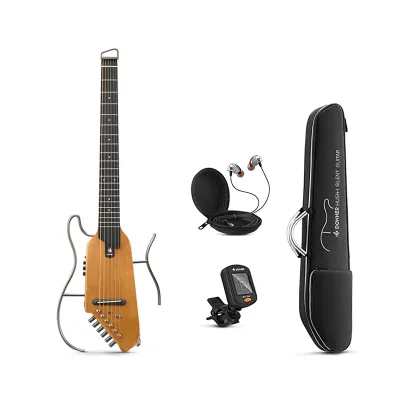
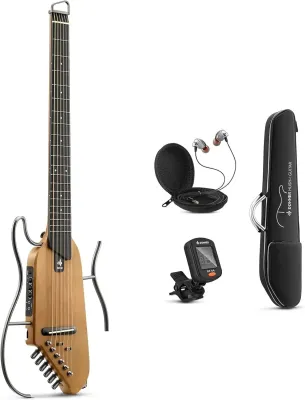
![Donner HUSH-I SE Acoustic Electric Travel Guitar Silent Package Steel Strings HUSH I [LIMITED STOCK]Fast shipping](https://img.lazcdn.com/g/p/f1cb560c68fa6201c90bd175367b2f53.png_400x400q80.png_.webp)
![Donner HUSH-X Headless Compact Travel Electric Guitar Package Steel Strings HUSH X Series [LIMITED STOCK]](https://img.lazcdn.com/g/p/eeea33a57f0b3c1c02db5571ea2a856b.jpg_400x400q80.jpg_.webp)
Prices are valid at publication and may change. Please refer to the product page for the latest price.

Electronics and connectivity are the lifeblood of any silent instrument. Look closely at the control panel on the side of the body to confirm the available input and output options. A standard setup should include a 3.5mm headphone output for private listening, a 6.35mm main output jack for connecting to external amplifiers, and a 3.5mm auxiliary input. This auxiliary input is crucial for beginners, as it allows you to plug in a smartphone or media player to play along with backing tracks or metronome apps directly through your headphones.
Power requirements are another critical factor to check before finalizing your purchase. Some editions of this guitar run on a standard 9V block battery, while other variations may feature an integrated rechargeable lithium-ion battery. You should consult the manufacturer’s product sheet for the specific model version you are buying to verify the expected battery life and charging method. If the unit uses a rechargeable system, check whether it charges via a standard USB-C port, which offers excellent convenience when using common phone chargers or portable power banks.
Playability and Sound Experience for Beginners
For someone learning the guitar, the physical feel of the neck and fretboard is just as important as the sound. Many travel and silent guitars feature unique neck shapes designed to maximize stability while minimizing bulk. You should verify the neck profile—some models utilize an asymmetrical design that is thicker on one side to support the natural curvature of your hand. Ensure the fretboard material and fret edge finishing are smooth, as rough metal edges can make sliding up and down the neck uncomfortable during long practice sessions.
String action, which is the height of the strings above the frets, must be set correctly to prevent finger fatigue. Because silent guitars do not have a traditional hollow body to project sound, they rely entirely on an under-saddle piezo pickup to capture string vibrations. This means the physical setup can often be adjusted lower than a standard acoustic guitar without causing excessive fret buzz. Beginners should check if the guitar includes a dual-action truss rod, which allows you to adjust the neck relief if the strings begin to sit too high or too low.
When practicing with headphones, the audio quality depends heavily on the onboard preamp and any built-in effects. Check if the model you are looking at includes basic tone controls, such as high and low frequency adjustments, or built-in effects like reverb and chorus. These effects help simulate the natural acoustic space of a room, making the headphone signal sound less dry and more inspiring to play. Unplugged, the guitar produces only a very quiet, metallic whisper—similar to an electric guitar that is not plugged in—making it virtually silent to anyone standing more than a few meters away.
Practical Purchasing Considerations in Singapore
Buying a musical instrument in Singapore requires looking beyond the initial price tag to consider local logistics and environmental factors. When browsing local e-commerce platforms or official brand stores, always verify the seller’s credentials to ensure you are purchasing from an authorized dealer. This verification is essential for securing a valid local warranty, which protects you against manufacturing defects without the hassle and high cost of shipping the instrument back to an overseas service center for repairs.
Electrical compatibility is another detail that is easily overlooked when ordering online. If the guitar package includes an external wall adapter for charging or direct power, you must ensure it is compatible with Singapore’s 230V, 50Hz electrical grid. The adapter should feature a standard Type G three-pin plug or be compatible with certified local USB wall chargers. Using uncertified or incompatible power adapters can damage the sensitive internal preamp electronics of your silent guitar.
Singapore’s tropical climate, characterized by consistently high humidity levels often exceeding 80 percent, presents unique challenges for wooden instruments. While the minimalist frame of a silent guitar has less wood to warp than a full-sized acoustic, the neck remains susceptible to humidity-induced bending. When purchasing, check if the package includes a protective gig bag that can accommodate small desiccant packets. Storing your guitar in an air-conditioned room or using a simple dehumidifier nearby will help maintain stable string action and prevent the neck from bowing over time.
Decision Framework: Evaluating Your First Silent Guitar
To determine if this instrument is the right investment for your musical journey, it helps to use a structured decision framework. Start by comparing your total budget against the cost of the guitar and any necessary accessories. Remember that a silent guitar requires a decent pair of headphones to sound its best, so you should factor that cost into your overall calculation. Compare the specifications of the Donner Hush against other entry-level travel or silent options using this checklist:
- Portability: Does the instrument feature a fully detachable frame, and does it fit within standard airline carry-on dimensions?
- Silent Functionality: Is there a dedicated headphone preamp built directly into the body, or will you need to purchase an external headphone amplifier?
- Connectivity: Does the control panel include an auxiliary input for playing along with external audio sources?
- Climate Resilience: Is the neck reinforced with an adjustable truss rod to handle local humidity changes?
- Power Source: Does the battery type align with your preferences for either quick replacement or USB recharging?
By systematically checking these points against the manufacturer’s official specifications, you can avoid common purchasing pitfalls. If your primary constraints are limited space, strict noise boundaries in your living area, and a desire to travel with your instrument, a silent guitar of this caliber offers a highly practical and cost-effective solution for your first stringed companion.
Frequently Asked Questions (FAQ)
Can I use standard acoustic guitar strings on a silent guitar?
Yes, but you must match the strings to the specific design of your guitar model. Silent guitars are typically built and braced for either steel strings or nylon strings, and these two types are not interchangeable. Installing high-tension steel strings on a neck designed for nylon strings can cause severe, irreversible warping. Always consult the manufacturer’s specifications to verify the correct string material and recommended gauge to ensure optimal tension and protect the under-saddle piezo pickup from uneven pressure.
Do I need a special amplifier to play the Donner Hush out loud?
No, you do not need a highly specialized amplifier, but you should use one designed for acoustic instruments or a flat-response PA system. Standard electric guitar amplifiers are voiced to color the sound of magnetic pickups and may make a piezo-equipped silent guitar sound harsh or unnatural. To play out loud, simply connect a standard 6.35mm instrument cable from the guitar’s main output jack to the input of an acoustic amplifier, a portable personal PA speaker, or an audio interface connected to your computer.
Community discussion
Share your experience or ask a question. Comments are reviewed before publication.