
Choosing your first electric guitar stand is just as important as selecting your first amplifier or cable. The right stand keeps your instrument safe, accessible, and ready to play, while an unsuitable choice can lead to accidental falls, finish damage, or a cluttered living space. For most beginners, the decision comes down to three primary form factors: the compact A-frame, the highly portable X-frame, and the space-saving wall mount. Your choice should depend on your daily routine, the layout of your home, and how often you plan to travel with your instrument.
If you have a dedicated practice corner in a bedroom or living room where floor space is limited but available, an A-frame stand is often the most practical choice. Its low profile keeps the guitar stable and within arm’s reach without dominating the room.
For beginners who need to transport their gear to weekly music lessons, band rehearsals, or different rooms in the house, an X-frame stand offers the necessary portability. These stands fold down quickly, making them easy to pack into a car boot or carry alongside a gig bag.
Products mentioned in this guide



Prices are valid at publication and may change. Please refer to the product page for the latest price.
If you are dealing with zero available floor space or want to keep your guitar completely out of reach of curious pets and toddlers, a wall mount is an ideal solution. It transforms your instrument into a piece of wall art while keeping the floor completely clear.
However, if you anticipate expanding your collection quickly or need to swap between multiple guitars during a practice session, none of these single-stand options may fit perfectly. In those scenarios, a multi-stand rack is a more secure and organized alternative to buying several individual stands.
A-Frame Stands: Stability in a Compact Footprint
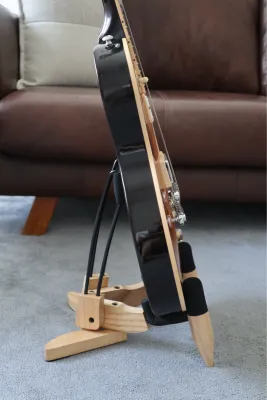
A-frame stands are named for their distinct triangular shape when viewed from the side. This design typically features two short front legs that support the base of the guitar body and a single rear leg that tilts backward to establish a low, stable center of gravity. Because the instrument sits low to the ground, the risk of the stand tipping over from a light bump is significantly reduced compared to taller designs. This low-slung profile makes them exceptionally sturdy for standard-shaped electric guitars.
These stands are highly suited for compact living environments, such as HDB flats or cozy study rooms in Singapore, where every square meter of floor space matters. An A-frame stand can easily tuck into a small corner, slide slightly under a desk, or sit parallel to a wardrobe. Because they lack a tall neck support column, they do not block sightlines, helping a small room feel less cluttered while keeping your guitar visually inviting.
Despite their stability, A-frame stands do have notable limitations. Because they support the guitar from the bottom of the body and lean the back of the body against a low rear pad, they are less adjustable for non-traditional or offset guitar shapes, such as Flying V or Explorer designs. Additionally, while some models fold relatively flat, they generally remain wider and more awkward to pack into a backpack or carry on public transport compared to fully collapsible travel stands.
Before committing to an A-frame, always perform a safety check on the contact padding. The foam or rubber lining on the base cradles and the rear backrest must be in pristine condition. Over time, degraded padding can expose raw metal edges that can easily scratch your guitar’s body or react chemically with the instrument’s finish.
X-Frame Stands: Portability and Universal Fit
X-frame stands, often referred to as tubular cross stands, utilize a familiar scissor-like folding mechanism. They feature a tall vertical neck support column connected to a crossing base frame that can be adjusted in width and height. This design allows the stand to accommodate a wide variety of instrument shapes and sizes, holding the guitar securely at both the base of the body and high up on the neck.

This folding capability makes the X-frame the go-to option for beginners who do not confine their practice to a single room. If you regularly travel to a tutor’s studio, jam at a friend’s house, or simply want to pack your stand away in a closet when guests visit, the X-frame collapses into a neat, linear shape. It is lightweight and highly convenient for carrying alongside your gig bag on the MRT or bus.
However, the versatility of the X-frame comes with trade-offs in terms of physical footprint and stability. When fully deployed, the crossing legs require a wider area of floor space than an A-frame, which can make a small bedroom feel cramped. The front crossbar can also present a tripping hazard in high-traffic areas. Furthermore, because the stand is taller and has a higher center of gravity, it is inherently more susceptible to tipping over if accidentally bumped from the side.
To ensure safety when using an X-frame stand, always verify that the locking pin, adjustment clutch, or safety strap is fully engaged before placing your guitar on it. A loose adjustment mechanism can cause the stand to collapse under the weight of the instrument, leading to costly repairs.
Wall Mounts: Zero Floor Space and Visual Display
Wall mounts are specialized hangers that secure directly to a vertical wall surface, suspending the guitar by its headstock. This installation requires a permanent commitment, involving drilling into the wall and using appropriate hardware. In Singapore, where most residential walls are made of solid concrete or brick, you will need a masonry drill bit and high-quality wall plugs. If you are installing on drywall or partition walls, finding a timber stud or using heavy-duty toggle anchors is essential to prevent the mount from pulling out of the wall.
For beginners living in tight quarters, wall mounts are highly practical because they require absolutely zero floor space. They keep your guitar safe from vacuum cleaners, rolling office chairs, playful pets, and toddlers. Beyond the practical benefits, wall mounts turn your electric guitar into a striking visual centerpiece, serving as a constant reminder and motivation to pick up the instrument and practice.
The primary drawback of a wall mount is its lack of flexibility. Once drilled and mounted, you cannot easily rearrange your room layout without leaving visible holes that require patching and painting. Additionally, because the entire weight of the guitar hangs from the headstock, the setup relies heavily on the structural integrity of both the mount and the guitar’s neck joint.
When installing a wall mount, always verify the manufacturer’s maximum weight rating to ensure it can support your specific electric guitar, as some solid-body models can be surprisingly heavy. Ensure the hanger’s cradle is wide enough to support the headstock evenly, preventing the guitar from slipping through or putting uneven lateral stress on the neck.
Critical Features to Verify Before Purchasing
When shopping for an electric guitar stand, look beyond the basic shape and focus on the materials and construction details that protect your investment. The first and most critical feature to verify is finish safety. Many electric guitars, particularly vintage-reissue models or those with premium finishes, use a nitrocellulose lacquer. Standard rubber or plastic padding can chemically react with nitrocellulose, causing the finish to melt, discolor, or become sticky. Look for stands explicitly labeled as “nitro-safe” or “lacquer-safe,” or consider draping a clean cotton cloth over the contact points as a protective barrier.
Next, evaluate the neck support and cradle design. A good stand should feature a secure closure mechanism, such as a rubber strap or a gravity-activated auto-grip gate, to prevent the neck from sliding out if the stand is bumped. The cradle should be lined with soft, non-abrasive material and shaped to prevent the guitar from twisting or shifting sideways.
Base stability is another non-negotiable factor. Look for stands with a wide, reassuring footprint and non-slip rubber feet that grip the floor securely. Weighted bases or lower crossbars add ballast, keeping the center of gravity as low as possible to resist tipping.
Finally, inspect the overall build quality of the stand. Check the welded joints for smooth finishes and ensure there are no exposed metal edges, loose screws, or sharp plastic molding lines. Adjustable clamps and hinges should operate smoothly and lock tightly without slipping under pressure. Investing in a well-constructed stand prevents mechanical failures that could drop your guitar.
Frequently Asked Questions (FAQ)
Can leaving a guitar on a stand damage the neck?
Standard, well-designed guitar stands do not apply enough localized pressure to warp or damage a guitar’s neck. The tension exerted by the guitar strings themselves is far greater than any force applied by a resting cradle. However, real damage can occur if the guitar is subjected to extreme environmental changes. In Singapore’s tropical climate, leaving a guitar on a stand near an open window exposed to direct sunlight, or directly under an air conditioning vent, can cause rapid temperature and humidity fluctuations. These fluctuations can warp the wood and affect the neck relief. To keep your instrument in optimal condition, place your stand in a stable, climate-controlled area of the room and perform routine neck relief checks as outlined in your guitar manufacturer’s care guide.
Are A-frame or X-frame stands safe for acoustic and bass guitars?
Most standard A-frame and X-frame stands are designed with a degree of universal compatibility, meaning they can physically hold acoustic and bass guitars. However, because acoustic guitars have much deeper bodies and bass guitars are significantly longer and heavier, you must verify the stand’s specific dimensions and weight limits. An acoustic guitar may not sit securely in a narrow electric guitar cradle, while a heavy bass guitar could make a lightweight X-frame top-heavy and unstable. Always check the manufacturer’s specifications for maximum weight capacity and cradle width before sharing a stand between different instrument types.
How do I clean and maintain the rubber padding on my stand?
Over time, the protective rubber or foam padding on your stand can accumulate dust, sweat, and oils from your hands and the guitar’s finish. To clean the padding, wipe it down gently with a soft microfiber cloth slightly dampened with warm water and a drop of mild dish soap. Avoid using harsh chemical solvents, alcohol, or aerosol polishes, as these substances can rapidly degrade, dry out, or melt the rubber, rendering it unsafe for your guitar’s finish. Regularly inspect the padding for signs of cracking, hardening, or stickiness, and replace either the padding or the entire stand if you notice any deterioration.

Community discussion
Share your experience or ask a question. Comments are reviewed before publication.