
Finding the right classical guitar as a beginner in Singapore is a highly personal journey. While many online guides point to a single “best” brand, the truth is that the ideal instrument depends on your physical comfort, your budget, and the local support available to you. A classical guitar is uniquely suited for beginners due to its nylon strings, which are much softer on inexperienced fingertips than the steel strings found on acoustic or electric guitars. However, classical guitars also feature wider necks and flat fretboards, which require a different physical approach. To make a successful purchase, you need a clear decision framework that balances physical fit, climate resilience for Singapore’s tropical environment, and reliable local after-sales support.
Key Factors for Beginners Choosing a Classical Guitar
Before looking at specific brand names, you must understand the physical and structural specifications that determine whether a classical guitar will help or hinder your learning progress. The physical dimensions of the instrument directly impact your playing posture and hand comfort.
Standard classical guitars typically feature a nut width of 52mm and a scale length of 650mm. The nut width refers to the width of the fretboard where it meets the headstock, while the scale length is the distance between the nut and the bridge. This wide spacing is intentional, as it provides ample room for complex fingerstyle playing and prevents adjacent strings from buzzing against your fingers. However, for players with smaller hands, younger students, or those transitioning from steel-string guitars, this wide grip can feel intimidating. If you find the standard dimensions uncomfortable during a physical trial, look for brands that offer “crossover” or “hybrid” models, which often feature a narrower nut width of 48mm to 50mm and a slightly curved fretboard.
Products mentioned in this guide
![Suzuki SCG-2S 3/4 Classical Guitar [Assorted Colors]](https://img.lazcdn.com/g/p/32be7b10f4c0caf0d36362f0136460f1.jpg_400x400q80.jpg_.webp)


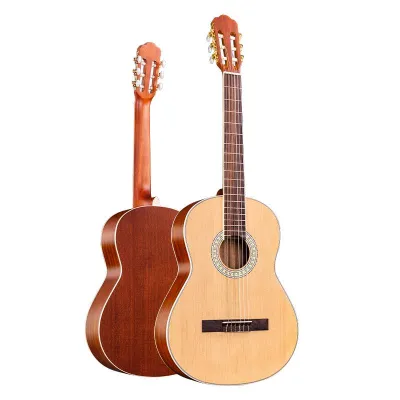
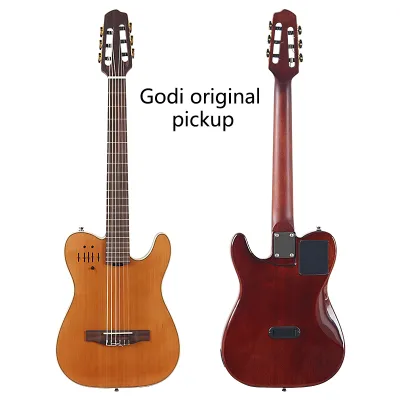

Prices are valid at publication and may change. Please refer to the product page for the latest price.
Another critical decision point is the construction of the guitar’s top wood, also known as the soundboard. The top wood is responsible for producing the instrument’s primary tone and projection. Entry-level classical guitars generally fall into two categories: laminate tops and solid tops. Laminate tops are constructed from multiple thin layers of wood glued together. While they do not offer the rich resonance or tonal depth of solid wood, they are incredibly durable, highly resistant to cracking, and less sensitive to environmental changes. Solid tops, usually made of spruce or cedar, consist of a single piece of seasoned timber. Solid spruce offers a bright, clear, and articulate tone that projects well, while solid cedar provides a warmer, darker, and more immediate response. Solid wood tops also undergo an “opening up” process, meaning their sound quality improves and matures the more the instrument is played.
Action and setup are equally vital to initial playability. “Action” refers to the height of the strings above the fretboard. Because nylon strings have lower tension than steel strings, they vibrate in a wider arc and require a slightly higher action to prevent fret buzz. However, if the factory action is set too high, you will have to exert excessive finger pressure to fret notes clearly, leading to rapid hand fatigue and soreness. A well-constructed beginner guitar should have a comfortable factory setup, but it is always beneficial to buy from a retailer that can perform custom adjustments to lower the action if needed.
Aligning your expectations with your budget will help narrow down your options in the Singapore market. Entry-level classical guitars generally fall into three distinct price tiers:
- Under S$200: These instruments are almost exclusively made of laminate woods. They are highly durable and budget-friendly, making them excellent for testing your interest without a significant financial commitment. Focus on finding a model with reliable tuning stability and smooth fret edges in this tier.
- S$200 to S$500: This is the sweet spot for serious beginners. In this range, you will find guitars featuring a solid spruce or cedar top paired with laminate back and sides. These instruments offer a noticeable upgrade in tone and dynamic range while remaining relatively easy to maintain.
- S$500 to S$800: Guitars in this tier feature superior hardware, more refined craftsmanship, and higher-grade solid tops. Some models may even feature solid back and sides, offering professional-level tone and projection that will support your learning journey well into intermediate and advanced levels.
Evaluating Brands for the Singapore Market
When assessing classical guitar brands, you must look beyond global marketing campaigns and evaluate how these instruments perform within Singapore’s specific retail and environmental landscape.

Singapore’s tropical climate presents a unique challenge for wooden musical instruments. The island experiences high relative humidity, often hovering around 80% or higher, alongside consistent warmth. Wood is a natural, hygroscopic material that absorbs moisture from the air, causing it to expand. In a classical guitar, excessive humidity can cause the soundboard to swell or “belly up,” which raises the string action and makes the instrument difficult to play. In extreme cases, high humidity can weaken the water-soluble glues used in traditional construction, leading to bridge separation or loose internal bracing. When evaluating brands, look for manufacturers known for using modern, moisture-resistant adhesives and stable, multi-layered laminate woods for the back and sides, which provide structural reinforcement against humidity fluctuations.
Buying from authorized local distributors in Singapore is highly recommended over purchasing from unverified online marketplaces or parallel importers. Authorized dealers store their inventory in climate-controlled environments, ensuring the wood has not been subjected to extreme humidity cycles before reaching your hands. Furthermore, local dealers provide valid manufacturer warranties, which are essential if your guitar develops structural issues like a warped neck or a lifting bridge due to local climate conditions. A physical store also allows you to take advantage of in-house luthier services for initial setups, string changes, and seasonal maintenance.
Brand transparency is another factor to consider. When browsing specifications, read the labels carefully to avoid misleading marketing terms. Some brands use phrases like “spruce top” or “cabernet finish” to describe laminate woods. A reputable brand will clearly state “Solid Spruce” or “Solid Cedar” if the top is solid wood. If the specification sheet simply says “Spruce” or “Mahogany” without the word “Solid,” you should assume the component is made of laminate wood. Transparent brands also provide detailed information regarding the neck material, fretboard wood, and the type of finish used, allowing you to make an informed comparison.
Building Your Shortlist: In-Store Inspection Checklist
Once you have identified a few candidate brands available at local music stores, the final step is to visit the shops and physically inspect the instruments. Do not rely solely on aesthetics; use this practical checklist to evaluate the structural integrity and playability of each guitar.
First, conduct a thorough visual and structural inspection of the guitar’s body and neck. Hold the guitar up to the light and look closely at the neck joint, which is where the neck connects to the body. There should be no visible gaps, hairline cracks, or dried glue residue along this seam. Next, run your hand gently up and down the sides of the neck. The metal fret ends should feel smooth and flush with the wood. If the fret ends feel sharp or scratchy, it indicates that the wood of the fretboard has shrunk, or that the frets were poorly finished at the factory. Finally, examine the bridge where it is glued to the soundboard. Try to slide a thin piece of paper under the back edge of the bridge; if the paper slips underneath, the bridge is beginning to lift, and you should reject that specific instrument.
Second, test the tuning stability and hardware. Turn each machine head (tuning peg) slowly. The gears should rotate smoothly and consistently without catching, grinding, or feeling excessively loose. Nylon strings naturally stretch and take several days to settle into stable tuning when new, but the tuning pegs themselves must hold their position firmly under tension. Check the nut slots where the strings pass over to the headstock; the strings should sit snugly in their slots without binding or pinching, which can cause sudden jumps in pitch when tuning.
Third, perform a basic sound and playability test, even if you do not yet know how to play. Sit in a comfortable classical posture, resting the guitar on your left thigh (if you are right-handed) with your left foot slightly elevated. Pluck each string individually, starting from the low E string up to the high E string, at every single fret along the neck. Listen closely for any buzzing sounds, which indicate that a fret is uneven or that the action is too low. Pay attention to the volume and sustain of the notes; the sound should decay gradually and naturally rather than cutting off abruptly. Play an open chord or ask a store assistant to play a simple progression for you so you can stand a few paces away and evaluate the projection. The bass notes should sound warm and full without muddying the clear, singing qualities of the treble strings.
Frequently Asked Questions (FAQ)
Do I need a solid top classical guitar as a beginner?
You do not strictly need a solid top classical guitar to begin learning, but it is highly recommended if your budget allows. A solid top offers superior resonance, volume, and tonal warmth, which can make your practice sessions more rewarding and encourage you to play more often. However, if you are on a tight budget or cannot commit to maintaining a solid wood instrument in Singapore’s humid climate, a high-quality laminate top is a practical and durable alternative. Laminate tops are much less susceptible to cracking or warping and will easily withstand the rigors of daily practice and travel.
How does Singapore's humidity affect my classical guitar?
Singapore’s high relative humidity causes the natural wood fibers of a classical guitar to absorb moisture and swell. This swelling typically manifests as a bulging soundboard, which raises the saddle and increases the string action, making the guitar significantly harder to play. Over time, excessive moisture can also soften the internal glues, leading to structural failures like loose braces or a lifting bridge. To protect your investment, store your guitar in its case when not in use, preferably with a few silica gel packs or a specialized instrument dehumidifier pouch. Avoid storing the guitar in direct sunlight, near open windows, or directly under air conditioning vents, as rapid temperature and humidity fluctuations can stress the wood.
Should I buy a 3/4 size or full-size classical guitar?
The correct size depends entirely on the player’s physical proportions, specifically height and hand span. A standard full-size (4/4) classical guitar is designed for adults and teenagers taller than 150cm. If you are buying for a child, or if you have smaller hands and find the 650mm scale length too physically demanding, a 3/4 size or 7/8 size guitar is an excellent choice. A 3/4 size guitar typically features a scale length of around 580mm to 610mm, making it much easier to reach wide chord shapes without straining your wrist or fingers. Choosing an instrument that fits your body comfortably is essential for developing proper classical technique and preventing repetitive strain injuries.

Community discussion
Share your experience or ask a question. Comments are reviewed before publication.