
Selecting the right tambourine for a child involves matching the instrument’s physical dimensions to their hand size, grip strength, and developmental stage. Rather than relying solely on age labels, parents should evaluate specific features like diameter, weight, jingle configuration, and grip design to ensure the instrument is comfortable, safe, and encouraging for young musicians. A tambourine that is too heavy or wide can quickly lead to fatigue and frustration, while a well-fitted instrument fosters a love for rhythm and active musical play.
When shopping for a young percussionist, understanding how these physical characteristics interact with a child’s growing body is key. From lightweight plastic jingle rings for toddlers to traditional wooden models for older children, the market offers a wide variety of options. By taking a few simple measurements and observing your child’s natural grip, you can select an instrument that supports their musical journey without causing physical strain.
Assessing Your Child's Hand Size and Grip Strength
Before browsing musical instruments, take a moment to evaluate your child’s physical readiness. A simple way to start is by measuring their palm width and finger span. Use a soft measuring tape to measure across the widest part of their palm, excluding the thumb. This measurement gives you a baseline for the maximum frame depth or handle thickness the child can comfortably grasp.
Products mentioned in this guide
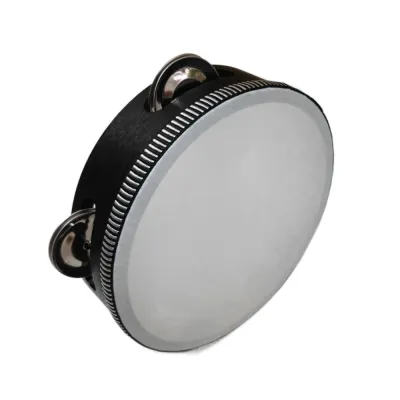
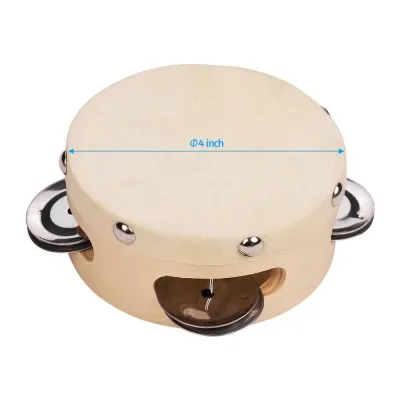
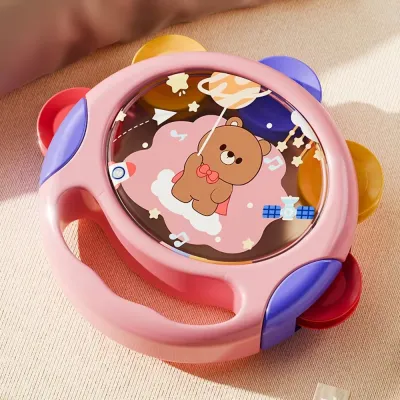
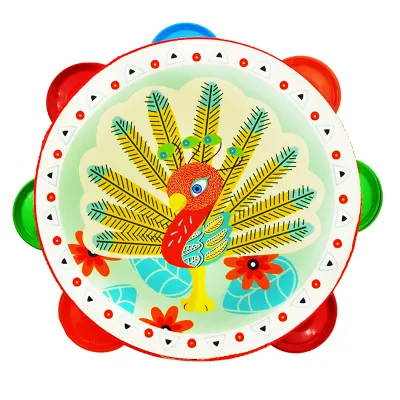
Prices are valid at publication and may change. Please refer to the product page for the latest price.
Next, observe your child’s finger span by asking them to stretch their hand flat on a piece of paper. Mark the distance from the tip of the thumb to the tip of the pinky finger. If this span is less than 12 centimeters, the child will struggle to hold a standard circular tambourine frame securely with one hand. For these smaller hands, a crescent-shaped jingle ring with a central handle is often a much more manageable choice.
Grip endurance and wrist strength are equally important to observe during active play. Watch how your child handles everyday objects like a full water bottle or a thick toy mallet. If you notice their wrist drooping, or if they frequently switch hands or drop objects after a minute or two of play, they will likely experience rapid fatigue with a heavy wooden tambourine.
Keep in mind the general developmental milestones for fine motor skills. Toddlers between ages 1 and 3 primarily use a palmar grasp, wrapping their entire fist around an object. Children aged 4 to 6 begin to develop a digital grasp, allowing them to use their fingers more precisely to hold and manipulate objects. By age 7, most children have developed the wrist rotation and finger strength required to play a standard tambourine using traditional striking and shaking techniques.
Matching Tambourine Diameter and Weight to Age
When looking at product specifications, it is common to see manufacturer age recommendations like “3+” or “6+”. While these labels are crucial for identifying potential choking hazards, they do not always reflect the ergonomic suitability of the instrument. A tambourine labeled for ages three and up might still be too heavy or wide for a petite child, making it essential to compare the actual dimensions against your child’s measurements.

The overall weight of the instrument has a direct impact on how long a child can play before experiencing muscle strain. For toddlers and preschool-aged children, look for lightweight instruments weighing under 150 grams. As children grow and develop stronger forearm muscles, they can gradually transition to medium-weight models between 150 and 250 grams. Standard wooden tambourines, which often weigh 300 grams or more, should generally be reserved for older primary school children who have the wrist stability to support them.
To ensure a successful purchase, use this quick checklist to verify product dimensions and weight limits:
- Check the product description for the exact outer diameter, keeping in mind that 4-inch to 6-inch models are best for toddlers, while 8-inch models suit older children.
- Verify the net weight of the instrument rather than the shipping weight to get an accurate idea of the physical load.
- Ensure the frame thickness or handle diameter does not exceed the child's comfortable grip capacity, which is typically around 2 to 3 centimeters for younger players.
Evaluating Jingle Count and Material for Sound and Safety
The sound of a tambourine is produced by its jingles, also known as zills. When choosing an instrument, you must balance the desired volume and tone with the physical weight of the jingles. Single-row tambourines feature a single layer of metal discs spaced around the frame, making them lightweight and producing a bright, crisp sound. Double-row models feature two stacked layers of jingles, which significantly increases the volume and adds noticeable weight to the frame. For home use, especially in smaller living spaces or apartments, a single-row tambourine is usually the preferred choice to keep noise levels comfortable.
The frame material also plays a major role in durability and weight. Molded plastic frames are highly durable, impact-resistant, and easy to wipe clean, making them ideal for younger children and outdoor play. Wooden frames offer a classic look and a warmer, more resonant sound, but they are more susceptible to damage if dropped on hard surfaces. In humid climates, wooden frames can also warp or absorb moisture over time, whereas plastic frames remain completely unaffected.
Safety should always be your top priority when inspecting a children’s musical instrument. Before allowing your child to play, run your fingers along the edges of the metal jingles to ensure they are completely smooth and free of sharp burrs. Check the pins, rivets, or screws that hold the jingles in place; they must be securely fastened and recessed so they cannot work loose during vigorous shaking, which could present a choking hazard or pinch small fingers.
Checking Grip Design and Ergonomics
A tambourine’s grip design determines how easily a child can control the instrument during play. Traditional circular tambourines are held by gripping the outer rim, which sometimes features a small thumb hole cut into the frame. While this design works well for older children and adults, younger players often find it difficult to maintain a secure hold on a wide, smooth frame.
For toddlers and younger primary school children, a crescent-shaped or open-ring design with a dedicated handle is highly beneficial. These ergonomic handles are positioned close to the center of gravity, making the instrument feel lighter and more balanced in the hand. Look for grips that feature contoured finger grooves or non-slip rubberized textures, which help prevent the tambourine from slipping out of sweaty hands during energetic play sessions.
Before committing to an instrument, you can perform a simple practical trial to test the grip angle and balance:
- Have your child hold the tambourine in their non-dominant hand and shake it back and forth for 30 seconds.
- Observe whether their wrist remains straight and aligned with their forearm, or if it bends awkwardly to support the weight.
- Check that their fingers can wrap fully around the handle without overlapping excessively or straining to reach.
- Ensure the instrument does not feel top-heavy, which can cause the wrist to twist and lead to discomfort.
Frequently Asked Questions (FAQ)
At what age can a child start playing the tambourine?
Children can begin exploring simple, lightweight jingle toys as early as 12 months, provided the instrument is specifically designed for infants with no small, detachable parts. Structured rhythmic play and standard tambourine use typically start around age 3, when children develop the bilateral coordination needed to hold the instrument in one hand and strike it with the other. Always supervise young children during play to ensure they do not attempt to chew on the metal jingles or loosen the fasteners.
Should I choose a tambourine with a drumhead or a jingle ring?
A headless tambourine, or jingle ring, is lighter, easier to grip, and focuses entirely on the bright sound of the metal discs, making it an excellent choice for shaking along to music. A tambourine with a drumhead (made of synthetic plastic or natural skin) adds a striking surface, allowing the child to learn both shaking and hand-striking techniques. For children, synthetic drumheads are generally preferred over natural skin because they are highly durable, easy to clean, and do not lose tension in humid environments.
Community discussion
Share your experience or ask a question. Comments are reviewed before publication.