
Quick Answer: The Core Specs That Dictate Your Choice
Selecting a reliable music stand foldable model is a balancing act between physical stability and transport convenience. To ensure your sheet music remains secure and legible throughout a performance, you must prioritize three critical specifications: weight capacity, height range, and folded dimensions. Reading the manufacturer’s spec sheet correctly prevents the common frustration of purchasing a stand that is either too flimsy to support a heavy binder or too bulky to fit into your transit bag. Whether you are practicing in a compact HDB flat or commuting to rehearsals across Singapore, matching these technical metrics to your specific performance environment is the key to a stress-free setup.
Weight Capacity and Tray Design: Securing Your Sheet Music
A music stand’s primary duty is to hold your notation steady, but different formats of music demand vastly different levels of structural support. If you primarily read from single loose sheets or lightweight pamphlets, a basic wire frame is often sufficient. However, if your repertoire relies on heavy bound method books, thick anthology volumes, or modern digital tablets, a standard wire stand can easily buckle or tilt unexpectedly. Before purchasing, check the manufacturer’s official product label or manual for the maximum weight limit, rather than making assumptions based on visual appearance alone.

The physical dimensions of the tray lip are equally vital for keeping your materials in place. Lip depth determines how thick of a book or binder the stand can accommodate; a shallow lip of less than 2 centimeters will cause thick pages to spring closed or slide off entirely. For heavy anthologies or tablets in protective cases, look for a tray lip depth of at least 4 to 5 centimeters. Additionally, verify the tray’s width and overall backplate design. A solid metal or plastic backplate provides continuous support for loose sheets, whereas open wire designs allow individual pages to slip through the gaps.
Products mentioned in this guide
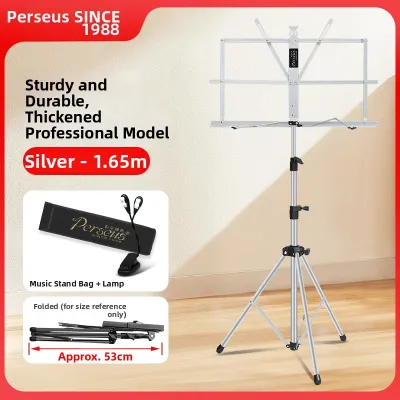
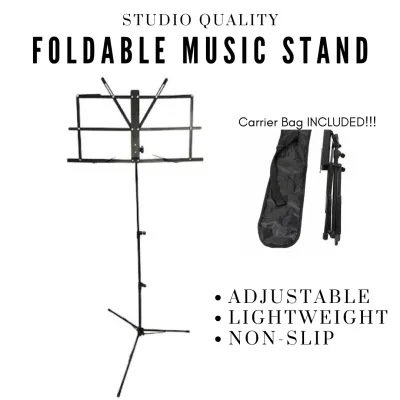
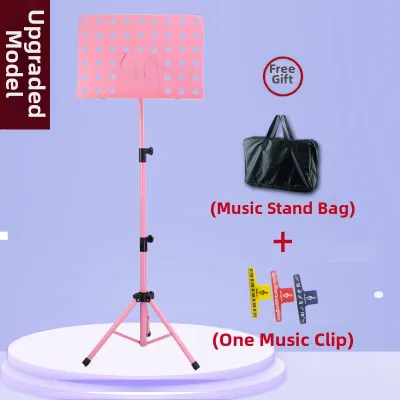

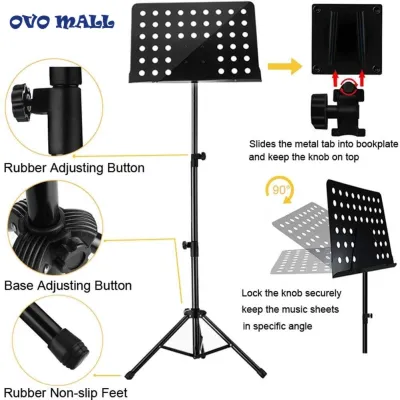
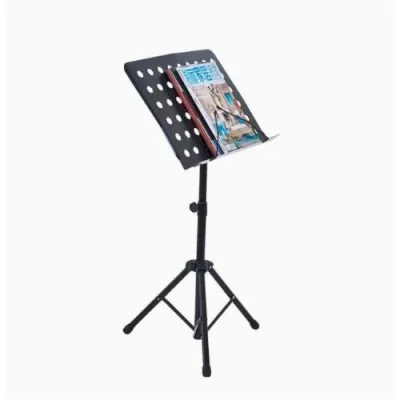
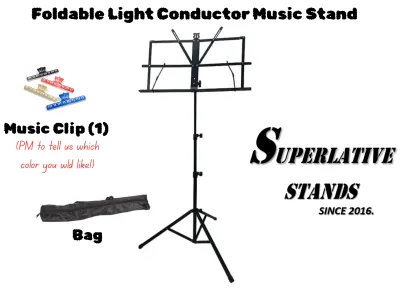
Prices are valid at publication and may change. Please refer to the product page for the latest price.
You must also evaluate the tray tilt mechanism, which controls the viewing angle of your music. Look for robust locking joints—such as friction-tilt collars or geared teeth—that can handle off-center weight. When a tray is set to an extreme angle, the center of gravity shifts dramatically. If the adjustment mechanism is weak, the weight of a heavy binder or a digital tablet will cause the tray to slip downward, potentially dropping your expensive gear or disrupting your performance mid-song.
Height Range and Adjustability: Matching Your Playing Posture
An ergonomic setup is essential for preventing neck strain and maintaining proper playing posture, whether you perform seated or standing. To determine your ideal height range, measure the distance from the floor to your eye level while holding your instrument in your standard playing position. Your sheet music should sit just below eye level so you can easily glance between the notes and your instrument or conductor. Compare this personal measurement against the manufacturer’s minimum and maximum height specifications to ensure a comfortable fit.
Most portable music stands utilize telescopic shafts secured by either twist-lock collars or push-button clutch mechanisms. Twist knobs are highly adjustable and allow for precise height tuning, but they require physical strength to tighten securely and can wear down over time. Push-button clutches offer rapid adjustment to preset heights, which is highly convenient for quick transitions but limits fine-tuning. Whichever mechanism you choose, ensure the locking collars are made of durable materials that will not crack under repeated tightening.
It is important to note that a stand extended to its absolute maximum height limit is inherently less stable than one operating within its mid-range. When the telescopic segments are fully extended, the overall center of gravity rises, making the stand highly susceptible to wobbling or tipping from minor bumps. To maintain structural integrity, select a stand whose comfortable working height sits at least 10 to 15 centimeters below its maximum specified limit.
Folded Dimensions and Portability: Fitting Your Music Stand Foldable into a Gig Bag
For gigging musicians, music teachers, and students commuting to rehearsals, portability is just as important as stability. The folded length and overall diameter of the collapsed stand dictate how easily it will fit into a standard instrument case pocket, a backpack, or a dedicated gig bag. If you rely on public transport to travel to rehearsals in Singapore, a stand that collapses down to under 50 centimeters is highly desirable, as it can be easily stowed alongside your instrument without adding awkward bulk.
However, achieving ultra-compact folded dimensions often requires engineering trade-offs. Manufacturers frequently use thinner, lighter tubing and multi-segmented shafts to allow a stand to fold down to a fraction of its extended size. While highly portable, these multi-jointed designs introduce more potential failure points and generally offer less rigidity than stands with fewer telescoping sections. You must decide whether the ease of carrying a pocket-sized stand outweighs the rock-solid stability of a slightly longer, two-section model.
The base footprint of the stand when fully deployed is another critical dimension to analyze. A wider leg spread creates a larger, more stable base that resists tipping, but it also occupies significant floor space. In tight environments, such as crowded orchestra pits, small practice studios, or cozy church stages, a massive tripod footprint can become a tripping hazard. Look for a stand that offers adjustable leg angles, allowing you to widen the base for outdoor gigs or narrow it down when space is at a premium.
Material and Build Quality: Balancing Weight and Stability
The materials used in a stand’s construction directly impact its weight, durability, and resistance to environmental wear. Steel is the traditional choice for heavy-duty stands, offering exceptional rigidity and wind resistance, making it ideal for permanent studio use or outdoor performances. However, steel stands are heavy to carry and can rust over time if exposed to high humidity. Aluminum stands present a popular alternative, providing a highly favorable weight-to-rigidity ratio that is easy to transport while remaining naturally corrosion-resistant.
When evaluating build quality, do not rely on vague marketing terms like “heavy-duty” or “professional grade.” Instead, examine the actual net weight of the stand and the construction of its joints. High-quality stands feature metal hinges, rivets, and reinforcement plates at key stress points, whereas cheaper models often rely on thin plastic components that are prone to cracking under pressure. A slightly heavier net weight usually indicates thicker tubing walls and more robust hardware, which translates directly to a longer product lifespan.
Finally, pay close attention to the contact points at the base of the stand. High-quality non-slip rubber feet or durable plastic end caps are essential for protecting delicate hardwood floors from scratches. More importantly, these textured feet provide crucial traction on smooth surfaces, preventing the stand from slowly creeping away from you as you turn pages or play energetic passages.
Minor Specs You Can Safely Ignore
To simplify your buying decision, it is helpful to identify which specifications have little to no impact on real-world performance. First, avoid stands that require complex, multi-piece assembly or loose screws that must be detached every time you pack up. A well-designed foldable stand should feature a single-piece, integrated folding mechanism where all parts remain connected, minimizing the risk of losing vital components during a busy gig transition.
Aesthetic variations, such as the exact shade of the matte finish or the decorative shape of the adjustment knobs, are purely subjective and do not contribute to the structural integrity of the stand. While a sleek black finish is standard for professional orchestral settings, minor cosmetic differences will not affect how well the stand holds your music.
Additionally, be skeptical of proprietary accessory attachments, such as built-in cup holders, specialized smartphone mounts, or proprietary clip-on light fixtures. These integrated add-ons often add unnecessary weight and bulk to the stand’s frame. It is generally more practical to purchase universal, clamp-on accessories separately, which can be easily detached when transport space is limited and replaced if they wear out.
Frequently Asked Questions (FAQ)
Can I use a standard foldable stand for a heavy tablet or laptop?
Standard lightweight or wire foldable stands are generally not designed to support the weight and dimensions of a laptop or a heavy tablet. These devices require a solid, continuous backplate to prevent slipping through wire frames, as well as a deeper tray lip to accommodate the device’s thickness. Before placing any expensive digital device on a stand, check the manufacturer’s specified weight limit on the product label and ensure the tilt mechanism can be locked securely to prevent sudden slipping.
How do I prevent a lightweight foldable stand from tipping over?
To maximize the stability of a lightweight stand, always extend the tripod legs to their widest possible footprint. Position the tray so that it tilts slightly backward, which shifts the center of gravity directly over the center pole rather than leaning forward. Additionally, avoid placing your stand in high-traffic areas where it might be easily bumped, or directly in front of powerful air conditioning vents, as strong drafts can catch large binders and blow the stand over.
Community discussion
Share your experience or ask a question. Comments are reviewed before publication.