
Selecting a sudoku book specifically designed to enhance focus and mental agility requires moving past the generic, mass-produced puzzle pads found at local newsstands. True cognitive training relies on deliberate practice, which occurs when you engage with challenges that lie just beyond your current comfort zone. To achieve measurable improvements in concentration and working memory, a puzzle book must offer more than a random assortment of grids; it must serve as a structured training manual.
The ideal book for cognitive development features a systematic progression of difficulty, explicit instruction on advanced logical strategies, and a physical layout that supports sustained attention. By focusing on these structural elements, you can transform a casual pastime into a rigorous mental workout that actively builds new neural pathways.
Why Casual Puzzle Books Fall Short for Cognitive Training
Many puzzle enthusiasts fall into a common trap: they mistake the rapid completion of familiar puzzles for cognitive improvement. When you solve a standard sudoku puzzle using basic scanning techniques that you have practiced hundreds of times, your brain is not actually learning or adapting. Instead, it is relying on established cognitive shortcuts and heuristics. This passive pattern recognition feels satisfying because it is low-friction, but it does little to stimulate neuroplasticity or improve executive function.
Products mentioned in this guide

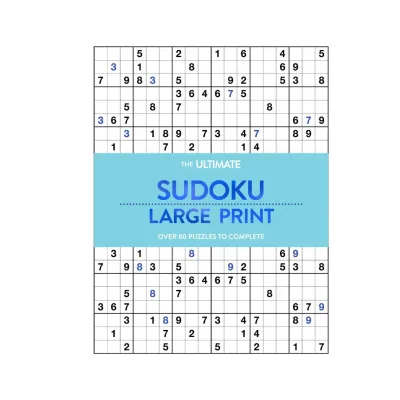
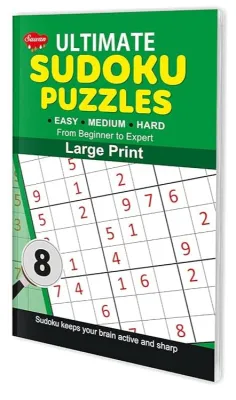
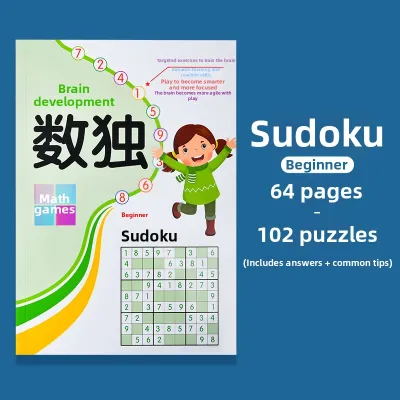
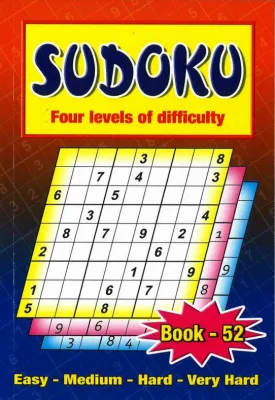
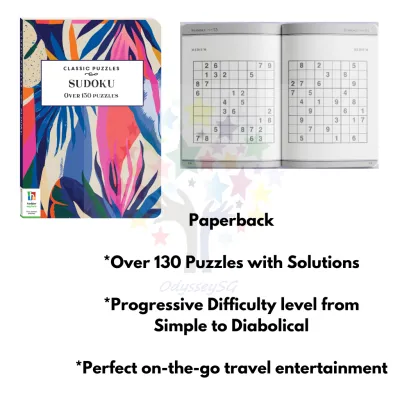
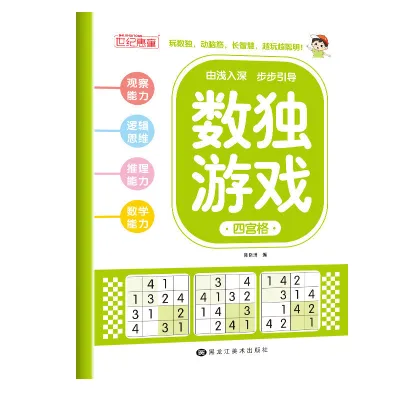
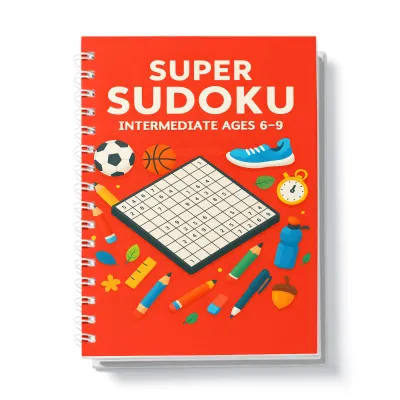
Prices are valid at publication and may change. Please refer to the product page for the latest price.
Mass-market puzzle compilations often exacerbate this issue by lacking a structured difficulty progression. These books are frequently assembled by automated software programs that generate grids with random distributions of starting numbers. Without careful curation, a book might place an incredibly easy puzzle right next to an excessively difficult one, or worse, maintain a flat level of difficulty throughout its entire run. This lack of structure leads directly to a cognitive plateau, where your brain is never pushed to adopt new problem-solving frameworks or expand its working memory capacity.
Furthermore, cheap compilations rarely provide the educational tools necessary to break through these plateaus. They typically present page after page of blank grids followed by a bare answer key at the back. Without explanations of the underlying logic required to solve complex configurations, readers are left to rely on trial and error or guessing. Guessing is the antithesis of cognitive training, as it replaces systematic logical deduction with random chance, failing to train the prefrontal cortex in structured decision-making.
Essential Features of Brain-Training Sudoku Books
To elevate your practice, you must seek out books that are intentionally designed for cognitive development. The first feature to verify is the inclusion of comprehensive instructional chapters. A high-quality training book does not assume you already know how to execute advanced solving techniques. It should actively teach strategies such as “X-Wing,” “Swordfish,” “XY-Wing,” and “forcing chains.” These techniques require you to hold multiple hypothetical scenarios in your mind simultaneously, which directly exercises and expands your working memory.

Another critical element is the presence of structured sections that isolate specific cognitive skills. For instance, some books feature puzzles designed to test spatial reasoning by grouping non-adjacent cells into irregular shapes, while others focus heavily on numerical relationships. By isolating these skills, you can target your specific cognitive weaknesses, much like an athlete performs targeted drills to improve overall athletic performance.
Finally, look for books that incorporate explicit cognitive constraints or training aids. This includes timed challenges that force you to maintain high concentration under pressure, or grids that require you to solve portions of the puzzle entirely in your head before writing down any numbers. Some advanced books even feature “blind” or “memory-based” exercises where certain clues disappear after a set period, forcing you to rely entirely on your internal mental map of the board. These features ensure that your brain remains actively engaged and prevented from slipping into autopilot.
Matching Sudoku Variants to Specific Mental Goals
Standard sudoku is excellent for foundational training, but introducing variants can stimulate different areas of the brain and prevent cognitive adaptation. If your primary goal is to enhance spatial reasoning and cognitive flexibility, look for books that feature Diagonal Sudoku (often called X-Sudoku) or Irregular Sudoku (also known as Jigsaw Sudoku). Diagonal Sudoku adds the constraint that the two main diagonals must also contain the numbers one through nine. This forces your eyes to scan the grid in unfamiliar patterns, breaking the habit of only looking horizontally and vertically. Irregular Sudoku replaces the standard three-by-three boxes with irregular, interlocking shapes, demanding a high level of visual-spatial processing to identify overlapping constraints.
For those looking to improve arithmetic working memory alongside logical deduction, Killer Sudoku is an exceptional choice. In this variant, the grid is divided into dotted regions called “cages,” each with a target sum. You must determine which combinations of unique numbers can add up to that sum while still adhering to standard sudoku rules. This constant mental arithmetic, combined with complex logical elimination, places a heavy load on your working memory, training you to manipulate multiple variables at once.
If sustaining prolonged concentration and practicing task-switching is your objective, Samurai Sudoku or other multi-grid formats are highly effective. Samurai Sudoku consists of five overlapping standard grids. Solving these requires you to manage overlapping regions where a number in one grid directly dictates the solution in another. This setup prevents you from focusing solely on a single local area, training your brain to shift focus fluidly between macro-level strategy and micro-level execution over an extended period.
Evaluating Difficulty Progression and Book Layout
The physical and structural design of a puzzle book plays a massive role in maintaining the deep focus required for cognitive training. When evaluating a book, pay close attention to the difficulty transition curve. The progression should feel like a steady, manageable incline rather than a series of steep cliffs. A well-designed book will gradually introduce more complex logical requirements, allowing you to consolidate your understanding of one technique before demanding the mastery of the next. This prevents the cognitive fatigue and frustration that often lead to abandoned habits.
The physical layout of the pages is equally important for minimizing external distractions. Look for books with generous margins, large grids, and high-quality, high-opacity paper. Small, cramped grids force you to write tiny numbers, which increases visual strain and makes it difficult to note down candidate numbers (pencil marks) clearly. High-quality paper is essential because cognitive training requires active note-taking, erasing, and re-writing. If the paper is thin, ink or pencil marks will bleed through to the other side, creating visual clutter that disrupts your concentration. While mass-market books are cheap, investing S$15 to S$30 in a high-quality, specialized book is a worthwhile commitment to your cognitive health.
Crucially, check the back of the book to see how the solutions are presented. A book designed for learning will not simply show the completed grid. Instead, it will provide step-by-step explanations or highlight the specific cells where advanced techniques must be applied to break a deadlock. This allows you to treat mistakes as learning opportunities, helping you understand exactly where your logical chain broke down and how to recognize similar patterns in future puzzles.
Building a Sustainable Mental Agility Routine
Selecting the right book is only the first step; you must also establish a structured routine to reap the cognitive benefits. To maximize deep focus without causing mental burnout, aim for dedicated sessions of 15 to 30 minutes. During this time, eliminate all external distractions, such as phones or background television. Treat this as a period of deliberate meditation where your sole objective is logical clarity. It is far better to complete one highly challenging puzzle with total concentration than to mindlessly breeze through five easy ones while multitasking.
To ensure you are actually improving, keep a simple log of your progress. You can note down your solving times, the number of errors you make, and how often you find yourself needing to refer to the book’s instructional guides. However, do not focus solely on speed. True mental agility is reflected in your ability to solve increasingly complex logical structures without guessing. If you find your solving times for a particular difficulty level are dropping significantly, it is a sign that your brain has adapted, and it is time to move to the next difficulty tier or introduce a new variant.
Finally, be prepared to pivot when a puzzle type becomes automatic. The moment you can solve a specific style of sudoku without active, conscious effort, the cognitive training effect diminishes. To keep your brain adaptable, regularly cycle between standard grids, Killer Sudoku, and spatial variants. This constant variation ensures that your prefrontal cortex is always being challenged to build new problem-solving strategies rather than resting on its laurels.
Frequently Asked Questions (FAQ)
Do larger grid sizes improve focus better than standard 9×9 grids?
Larger grid sizes, such as 12×12 or 16×16, significantly increase the visual scanning area and the volume of information your working memory must hold. While this can provide a rigorous workout for your visual processing and short-term memory, it does not necessarily translate to better logical training. If you have not yet mastered the foundational logic of a standard 9×9 grid, moving to a larger size often leads to frustration and guessing. It is generally more beneficial to focus on highly complex 9×9 puzzles that require advanced deduction techniques rather than simply scaling up the size of simpler puzzles.
Should I use a pencil or pen for cognitive training?
For cognitive training, the choice of writing tool directly influences your thinking process. Beginning with a pencil is highly recommended because it allows you to write down candidate numbers and erase mistakes easily, which is essential when learning complex strategies. However, as you advance, transitioning to a pen can significantly heighten your focus. Using ink removes the safety net of easy erasure, forcing you to slow down, visualize several steps ahead, and commit to a number only when you are absolutely certain of its logical validity. This deliberate, forward-thinking approach is highly effective for training concentration and reducing careless errors.
Community discussion
Share your experience or ask a question. Comments are reviewed before publication.