
Finding the right ukulele chord presser requires matching the accessory’s physical dimensions to your instrument’s specific size. Whether you play a soprano, concert, tenor, or baritone ukulele, the neck width and fret spacing differ significantly. Choosing a mismatched tool will lead to misaligned pads that mute adjacent strings or fail to press the frets cleanly.
To make an informed purchase, you must evaluate nut width, string spacing, and fretboard radius. This guide explains how to decode these specifications, measure your instrument accurately, and select a tool that protects your ukulele’s neck and finish.
What Is a Ukulele Chord Presser and Do You Need One?
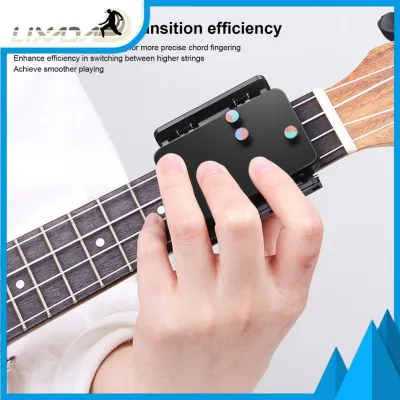
A ukulele chord presser is an external accessory designed to assist beginners, young players, or individuals with hand mobility challenges. By clamping onto the neck of the instrument, it provides buttons or keys that press down specific string combinations to form chords automatically.
Products mentioned in this guide



Prices are valid at publication and may change. Please refer to the product page for the latest price.
These tools generally fall into three distinct categories:
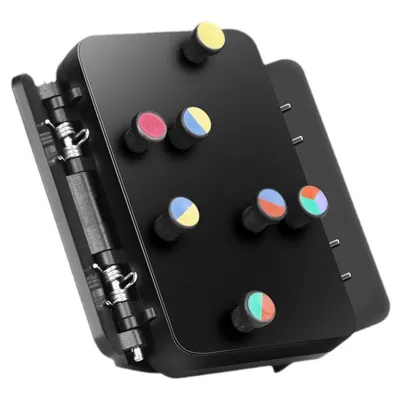
- Mechanical chord keys: Devices that clamp over the first few frets, using spring-loaded buttons to press multiple strings simultaneously.
- Silicone finger guides: Non-mechanical templates that sit flat on the fretboard to show correct finger placement without pressing the strings for you.
- Chord stampers: Ink-based stamps used to print blank chord diagrams on sheet music or notebooks, which do not attach to the instrument itself.
While a mechanical chord presser can help you play basic songs immediately and build initial confidence, it is important to set realistic expectations. These tools serve as temporary training wheels rather than permanent solutions. They do not help you develop the finger calluses, independent finger flexibility, or hand strength required for traditional, unassisted play.
Key Specifications: Decoding Fit for Soprano, Concert, Tenor, and Baritone
A common mistake is assuming that a chord presser labeled “universal” will fit any ukulele. Ukuleles scale up in size from soprano to baritone, and their physical neck dimensions change proportionally.

Nut Width and String Spacing
The nut width determines the overall thickness of the fretboard where it meets the headstock, while string spacing dictates the gap between each individual string. Soprano and concert ukuleles typically feature narrow nut widths of approximately 35mm, resulting in very tight string spacing.
Tenor and baritone ukuleles feature wider necks, often measuring 37mm to 38mm or more, which provides more room for finger placement.
If you attempt to use a soprano-sized chord presser on a tenor ukulele, the alignment will fail. The presser’s pads will sit too close together, missing the outer strings or pressing them at an angle that causes severe buzzing. Conversely, a tenor-sized presser on a soprano neck will overhang, muting adjacent strings and rendering chords unplayable. Baritone ukuleles require highly specialized tools due to their much wider necks and entirely different tuning layout.
Fretboard Radius and Fret Distance
The scale length of your instrument directly affects the distance between each fret. A soprano ukulele has a short scale length of around 13 inches, meaning the frets are clustered closely together. A tenor ukulele, with a scale length of roughly 17 inches, has significantly wider gaps between frets.
Because a mechanical chord presser spans across the first three or four frets to form chords like G or C, its physical keys are fixed at specific intervals. A tool engineered for the tight fret spacing of a soprano will not align with the wider frets of a tenor or baritone, causing the pads to press directly on top of the fret wire rather than behind it.
Additionally, you must consider whether your fretboard is flat or radiused. While most entry-level ukuleles have flat fretboards, some premium models feature a slight curvature. A rigid, flat chord presser cannot distribute pressure evenly across a curved fretboard, which often results in muted center strings or buzzing outer strings.
How to Measure Your Ukulele for a Perfect Fit
Before purchasing a chord presser from an online marketplace, you must take precise physical measurements of your instrument to verify compatibility.
Follow these steps to measure your ukulele accurately:
- Measure the Nut Width: Place a standard ruler or a digital caliper across the nut at the very top of the fretboard. Record the exact measurement in millimeters.
- Measure String Spacing: Measure the distance from the center of the bottom G string to the center of the top A string at both the first and third frets.
- Measure Fret Distance: Measure the span from the nut to the metal wire of the first fret, and then to the third fret.
Once you have these measurements, compare them directly with the technical specifications provided on the product page.
Always check the manufacturer’s detailed sizing charts before committing to a purchase. If a product listing lacks precise millimeter measurements for string spacing and nut width, contact the seller directly to request these details. If the seller cannot provide exact dimensions, it is best to avoid the purchase to prevent compatibility issues or potential damage to your instrument.
Material and Fretboard Safety Considerations
Before installing any mechanical accessory, always consult your ukulele manufacturer’s care instructions and warranty guidelines. If the instructions conflict with the accessory’s usage, or if your instrument is made of delicate vintage materials, stop and consult a professional luthier.
The materials used in a chord presser’s construction play a vital role in protecting your instrument’s wood and finish:
- Contact Pad Material: Opt for devices that use high-grade, soft silicone or dense felt lining on all contact points. These materials cushion the wood and frets against clamping pressure.
- Housing Quality: Avoid cheap, rigid plastic tools that feature sharp molding seams or burrs along the edges, as these can easily scratch the neck finish.
- Clamping Mechanism: Choose tools with adjustable, spring-loaded clamps rather than rigid screw-tightening designs, which can easily apply excessive force.
Applying too much clamping force can permanently dent nickel-silver frets, warp the neck, or leave deep indentations in soft tonewoods like mahogany, spruce, or cedar. This risk is amplified in warm, humid climates like Singapore, where high relative humidity can make wood slightly more pliable and susceptible to pressure damage. Never leave a mechanical presser clamped to your instrument when it is not in use, and avoid storing the clamped instrument inside a tight gig bag.
Alternatives When a Dedicated Presser Is Unavailable
If you cannot find a size-compatible mechanical chord presser for your specific ukulele, several practical alternatives can help you learn without risking damage to your instrument.
- Adjustable Multi-Instrument Trainers: Some advanced training aids feature modular, adjustable pads that can be slid horizontally and vertically. This allows you to customize the tool's layout to match your exact neck width and fret spacing.
- Fretboard Sticker Guides: These thin, color-coded vinyl decals apply directly to the fretboard without any clamping pressure. They provide a clear visual map for finger placement across all sizes, from soprano to baritone, without affecting the instrument's structural integrity.
- Standard Capos: Using a high-quality, adjustable ukulele capo allows you to transpose songs into easier keys, enabling you to play complex arrangements using simple, open chord shapes.
Ultimately, traditional manual practice remains the most effective and universally compatible method. Practicing for just ten to fifteen minutes a day allows your fingers to naturally adapt to the fretboard, building the necessary calluses and muscle memory that no mechanical tool can replicate.
Frequently Asked Questions (FAQ)
Can I use a guitar chord trainer on a baritone ukulele?
No, you should not use a standard six-string guitar chord trainer on a baritone ukulele. Although baritone ukuleles share the same tuning (D-G-B-E) and a similar neck width to the top four strings of a classical guitar, the scale length and fret distances are different. Clamping a wider, heavier guitar trainer onto a baritone ukulele will cause severe string misalignment, mute necessary notes, and potentially warp or scratch the ukulele’s neck. Always select an accessory designed specifically for four-string instruments.
Will a chord presser damage my ukulele's fretboard?
A high-quality chord presser with soft silicone padding is generally safe if used correctly and removed after each practice session. However, leaving a mechanical tool clamped tightly to your instrument during storage can cause permanent indentations in the wood and frets. In Singapore’s humid climate, moisture can also become trapped beneath the rubber or silicone pads, which can damage the wood finish over time. Always remove the presser after playing and wipe down the neck with a dry microfiber cloth.
Community discussion
Share your experience or ask a question. Comments are reviewed before publication.