
Selecting the ideal A-Level physics reference book depends entirely on whether your primary learning bottleneck is conceptual visualization, mathematical execution, or exam-style application. Students who struggle to grasp abstract theories require highly visual, analogy-driven textbooks, while those who understand the theory but stumble during calculations need books dense with step-by-step worked examples. Meanwhile, students aiming to refine their exam timing and precision benefit most from structured practice workbooks aligned with specific marking rubrics.
Rather than searching for a single, universally acclaimed volume, you should evaluate reference materials based on how their structural layout matches your cognitive habits. A mismatched book—such as a dense, text-heavy academic volume for a student who needs rapid formula-application drills—can lead to frustration and wasted study hours. Investing in supplementary resources in Singapore typically costs between S$30 and S$60 per book, making it highly practical to diagnose your academic needs before purchasing.
By diagnosing your specific academic pain points and verifying syllabus alignment before purchasing, you can assemble a targeted toolkit that directly addresses your learning gaps. This systematic approach ensures that every study session is highly efficient, helping you transition from passive reading to active, exam-ready mastery of the subject.
Products mentioned in this guide
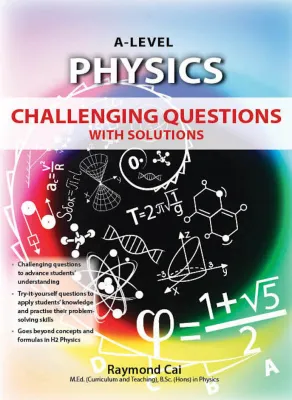
Prices are valid at publication and may change. Please refer to the product page for the latest price.
Identifying Your Physics Learning Style
If you find yourself memorizing formulas without understanding what the variables actually represent in physical space, your primary bottleneck is conceptual. This challenge often becomes apparent during the transition from secondary school science to the rigorous demands of A-Level physics. You might struggle to visualize abstract topics like electromagnetic induction, gravitational fields, thermodynamics, or quantum phenomena. For instance, you may easily recall Faraday’s law but struggle to explain qualitatively why a current is induced in a moving conductor. For these challenges, you need resources that prioritize qualitative explanations, visual models, and physical intuition before introducing complex mathematics.
Many students can state Newton’s laws or define capacitance perfectly but freeze when presented with a multi-step calculation. If you struggle to identify which formula to use, fail to rearrange equations correctly, or get lost when combining two different formulas—such as equating centripetal force to gravitational force—your primary need is structured, step-by-step guidance. This “blank page syndrome” occurs when you understand the theory in isolation but cannot construct a logical mathematical path. You require books that break down the problem-solving process into explicit, repeatable steps, showing exactly how to transition from raw question data to a final numerical answer.
If you consistently understand the classroom lectures and can solve homework problems when unhurried, but perform poorly under timed test conditions, your bottleneck is application under pressure. Common indicators include running out of time during practice papers, misinterpreting command words like “determine” versus “estimate,” or losing marks on simple errors like failing to convert millimeters to meters. To overcome this, your study routine must center on high-volume, progressively difficult practice questions. You need resources that train you to recognize the specific cues in exam questions and respond with the precise terminology required by examiners.
What to Look for in a Physics Reference Book
When evaluating books designed to build foundational understanding, look closely at the quality of the visual aids. High-quality conceptual guides use clear, multi-colored vector diagrams to illustrate field lines, wave fronts, and particle interactions, rather than relying solely on dense blocks of text. Look for books that employ real-world analogies to explain abstract ideas, such as comparing electrical potential to gravitational height. Additionally, check if the text includes detailed derivations of key formulas; understanding how an equation is constructed from fundamental principles makes it far easier to remember and apply during an exam.

For mathematical support, look for books that feature a highly structured layout for their solved problems. The most effective resources do not simply jump from the question to the final answer; they explicitly list the given variables, state the formula to be used, show the algebraic rearrangement, and highlight the substitution step. Look for callout boxes that warn against common student pitfalls, such as forgetting to square the distance in the inverse-square law or failing to convert degrees to radians in circular motion. A good worked-example book should also feature parallel exercises—unsolved problems immediately following a worked example that allow you to practice the exact same method with different numbers.
If your goal is exam preparation, the workbook must offer a substantial volume of questions categorized by topic and difficulty level. Look for books that organize questions progressively, starting with simple recall and basic calculations before moving on to complex, synoptic questions that combine multiple syllabus areas. Most importantly, inspect the answers section before buying. A high-quality workbook must provide fully worked solutions and explicit marking criteria, showing exactly where marks are awarded for intermediate steps, units, and final values, rather than just listing a single numerical answer.
Matching Book Categories to Your Study Needs
Comprehensive textbooks are typically large, heavy volumes, often officially endorsed by major examination boards. They are designed to be the primary source of information throughout your two-year course, offering exhaustive coverage of every syllabus point. While they are excellent for building a deep, rigorous foundation and understanding the historical context of physical discoveries, their sheer volume can make them overwhelming for quick revision. They are best used at the start of a topic to ensure no conceptual gaps remain.
Revision guides and summary books are highly condensed, focusing on key definitions, core formulas, and brief summaries of essential experiments. They are designed for rapid review in the weeks leading up to an exam, translating complex textbook chapters into bullet points, mind maps, and quick-reference tables. While they are incredibly efficient for active recall techniques like “blurting” and self-testing, they should not be used as a primary learning tool, as they often omit the detailed explanations and derivations necessary for a deep understanding of complex physics.
Dedicated practice workbooks and past-paper compilations contain minimal explanatory text, dedicating almost all their pages to practice questions, exam-style scenarios, and practical assessment preparation. They are indispensable for the final stages of study, helping you build muscle memory for calculations and familiarize yourself with the specific phrasing used by examiners. Using these books under timed conditions is the most effective way to improve your pacing and eliminate careless errors.
For most students, the most effective study routine involves combining two complementary resources rather than relying on a single book. You can use a comprehensive, officially endorsed textbook as your primary reference to build a solid conceptual foundation during school terms. Alongside this, integrate a dedicated practice workbook or a topical past-paper compilation to test your understanding immediately after completing each chapter. This dual-book approach ensures that your theoretical knowledge is constantly validated by practical application, preventing the common trap of passive reading.
Essential Pre-Purchase Checks for A-Level Students
Physics syllabi vary significantly across different examination boards, such as Cambridge International (CIE), Pearson Edexcel, AQA, OCR, and the Singapore-Cambridge GCE A-Level. A book designed for one board may include topics that are completely irrelevant to your course, or omit critical areas that you will be tested on. For instance, practical assessment requirements, specific mathematical expectations, and the depth of quantum or particle physics covered can differ greatly. Always check the book’s introduction or publisher specifications to confirm it is tailored to your exact exam code.
Syllabi are updated periodically to reflect modern scientific developments and pedagogical shifts. Purchasing an outdated edition, even if available at a steep discount on online marketplaces, can be a risky decision. Older prints may lack coverage of newly added topics, feature outdated practical experiments, or use exam question formats that have since been retired. Verify the publication date against your syllabus’s effective years to ensure you are studying the correct material.
Decide whether a physical paperback or a digital eBook best suits your study environment. Physical books allow for easy highlighting, margin notes, and quick flipping between question pages and answer keys, which is highly beneficial for active study. However, digital editions offer portability and searchability, and they often come with access codes for online portals. These digital platforms may include interactive simulations, video tutorials, and self-marking quizzes that can greatly enhance your visualization of dynamic physical processes.
Frequently Asked Questions (FAQ)
Do I need the official textbook endorsed by my exam board?
While an officially endorsed textbook guarantees complete coverage of the syllabus, it is not always the most effective tool for every student. Endorsed books are written to meet strict board specifications, which can sometimes result in dry, academic language and a lack of targeted exam-preparation strategies. If you find the official textbook difficult to digest, supplementing it with a third-party revision guide or a dedicated practice workbook can provide the alternative explanations and structured drilling you need to succeed.
Can I use an older edition of an A-Level physics reference book?
Using an older edition is acceptable for core, unchanging topics like Newtonian mechanics or basic electricity, but it carries significant risks for modern physics and practical skills. Exam boards regularly update their practical endorsement requirements and fine-tune their assessment objectives. If you choose to use an older book to save money, you must cross-reference its table of contents with your current official syllabus to identify any missing topics or outdated terminology that could cost you marks on the exam.
How should I integrate a reference book with my school notes?
Your reference book should act as an active partner to your classroom learning, not a passive replacement. When you encounter a difficult topic in class, consult your reference book the same evening to read an alternative explanation, which can help solidify the concept. Use the book’s worked examples to verify the steps in your school notes, and use its topical practice questions to self-assess your understanding before your school tests. This active integration helps identify and correct misconceptions early in the academic year.
Community discussion
Share your experience or ask a question. Comments are reviewed before publication.