
Selecting the right 2025 Sec 4 prelim papers is a critical step for students preparing for their GCE O-Level examinations. These school-designed preliminary papers serve as excellent practice tools, offering fresh challenges that complement the official Ten-Year Series. To make an effective purchase, you must evaluate how well a compilation aligns with the latest Ministry of Education (MOE) syllabus, the depth of its marking schemes, and whether it provides a balanced representation of school difficulty levels.
As you prepare for your upcoming exams, practicing with the 2025 Sec 4 prelim papers offers the most up-to-date look at school-level assessment trends. Because these papers were compiled from the most recent complete exam cycle, they contain contemporary question styles and contexts that align closely with what you will face in the national examination hall. Understanding how to select and utilize these resources effectively can significantly elevate your revision strategy.
The Role of 2025 Prelim Papers in O-Level Preparation
Secondary 4 preliminary examination papers are mock exams set internally by individual secondary schools in Singapore. Administered a few months before the national O-Level examinations, these papers are designed by experienced school teachers to assess their students’ readiness. Because they are drafted by current educators, they reflect the most recent academic trends, question formats, and real-world application scenarios that teachers across the country anticipate.
Products mentioned in this guide
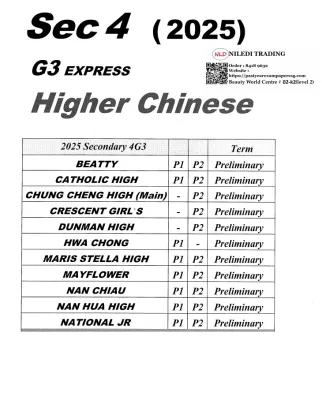
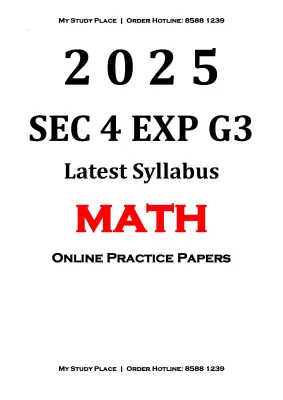
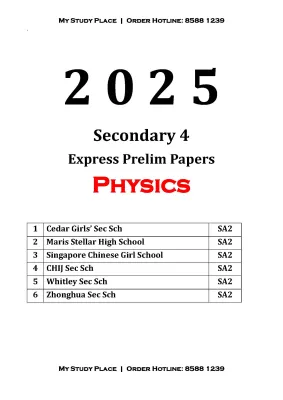
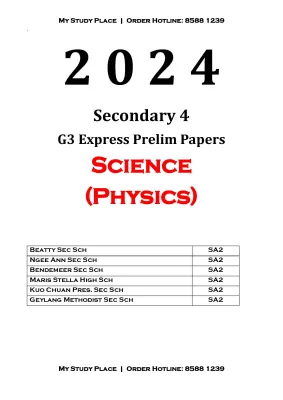
Prices are valid at publication and may change. Please refer to the product page for the latest price.
For students targeting high grades, the primary value of these papers lies in their ability to test conceptual understanding in unfamiliar contexts. While the official Ten-Year Series is indispensable for mastering the baseline exam structure, repeating those papers can sometimes lead to rote memorization of specific question types. Practicing with the latest prelim papers forces you to apply your knowledge to novel problems, which is exactly what separates distinction-grade students from the rest.
It is important to set realistic expectations when working through these compilations. School prelim papers are intentionally designed to be more challenging than the actual O-Level examinations. Teachers use these assessments to stretch students’ critical thinking and systematically expose lingering knowledge gaps before the national exams. Consequently, you should not be discouraged by lower scores during your initial practice sessions; instead, view every mistake as a valuable diagnostic opportunity.
What to Look for in a High-Quality Prelim Paper Series
With numerous publishers and distributors offering various compilations in Singapore, finding a high-quality series requires careful evaluation. Rather than relying on eye-catching covers or vague marketing promises, you should assess any potential purchase using three core educational standards.

Detailed Marking Schemes and Examiner Notes
The educational value of a practice paper is directly tied to the quality of its answer key. A compilation that only provides final numerical answers or brief, one-sentence summaries is of limited use for self-directed study. When browsing options, look for publishers that provide comprehensive, step-by-step worked solutions for every question.
For Mathematics and Science subjects, a high-quality marking scheme must illustrate the complete algebraic progression, formula applications, and intermediate steps. This level of detail allows you to trace your work line-by-line and identify the exact moment a calculation or conceptual error occurred. In Humanities and Language subjects, look for model essays or detailed structured response outlines that demonstrate how points are developed and marks are allocated.
Furthermore, the best series include examiner notes or common pitfall callouts. These sections explain why certain phrases or approaches are rejected by markers, helping you understand the strict requirements of the marking rubric. Having access to alternative solving methods is also highly beneficial, as it broadens your analytical toolkit and helps you find the most efficient path to the correct answer.
Accurate Reflection of the Latest MOE Syllabus
Syllabus alignment is a critical factor that can make or break your revision efficiency. The Singapore Ministry of Education (MOE) and the Singapore Examinations and Assessment Board (SEAB) periodically update subject syllabi to reflect modern educational standards. These updates often involve introducing new topics, removing outdated concepts, or adjusting the weightage of different exam components.
Before purchasing any 2025 Sec 4 prelim paper compilation, you must verify that the content has been curated to match the current syllabus requirements. Check the publisher’s preface, introduction, or product specifications for explicit confirmation of syllabus compliance. Practicing questions on topics that have been phased out of the syllabus is an inefficient use of your limited revision time.
You can also perform a quick manual check by cross-referencing the table of contents of the compilation with your current school textbooks or the official SEAB syllabus documents. For subjects with recent structural changes, such as revised practical exam formats or updated source-based question structures in Social Studies, ensure the compilation reflects these modern formats accurately.
Balanced School Representation and Difficulty Levels
A common pitfall among students is focusing exclusively on prelim papers from highly competitive or “elite” academic schools. While these papers are excellent for stretching top-tier students, they often feature exceptionally complex, non-standard questions. Relying solely on these papers can lead to unnecessary anxiety and a distorted view of your actual baseline readiness.
A superior compilation should feature a diverse mix of papers from autonomous, independent, and neighborhood secondary schools across Singapore. This variety ensures a more realistic difficulty curve, allowing you to scale your practice sessions according to your current level of preparation.
Starting your revision with papers from neighborhood schools helps consolidate your foundational knowledge and build exam confidence. Once you have mastered these standard questions, you can progressively transition to more challenging papers from autonomous and independent schools to sharpen your lateral thinking. This balanced approach ensures you are prepared for both the high-probability, standard questions and the complex application tasks that appear in the national exam.
Navigating the Major Prelim Paper Publishers in Singapore
As you shop for revision materials, you will find that prelim papers are packaged and distributed in several formats. Understanding the practical trade-offs of each format will help you choose the option that best fits your study environment and learning goals.
Subject-Specific Booklets vs. Comprehensive Bundles
Subject-specific booklets focus entirely on a single subject, compiling papers from various schools for that specific discipline. These are highly popular for targeted practice.
- Targeted Practice: These booklets are ideal if you have clearly identified weak subjects that require intensive, focused drilling.
- Portability and Focus: They allow you to carry only what you need for a specific study session, preventing you from getting overwhelmed by massive stacks of papers.
- Verification Check: Before buying, check the table of contents to ensure the booklet contains papers from a wide range of schools and includes both paper components (e.g., Paper 1 and Paper 2) to ensure complete subject coverage.
Comprehensive bundles, on the other hand, package exam papers for multiple subjects or schools together, often sold as thick, multi-subject sets.
- Full Exam Simulation: These bundles are excellent for students who want to simulate a realistic exam week, practicing the transition between different academic disciplines under time pressure.
- Cost Efficiency: Buying a comprehensive bundle is often more economical on a per-paper basis than purchasing several individual subject booklets.
- Verification Check: Ensure that the bundle matches your specific subject combination, especially for elective subjects, humanities pairings, or specific language streams, so you do not pay for materials you cannot use.
Physical Books vs. Digital Download Packages
Choosing between physical paper compilations and digital download packages depends on your study habits and access to printing facilities.
- Physical Books: Physical compilations offer a highly realistic exam experience, allowing you to practice writing by hand, drawing diagrams, and annotating questions directly on the page. This tactile experience helps reduce screen fatigue and mimics the actual test environment. However, physical books are bulkier to transport, generally carry higher price tags due to printing costs (typically ranging from S$12 to S$30 per subject), and cannot be easily reset for a second attempt once written in.
- Digital Packages: Digital downloads, typically offered as PDF files, are highly convenient and cost-effective, with bundles often priced between S$15 and S$45. They allow you to print clean copies of specific papers on demand, making it easy to attempt the same paper multiple times to track your improvement. The main drawback is that they require significant self-discipline to avoid digital distractions when studying, and the cost of home printing can accumulate quickly if you print entire papers.
- Quality and Safety Checklist: When purchasing digital packages from online marketplaces, always verify the seller's credibility to ensure you receive complete, high-resolution files. Poorly scanned PDFs with missing pages or illegible marking schemes will severely hinder your revision. Ensure the file format is compatible with your devices and that the complete answer key is included in the download package.
Strategies for Using Prelim Papers Effectively
Acquiring the right 2025 prelim papers is only the first step; maximizing their value requires a structured, strategic approach to your revision timeline.
- Phase 1 (Topical Practice): Do not wait until the final months of the school year to begin practicing prelim papers. During the early and middle stages of your revision, use these compilations as a source of topical reinforcement. Once you complete your school revision for a specific chapter, search through your prelim papers for questions related to that topic. Attempting these challenging, school-level questions early helps solidify your conceptual understanding and prepares you for the highest level of difficulty you might encounter.
- Phase 2 (Timed Mock Exams): As the O-Level examinations draw closer, transition to full-paper simulations. Find a quiet study space, set a timer to match the official exam duration, and remove all textbooks and notes. Use only approved stationery and calculators. Simulating these strict conditions builds the mental stamina and time-management skills necessary to handle the pressure of the actual examination hall without losing focus.
- Error Logging: The true value of practicing prelim papers lies in analyzing your mistakes. For every paper you complete, dedicate time to review the marking scheme thoroughly. Keep an error log where you record every incorrect answer, the correct concept, the specific reason for your mistake, and the step-by-step correction. Reviewing this log regularly before attempting new papers prevents you from repeating the same conceptual or careless errors.
- Pacing Advice: While prelim papers are excellent for stretching your academic limits, you should adjust your pacing as the national exams approach. In the final two to three weeks before the O-Levels, transition your focus back to the official Ten-Year Series. This step is crucial because the actual Cambridge examiners write questions with a distinct tone, style, and grading standard that differs slightly from school-designed papers. Returning to the official papers helps calibrate your mindset to the exact standard expected on exam day.
Frequently Asked Questions (FAQ)
Should I focus only on prelim papers from top-tier schools?
No, you should not focus exclusively on top-tier school papers. While these papers are highly beneficial for exposing you to complex, multi-step application questions, relying solely on them can lead to unnecessary stress and a distorted sense of your readiness. A balanced diet of papers from various school tiers ensures you master both the standard, high-probability questions and the advanced problem-solving techniques.
How do prelim papers compare to the official 10-year series?
The official Ten-Year Series (TYS) represents the exact baseline standard, recurring question formats, and grade boundaries of the actual national examinations. In contrast, school prelim papers are generally designed to be more difficult, introducing novel contexts and challenging variations to push students’ limits. The TYS is essential for mastering the baseline standard, while prelim papers are ideal for stretching your abilities and identifying hidden knowledge gaps.
Community discussion
Share your experience or ask a question. Comments are reviewed before publication.