
Choosing the right Arabic book depends entirely on your current proficiency and learning goals. Before making a purchase, you must accurately assess your reading, writing, and comprehension skills, then match those abilities to the appropriate book category. This guide will help you diagnose your level, identify the right type of material, and verify critical product specifications before you buy.
How to Assess Your Current Arabic Proficiency Level
To find the right book, you must first identify where you stand on the learning spectrum. This assessment relies on observable language skills rather than how long you have been studying.
If you are at the absolute beginning, your primary focus is the script itself. At this stage, you are learning to recognize the 28 letters of the Arabic alphabet, understanding how their shapes change based on their position in a word, and practicing basic phonetics. If you still rely heavily on English transliteration to pronounce words, you belong in the beginner category.
Products mentioned in this guide
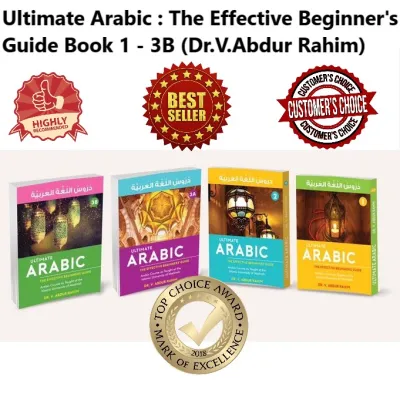
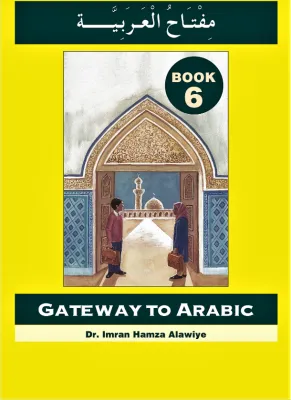
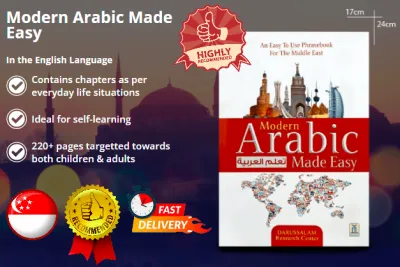
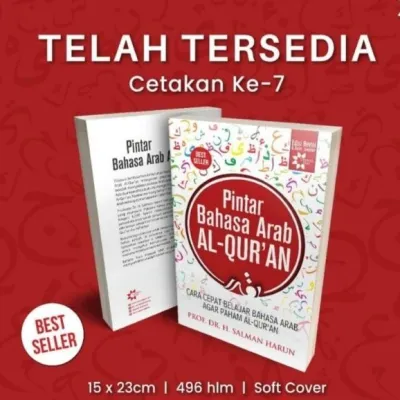
Prices are valid at publication and may change. Please refer to the product page for the latest price.
As you progress, you will transition to basic reading and writing. You can identify yourself as an early intermediate learner if you can form simple sentences, understand everyday greetings, and read fully voweled texts that include short vowel marks. At this stage, you can navigate basic vocabulary but still need grammatical aids to comprehend full paragraphs.
Advanced proficiency is marked by the ability to read unvoweled texts. If you can grasp complex grammar structures, recognize root patterns, and consume native media or literature without phonetic guides, you are ready for advanced materials. At this level, you no longer need English translations to understand the core message of a text.
Which Arabic Book Types Match Your Learning Stage?
Selecting the right category of Arabic learning material ensures you do not become overwhelmed by complex grammar or bored by repetitive alphabet drills.

Books for Complete Beginners
For those starting from scratch, the ideal book focuses on the mechanics of the language. Look for alphabet workbooks that offer stroke-by-stroke writing practice and phonetic guides. These books help you train your hand to write from right to left and teach your eyes to distinguish between similar-looking letters.
Vocabulary builders for beginners should feature high-frequency words paired with clear transliterations and, ideally, access to accompanying audio files. Audio support is critical at this stage to ensure you do not memorize incorrect pronunciations.
Finally, beginner textbooks should introduce basic grammar through highly structured, repetitive exercises. These materials focus on survival phrases, simple greetings, and essential nouns, providing a gentle introduction to the language without diving too deeply into complex verb conjugations.
Books for Intermediate Learners
Intermediate learners need materials that bridge the gap between basic survival phrases and fluent reading. Graded readers and short story books are excellent choices for this stage. These books present simplified narratives with contextual vocabulary lists and comprehension questions at the end of each chapter, allowing you to build reading stamina.
Grammar workbooks at this level shift focus toward sentence structure, verb conjugations, and the Arabic root system. Understanding how three-letter roots expand into different verb forms is essential for expanding your vocabulary exponentially, and intermediate workbooks provide the targeted exercises needed to master this concept.
Additionally, look for conversational texts that gradually phase out English transliterations. These books encourage you to rely entirely on the Arabic script while still providing marginal glossaries for difficult words, helping you transition toward natural reading habits.
Books for Advanced Learners
Advanced learners require authentic, unsimplified materials that challenge their comprehension and refine their stylistic nuances. Literary novels, compilation essays, and modern news anthologies are ideal for this stage. These texts do not use short vowel markings, forcing you to rely on your grammatical knowledge and context clues to read correctly.
Advanced grammar and rhetoric books focus on the fine details of the language, such as classical syntax and stylistic eloquence. These resources are essential if you aim to write professionally or academic papers in Arabic.
You may also benefit from specialized vocabulary resources. If you use Arabic for specific professional, academic, or theological fields, look for dictionaries and glossaries tailored to those industries, such as legal, medical, or classical terminology.
What to Check Before Buying an Arabic Book
Before finalizing your purchase on any online marketplace or bookstore, you must verify several critical specifications to ensure the book aligns with your goals.
First, determine whether the book teaches Modern Standard Arabic (MSA) or a specific regional dialect. MSA is the universal standard used in writing, news, and formal education, whereas dialects like Egyptian, Levantine, or Gulf Arabic are spoken in daily life. Purchasing a dialect book when you want to read formal literature, or vice versa, will lead to significant frustration.
Second, check the instructional language of the book. Some textbooks use full immersion, meaning all instructions, explanations, and exercises are written entirely in Arabic. While immersion is highly effective, self-study learners often prefer books with English explanations and a comprehensive answer key at the back to verify their work.
Finally, verify the physical and digital format specifications. If you are purchasing a physical workbook, ensure it is a new edition with clean pages for writing exercises. For e-books, check for digital rights management (DRM) restrictions and screen compatibility, as Arabic script can sometimes render poorly on older e-readers. If the book includes audio components, verify whether they are delivered via physical CDs or digital download links.
Frequently Asked Questions (FAQ)
Should I learn Modern Standard Arabic or a dialect first?
Your choice depends entirely on your personal communication goals. Modern Standard Arabic is the best starting point if your primary goal is to read books, write, consume news media, or communicate formally across different Arab countries. It provides a strong grammatical foundation that makes learning any dialect easier later on.
If your primary goal is to speak with locals, travel, or enjoy regional television shows and movies, you should focus on a specific regional dialect. Dialects vary significantly by region, so choose a book dedicated to the specific area you plan to visit or study.
Do I need an Arabic book with English translations?
Beginners and intermediate learners benefit significantly from books that include English translations, bilingual texts, or side-by-side glossaries. These aids reduce frustration and allow you to learn vocabulary efficiently without constantly stopping to look up words in an external dictionary.
As you reach advanced proficiency, you should transition to monolingual Arabic books and dictionaries. Eliminating English translations forces your brain to think directly in Arabic, which is essential for developing true fluency and understanding cultural nuances that do not translate directly.
Community discussion
Share your experience or ask a question. Comments are reviewed before publication.