
Preparing a Primary 2 student for the Singapore and Asian Schools Math Olympiad (SASMO) requires a deliberate selection of assessment books that bridge the gap between standard school mathematics and competitive problem-solving. At this foundational stage, the goal is not merely to drill formulas, but to nurture mathematical intuition, logical reasoning, and spatial awareness. The right preparation materials must offer structured guidance, progressive difficulty, and clear heuristic explanations that a seven- or eight-year-old can comprehend with minimal frustration.
To choose the most suitable books, parents should look for resources that categorize questions by specific Olympiad topics, such as number patterns, logic puzzles, and basic geometry. Rather than buying generic enrichment workbooks, focus on materials that explicitly target competitive math heuristics and provide detailed, step-by-step solution keys. A balanced preparation strategy typically combines topical heuristic workbooks to build core skills, followed by compiled past-year papers to develop exam stamina and familiarity with the actual test format.
Understanding the Primary 2 SASMO Syllabus and Difficulty
The SASMO syllabus for Primary 2 is designed to stretch a young learner’s cognitive abilities far beyond the standard primary school mathematics curriculum. While school exams at this level focus primarily on basic arithmetic, simple word problems, and introductory measurement, the Olympiad environment demands high-level logical deduction and non-routine problem-solving. Understanding these differences is essential to avoid purchasing books that are either too simple or inappropriately advanced.
Products mentioned in this guide
![[Qiafa][5 Books Collection ] SASMO Math Competition Primary 2-primary 6](https://img.lazcdn.com/g/p/75beca3f5c5be1c86a172a01ae2d48ef.jpg_400x400q80.jpg_.webp)
![[Qiafa][5 Books Collection ] SASMO Math Competition Primary 2-primary 6](https://img.lazcdn.com/g/p/8f17029c97c9500620be4bd5f88a4648.jpg_400x400q80.jpg_.webp)
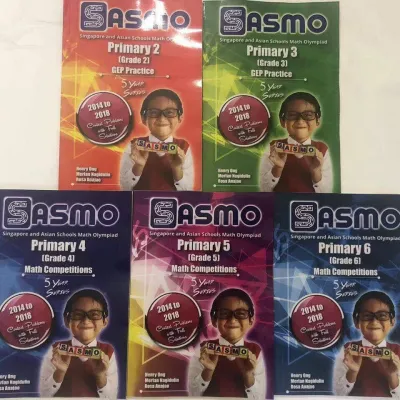
Prices are valid at publication and may change. Please refer to the product page for the latest price.
Core topics tested in the Primary 2 SASMO typically include advanced number patterns, cryptarithms, spatial visualization, grid-based pathfinding, and age-appropriate logic puzzles. For instance, instead of asking a student to perform straightforward addition, an Olympiad question might present a grid of shapes where each shape represents a hidden number, requiring the child to deduce the values systematically. Other common areas include interval problems, such as calculating the number of cuts needed to divide a log, and simple combinatorics, like finding the number of ways to arrange three distinct items.
The fundamental difference lies in the application of heuristics rather than rote memorization. Standard school math teaches children how to execute specific algorithms, whereas Olympiad math requires them to decide which strategy to apply when the path to the solution is not immediately obvious. This requires a high degree of cognitive flexibility and resilience, as students must feel comfortable encountering unfamiliar question formats.
When evaluating potential assessment books, parents should carefully inspect the table of contents and index. Verify that the chapters cover specific Olympiad heuristics rather than standard school topics. A book that simply repackages standard Primary 2 school syllabus questions under a challenging label will not adequately prepare a student for the unique conceptual demands of the SASMO competition. Look for explicit mentions of topics like working backwards, excess and shortage, and logic problems in the chapter listings.
Key Criteria for Evaluating P2 Math Olympiad Books
Selecting the right book involves looking beyond the cover design and examining the pedagogical structure of the content. The first and most critical criterion is the quality of the step-by-step solutions and heuristic explanations. At the Primary 2 level, children are still developing their abstract reasoning skills, meaning they rely heavily on visual representations. The answer key must not simply state the final numerical answer; it must explain the why and how behind each step using diagrams, model drawings, or systematic lists.

A high-quality assessment book should act as a silent tutor. If a child struggles with a problem, the solution section should guide them through the logical progression of the heuristic used, allowing them to identify exactly where their reasoning diverged. Avoid books that offer brief, single-line calculations without context, as these do little to help a young learner understand the underlying mathematical principles or replicate the strategy in future questions.
Another vital criterion is progressive difficulty scaling within each chapter. A well-designed workbook should begin with foundational exercises that reinforce basic concepts before gradually introducing intermediate and advanced competition-level questions. This scaffolding is essential for building a child’s confidence. If a book immediately presents highly complex problems without introductory practice, the student may quickly become discouraged and develop anxiety toward mathematical challenges.
Author credibility and publisher reputation also serve as reliable indicators of quality. Look for books written by experienced Olympiad trainers, mathematics educators, or established local publishers with a proven track record in Singapore’s competitive math landscape. These authors understand the specific nuances of local and regional competitions, ensuring that the terminology, question style, and difficulty levels accurately reflect what the student will encounter on the actual test day.
Types of Practice Materials for SASMO Preparation
To build a comprehensive and effective study resource library, parents should diversify the types of practice materials they use. Relying on a single workbook is rarely sufficient, as different formats serve distinct purposes in a child’s learning journey. A balanced preparation plan should incorporate three main categories of materials: past-year papers, topical heuristic workbooks, and comprehensive assessment compilations.
By understanding how these resources complement one another, you can structure a study plan that first builds conceptual understanding, then refines specific problem-solving techniques, and finally tests overall exam readiness under timed conditions. This multi-faceted approach ensures that the student is not only mathematically capable but also mentally prepared for the format and constraints of the competition.
Past Year Papers and Mock Tests
Authentic past-year papers and simulated mock tests play an indispensable role in the final stages of SASMO preparation. These materials expose the student to the actual formatting, font sizes, and visual layouts used in the official competition, which helps reduce anxiety on the test day. More importantly, they allow students to practice managing their time across the paper’s sections, helping them understand when to persist with a difficult question and when to move on.
When sourcing compiled past papers, look for editions that include detailed marking schemes and explanations for each year’s questions. It is beneficial to select compilations that cover the most recent years, as competition trends and question styles can evolve over time. Utilizing these papers under timed, exam-like conditions at home provides an accurate assessment of the child’s current standing and highlights areas that require last-minute revision.
Topical Guides and Heuristics Workbooks
Topical guides and heuristics workbooks are the foundation of early-stage preparation. These books focus on teaching specific problem-solving models, such as drawing bar models, making systematic lists, guessing and checking, and working backwards. By isolating one heuristic at a time, these workbooks allow the student to master a specific cognitive tool before attempting to combine multiple strategies.
These resources are crucial for bridging the gap between standard school math and Olympiad logic. They provide the conceptual scaffolding necessary for a Primary 2 student to transition from concrete counting to abstract logical deduction. Working through topical chapters systematically ensures that the child develops a robust toolkit of strategies, making them less likely to feel overwhelmed when faced with non-routine problems.
Comprehensive Assessment Compilations
Comprehensive assessment compilations are all-in-one workbooks that feature mixed-topic exercises and full-length practice papers. Unlike topical books, these compilations do not group questions by heuristic, forcing the student to identify which mathematical tool is required for each problem. This mixed practice is highly effective for testing overall retention and identifying lingering weak areas across the entire syllabus.
While these compilations are excellent for general revision and mock exam simulation, they have limitations when used as primary teaching tools. Because they jump from one topic to another, they do not provide the deep, repetitive practice needed to master a new heuristic. Therefore, they should be introduced only after the student has built a solid foundation using specialized topical guides.
What to Check Before Buying Assessment Books
Before purchasing any assessment books from a bookstore or an online marketplace, parents must verify several critical product specifications to ensure the materials are relevant and effective. First, check the publication or edition year. The SASMO competition format and the broader primary school mathematics syllabus undergo periodic updates. Purchasing an outdated edition may result in your child practicing topics that are no longer tested, or missing out on newer question formats that have recently been introduced.
Language and terminology consistency is another vital factor. Ensure that the mathematical terms, units of measurement, and spelling used in the book align with what is taught in Singapore schools. For example, terms like regrouping or specific model-drawing conventions should match local classroom standards to prevent unnecessary confusion during self-study. Books imported from other regions may use unfamiliar terminology or notation systems that distract the child from the actual mathematical concepts.
Additionally, inspect the physical layout and print quality of the book. For Primary 2 students, visual clarity is essential. Look for books with clean layouts, clear diagrams, and sufficient white space for working out problems. Cramped pages with tiny fonts can cause visual fatigue and make the material feel intimidating. Finally, verify whether the detailed answer key is bound within the book, provided as a separate booklet, or requires a digital download, ensuring you have full access to the solutions before starting.
Building a Practical Study Plan with Your Selected Books
Acquiring the right assessment books is only the first step; integrating them into a sustainable, stress-free study routine is what determines success. For a Primary 2 student, consistency is far more valuable than intensity. Avoid long, exhausting study sessions that can lead to burnout and a dislike for mathematics. Instead, aim for short, focused sessions of about twenty to thirty minutes, two to three times a week, keeping the atmosphere positive and encouraging.
Use the selected books systematically for error analysis and targeted re-practice. When your child makes a mistake, do not simply write down the correct answer and move on. Encourage them to explain their thought process, and then walk through the book’s heuristic explanation together to identify the logical gap. Keep a record of challenging questions and return to them a few weeks later to verify if the concept has been fully internalized.
Recognize when to adjust your approach or seek external guidance. If your child consistently struggles with the foundational chapters of a heuristics workbook despite detailed explanations, it may indicate that they need to reinforce their basic school math concepts first. Alternatively, if the explanations in the books are insufficient to resolve recurring learning gaps, consider consulting a professional tutor or enrolling in a structured preparatory class to provide the necessary conceptual support.
Frequently Asked Questions (FAQ)
Is it too early for a Primary 2 student to start SASMO preparation?
It is not too early, provided the student has already demonstrated a strong mastery of foundational Primary 2 school mathematics and possesses a natural curiosity for problem-solving. The primary focus at this age should be on developing logical thinking and enjoying the process of solving puzzles, rather than intense competition pressure. If a child is still struggling with basic arithmetic or reading comprehension, it is best to focus on strengthening those core areas before introducing complex Olympiad heuristics.
Do I need to buy separate books for the SASMO English and Math sections?
No, because SASMO is strictly a mathematics competition. There is no English section in the SASMO exam. However, because the math questions are presented as word problems, a strong command of English reading comprehension is essential. If your child struggles to understand the context of the questions, you may want to focus on books that emphasize word problem analysis and language-based mathematical modeling to help them decode the scenarios accurately.
Community discussion
Share your experience or ask a question. Comments are reviewed before publication.