
Finding the right music score holder is more than a matter of convenience; it is a fundamental step in protecting your physical health and ensuring a seamless performance. The ideal holder must accommodate the physical dimensions of your sheet music or digital device while integrating perfectly with your instrument’s playing posture and your performance environment. Whether you are a stationary cellist reading from a heavy anthology or a marching brass player navigating outdoor wind, your choice of holder directly impacts your technique, breathing, and overall comfort. By evaluating your specific physical constraints and performance settings, you can select a tool that supports your musical journey rather than hindering it.
Assessing Your Physical Needs: Instrument and Posture
Every musical instrument imposes unique physical demands on the player, which in turn dictates the structural requirements of your music score holder. For string and orchestral players, such as violinists, cellists, and double bassists, stability is paramount. These instruments often require the player to read from large, multi-page sheet music layouts or heavy bound scores. A holder with a wide, solid desk and a robust, low-profile tripod base is essential to prevent tipping. The center of gravity must remain low, especially when the stand is positioned to accommodate a seated player whose line of sight is angled downward.
Wind, brass, and vocal performers face a different set of ergonomic challenges. Proper breathing technique and vocal projection rely heavily on an open chest cavity and a neutral neck alignment. If a music holder is too low or cannot tilt to the correct angle, the performer is forced to hunch forward, compressing the diaphragm and restricting airflow. For these musicians, extensive height adjustability is a non-negotiable feature. The stand must easily elevate to eye level, and the tilt mechanism must lock securely at precise angles to allow the performer to read clearly while maintaining an upright, relaxed posture.
Products mentioned in this guide

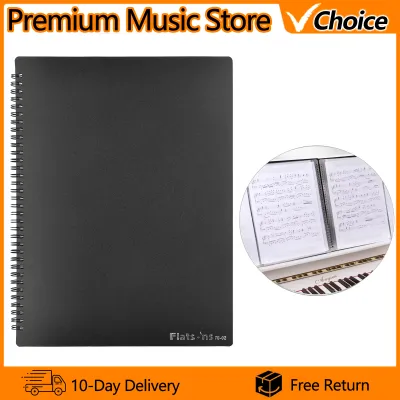

Prices are valid at publication and may change. Please refer to the product page for the latest price.
Fretted instrument players, including guitarists and bassists, must navigate the physical space occupied by the neck and body of their instrument. A standard music stand placed directly in front of a guitarist can obstruct the movement of the fretting hand or collide with the instrument’s headstock. To avoid these physical interferences, many guitarists benefit from low-profile floor stands or specialized clamp-on holders that attach directly to a microphone stand or a nearby piece of equipment. These compact solutions keep the score within the peripheral vision without encroaching on the physical space needed for expressive playing.
Keyboard and piano players require a completely different approach to score support. While many acoustic pianos feature built-in music desks, these integrated ledges may not always offer the depth or height required for modern performance setups. Digital keyboardists, in particular, often need to support a combination of heavy anthologies, loose-leaf binders, and digital tablets simultaneously. An extra-wide, heavy-duty double desk or a specialized mount that attaches directly to the keyboard stand frame provides the necessary surface area and weight capacity. This setup ensures that multiple pages can be displayed side-by-side without the risk of the entire assembly collapsing onto the keys.
Matching the Holder Type to Your Performance Environment
The environment in which you practice and perform plays a decisive role in determining the best form factor, material, and portability level for your music score holder. For home studios and dedicated practice spaces, portability is secondary to absolute stability and surface area. A heavy-base, non-collapsible or semi-collapsible steel stand is often the best investment for these environments. These stands feature solid metal desks that do not bend under the weight of heavy binders and heavy cast-iron bases that resist accidental bumps. Because they remain stationary, their weight is an asset rather than a liability, providing a reliable foundation for daily practice.

For gigging and touring musicians, the priorities shift dramatically toward portability, weight, and ease of setup. A heavy steel stand is impractical to transport from venue to venue alongside instruments and amplification gear. In these scenarios, lightweight, fully collapsible aluminum or high-grade wire stands are highly advantageous. However, choosing a portable stand requires a careful evaluation of trade-offs. Extremely lightweight wire stands are highly susceptible to stage vibrations caused by drums or bass frequencies, and they can easily be knocked over in high-traffic performance areas. Musicians must look for collapsible designs that feature reinforced joints and wider leg spreads to balance portability with structural integrity.
Outdoor performances and marching bands present the most extreme environmental challenges, where wind and constant movement can easily disrupt a performance. Standard music stands are virtually useless in these conditions. Instead, marching woodwind and brass players rely on specialized lyres—small metal clamps that attach directly to the instrument’s body—paired with flip-folders. These compact, plastic-sleeved folders hold small-format sheet music securely in place, moving with the instrument and protecting the pages from wind and light rain. For stationary outdoor gigs, heavy-duty solid stands equipped with weighted sandbags and spring-loaded page clips are necessary to prevent the wind from carrying away sheet music.
The rapid rise of digital sheet music has introduced hybrid performance setups that require specialized mounting solutions. Musicians who rely on tablets or hybrid devices must prioritize security and device protection over traditional desk space. A dedicated tablet mount with adjustable, padded clamps is essential to prevent expensive electronics from slipping or falling during a performance. These mounts should feature robust ball joints for 360-degree rotation, allowing the player to switch between portrait and landscape modes easily. Integrated cable management is also a valuable feature, keeping charging cables organized and preventing accidental trips that could pull the entire setup to the ground.
Key Structural Features to Verify Before Buying
When shopping for a music score holder, relying solely on product photos can lead to disappointing purchases. It is critical to verify specific mechanical and physical specifications against manufacturer labels and product descriptions. Begin by examining the desk dimensions and lip depth. The lip—the horizontal ledge at the bottom of the desk—must be deep enough to support the thickness of your thickest music books or the protective case of your tablet. A lip that is too shallow will cause pages to slide forward and spill, while a lip that is too deep might obstruct the bottom lines of text or music on a thin sheet.
The adjustment mechanisms are the primary point of wear and failure on any music stand. Musicians should carefully compare knob-tightened joints, friction-based systems, and trigger-activated clutches. Knob-tightened joints use a threaded screw to press against the inner shaft; while secure, cheap plastic knobs can strip over time. Friction-based systems allow for quick height adjustments simply by pulling or pushing the desk, but they can lose tension after years of heavy use. Trigger-activated clutches offer a reliable middle ground, providing positive locking action that is easy to operate with one hand. Verify that the locking collars are made of durable materials, such as reinforced nylon or metal, rather than brittle plastics.
The base footprint and weight distribution are critical indicators of a stand’s stability. A wider leg spread, or footprint, provides a more stable base, but it also occupies more floor space, which can be a limitation on crowded stages. Look for stands that feature a low center of gravity, where the heaviest components are concentrated near the bottom of the vertical shaft. Tripod bases with tubular legs and rubber feet offer excellent stability on uneven surfaces, while flat, heavy cast-iron bases are ideal for flat floors where space is limited. If you plan to tilt the desk at an extreme angle or extend the stand to its maximum height, a wider footprint is essential to prevent tipping.
Finally, evaluate the material and build quality of the entire assembly. Steel stands offer the highest durability and load capacity, making them suitable for heavy-duty applications, but they are heavy to transport. Aluminum stands provide a lightweight alternative that resists corrosion, making them excellent for travel, though they may be more prone to denting under rough handling. Reinforced plastic components are common in modern portable stands and tablet mounts; when evaluating these, ensure the plastic is high-impact ABS or glass-filled nylon, particularly at high-stress points like clamps, joints, and mounting brackets.
Building Your Shortlist: A Decision Matrix for Musicians
To simplify your search, it is helpful to synthesize your instrument and environmental requirements into a clear set of search criteria. The following decision matrix maps common musician profiles to the most suitable music score holder categories and highlights the non-negotiable features you should look for during your shopping process.
| Musician Profile | Recommended Holder Category | Non-Negotiable Features to Verify |
|---|---|---|
| Traveling Acoustic Guitarist | Clamp-on holder or lightweight tripod stand | Compact folded length, secure clamp mechanism, rubberized contact points |
| Stationary Orchestral Cellist | Heavy-duty solid-desk steel stand | Low center of gravity, wide desk, deep lip, robust tripod base |
| Marching Band Woodwind Player | Instrument-specific lyre and flip-folder | Secure instrument mounting clamp, weather-resistant plastic sleeves |
| Digital Keyboardist | Extra-wide double desk or heavy-duty tablet mount | High weight capacity, adjustable viewing angles, secure device grips |
When evaluating potential options, always cross-reference the manufacturer’s listed dimensions and weight capacities with your actual equipment. Measure your sheet music binders, books, or tablet cases before purchasing to ensure a perfect physical fit. Additionally, review the retailer’s return policy, especially when buying online, to ensure you can test the stand’s stability with your instrument in your actual practice space. A stand that looks stable on a screen may perform differently when loaded with your heaviest music books on a carpeted floor.
Frequently Asked Questions (FAQ)
Can I use a standard wire music stand for heavy sheet music books?
Standard collapsible wire stands are designed primarily for lightweight, loose-leaf sheet music and are generally unsuitable for heavy anthologies or thick binders. Placing a heavy book on a wire stand poses a significant risk of the desk sagging, the height adjustment joints slipping, or the entire stand tipping over, which can damage your music or cause injury. Before attempting to use a wire stand, check the manufacturer’s stated weight limit and inspect the thickness of the metal wires and the locking mechanisms. If your repertoire regularly requires heavy books, it is highly recommended to invest in a solid-desk stand or a heavy-duty semi-collapsible model designed to support substantial weight safely.
How do I secure a tablet to a music stand without it slipping or falling?
To secure a digital tablet safely, you must verify that the mount’s minimum and maximum grip dimensions and weight limits are fully compatible with your specific tablet model, including its protective case. Spring-loaded clamps offer quick mounting but must have strong tension and rubberized grips to prevent slippage. Screw-tightened grips provide a more permanent, high-security hold that is ideal for active stage environments, while lip-and-strap systems offer secondary physical barriers against drops. Always ensure that the mount’s design does not obstruct your tablet’s screen edges, physical buttons, or charging ports, allowing you to perform without interruption or power loss.
Community discussion
Share your experience or ask a question. Comments are reviewed before publication.