
Selecting the right music stand is a fundamental decision that directly impacts your playing posture, technical execution, and physical comfort. Musicians often assume any basic stand will suffice, only to find themselves struggling with neck strain, unstable setups, or sheet music that constantly slips out of view. The ideal music stand depends entirely on the specific physical demands of your instrument. Piano players require wide, solid desks that can support heavy anthologies at a fixed seated distance. Guitarists need excellent base clearance to accommodate the instrument’s body and a highly adjustable tilt to match their unique downward line of sight. Violinists, who frequently practice and perform standing up, require exceptional height range and absolute base stability to prevent tipping during expressive movements. By understanding how your instrument’s physical profile interacts with a stand, you can make an informed choice that supports your musical development and protects your physical health.
Why Your Instrument Dictates Your Music Stand Needs
The physical relationship between a musician, their instrument, and their sheet music is highly dynamic. When you play, your eyes must transition smoothly between the music and your hands or strings, requiring the stand to be positioned at a precise height and angle. If a stand is too low, too high, or positioned at an awkward angle, you will instinctively compensate by tilting your head or slouching your shoulders. Over time, these minor postural adjustments accumulate, leading to chronic muscle tension, back pain, and repetitive strain injuries.
Seated and standing playing postures place vastly different physical demands on a music stand. A seated classical guitarist, for example, sits relatively low to the ground and requires a compact base footprint that does not interfere with their footstool or chair legs. Conversely, a standing violinist needs a stand that can extend to eye level—often well over 1.5 meters high—without becoming top-heavy or unstable. The physical bulk of the instrument also plays a critical role. A deep-bodied acoustic guitar pushes the player further away from the stand, meaning the sheet music must be larger or positioned closer to remain legible, whereas a compact violin allows the player to stand much closer to the desk.
Products mentioned in this guide
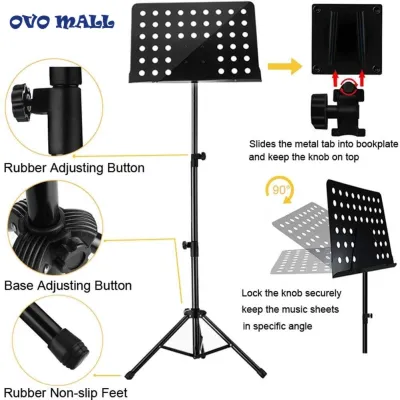
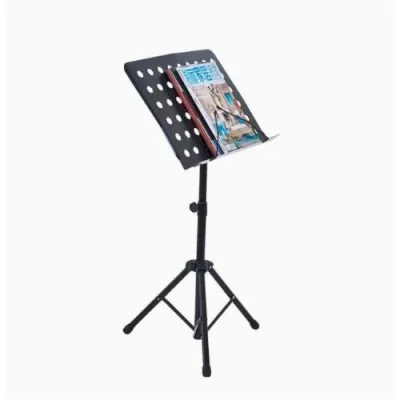
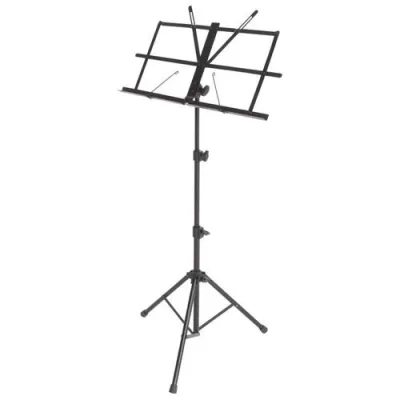
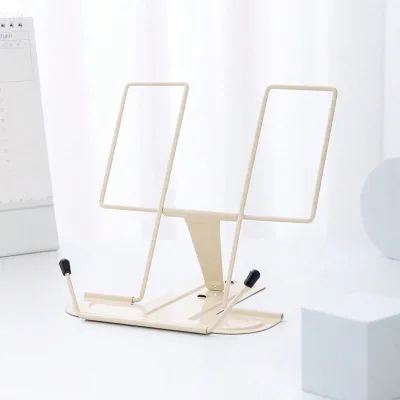
Prices are valid at publication and may change. Please refer to the product page for the latest price.
To select the perfect stand, you must evaluate three primary decision dimensions: height adjustability, desk design (including size and tilt mechanisms), and base stability. A “one-size-fits-all” approach fails because it ignores how these dimensions interact with specific instruments. A lightweight, collapsible wire stand might be highly portable, but it will quickly buckle under the weight of a heavy piano anthology or tip over at the maximum height required by a standing violinist. By analyzing your instrument’s specific spatial and physical requirements, you can identify the exact specifications needed to create an ergonomic and secure practice environment.
What Piano Players Need: Wide Desks and Seated Ergonomics
While acoustic pianos are equipped with integrated music desks, digital keyboards, synthesizers, and stage pianos often require an external music stand. Even acoustic players sometimes need a secondary stand when performing large orchestral scores that exceed the width of the piano’s built-in music rest. For these musicians, selecting a stand involves understanding the unique ergonomics of fixed seated playing.

Height and Distance Alignment
- Fixed Seated Position: Piano players sit at a fixed distance from their keys, meaning they cannot easily lean forward to read small print without disrupting their playing posture and hand positioning.
- Line of Sight: The music stand must be positioned so that the sheet music sits directly in the player's natural line of sight, slightly below eye level.
- Peripheral Awareness: This height alignment allows the performer to read the score while keeping the keyboard in their peripheral vision, eliminating the need to constantly look up and down, which strains the neck muscles.
Desk Size and Solid-Back Construction
- Solid-Back Desks: A solid wood or heavy-gauge metal desk provides a continuous, rigid surface that prevents individual sheets from bending and supports heavy books without flexing.
- Ledge Depth: Look for a bottom lip or ledge with a depth of at least 5 centimeters to accommodate thick scores or protective tablet cases securely.
- Page Retainers: Built-in spring arms or page pegs are highly beneficial for keeping bound books flat and preventing pages from self-turning during a performance.
Stability Over Portability
- Stationary Setup: Because piano stands are typically set up permanently in a home studio or practice room, portability is a secondary concern.
- Robust Base: A heavy, robust base—such as a cast-iron tripod or a weighted flat plate—is highly desirable.
- Secure Page Turns: This added weight ensures the stand remains completely stationary, even when you are turning pages rapidly or adjusting a tablet screen mid-piece.
What Guitarists Need: Base Clearance and Adjustable Tilt
Guitarists face a unique physical challenge: the bulky body of the instrument sits directly in front of their torso, creating a physical barrier between themselves and the music stand. Whether playing classical, acoustic, or electric guitar, the stand must be positioned to accommodate this physical bulk without forcing the player into an awkward posture.
Height and Base Clearance
- Low-Profile Bases: Classical guitarists who use a footstool need a stand with a compact, low-profile tripod base that can slide easily under their chair or footstool.
- Central Shaft Adjustment: For electric and acoustic players who play seated, the stand's central shaft must be highly adjustable, allowing the desk to be raised high enough to clear the neck and headstock of the guitar while remaining close enough for easy reading.
- Instrument Clearance: This prevents the deep body of acoustic and classical guitars from bumping into the stand's vertical shaft or tripod legs.
Desk Tilt Mechanism
- Friction-Tilt vs. Locking Knobs: Friction-tilt mechanisms are convenient but can slip over time. For heavy use, a secure locking knob with teeth or a heavy-duty compression clutch is preferred to keep the desk at the exact angle required.
- Angle Range: Ensure the desk can tilt back at least 45 to 60 degrees, allowing you to position the music in a way that aligns with your downward gaze without forcing you to slouch.
- Ergonomic Alignment: Guitarists often look down at their instrument's fretboard, meaning their line of sight is naturally angled downward. A highly adjustable and secure tilt mechanism is essential to maintain good ergonomics.
Portability for Gigging and Rehearsals
- Collapsible Wire Stands: These are incredibly lightweight and fold down into a compact carrying bag, making them easy to transport alongside a guitar case and amplifier. However, they sacrifice stability and are easily knocked over.
- Three-Piece Orchestral Stands: These offer a middle ground, featuring a detachable solid desk and a collapsible tripod base, providing excellent stability while remaining relatively easy to pack into a car boot.
What Violinists Need: Maximum Height and Standing Stability
Violinists and violists have highly specific physical requirements due to their asymmetric playing posture and the fact that they frequently practice and perform while standing. Because the violin is held up at shoulder height, the player’s eyes are positioned relatively high, demanding a stand that can achieve significant elevation without sacrificing structural integrity.
Maximum Height Range
- Multi-Stage Shafts: Look for stands with three-tier telescoping shafts rather than two-tier systems, as they provide greater height flexibility while maintaining a thicker, sturdier tube diameter at the base.
- Secure Height Clutches: Ensure the height adjustment clutch—whether a threaded knob, a quick-release lever, or a pressure clutch—is made of high-quality metal or durable composite material to prevent the stand from slowly sinking during a performance.
- Standing Eye Level: A standing adult violinist needs a music stand that can extend its desk to a height of 1.2 to 1.6 meters (measured from the floor to the bottom of the lip). At this height, cheap or lightweight stands often become incredibly unstable as the center of gravity shifts upward.
Desk Size and Weight Trade-Offs
- Lightweight Materials: Violin sheet music is typically printed on lightweight, single-sheet parts or thin booklets rather than heavy anthologies. This means violinists do not necessarily need a massive, heavy solid-steel desk.
- Perforated Desks: A lightweight aluminum solid desk or a high-quality perforated desk (which features holes to reduce weight) is often the ideal choice.
- Reduced Top-Heaviness: This reduces the top-heavy nature of the stand while still providing a flat, stable writing surface for taking bowing notes.
Standing Stability and Environmental Adaptability
- Base Footprint: A wider base footprint provides a much lower center of gravity, making the stand highly resistant to tipping during expressive body movements.
- Draft Considerations: For musicians performing in outdoor settings or air-conditioned venues with strong overhead drafts (common in Singapore), wind can easily catch sheet music and act as a sail, tipping a lightweight stand over.
- Weight Anchors: Using a stand with a heavy base, or one that allows you to hang a weight or sandbag from the central collar, is highly recommended to ensure your setup remains secure.
Can One Music Stand Work for Piano, Guitar, and Violin?
For multi-instrumentalists, music schools, or households with multiple musicians, purchasing a separate stand for every instrument is often impractical due to cost and space constraints. While a single “universal” stand is possible, it requires understanding the inevitable design compromises and choosing a model that can adapt to different playing scenarios.
The Orchestral Stand Compromise
- Heavy-Duty Construction: The only category of music stand that can successfully accommodate piano, guitar, and violin is the heavy-duty, solid-desk orchestral stand.
- Adaptable Specifications: These stands feature thick steel central shafts with exceptional height ranges (suitable for standing violinists), wide and deep solid desks (suitable for heavy piano books), and robust tripod or weighted bases (providing the stability needed for all three instruments).
- Space Trade-Off: The primary compromise here is portability and space; these stands are heavy, do not fold down into a compact size, and require a permanent footprint in your room.
Why Desktop Stands Fail
- Height Limitations: Desktop stands that sit on a table or desk are completely useless for a standing violinist.
- Clearance Issues: They are highly impractical for a guitarist, as they cannot be positioned at the correct height or distance to clear the instrument's body.
- Floor-Standing Necessity: A proper floor-standing model is the only viable option for a true multi-instrument setup.
How to Balance the Compromises
- Prioritize Max Height: If you must share a single stand across these three instruments, you should prioritize maximum height extension and a solid, wide desk.
- Accommodate Seated Positions: It is far easier for a seated guitarist or pianist to use a slightly heavier, taller stand than it is for a standing violinist to use a stand that is too short or unstable.
- Accept Weight Trade-Offs: Accept the trade-off of extra physical weight and longer setup times in exchange for a single, highly durable stand that safely supports all your musical endeavors.
Pre-Purchase Checklist for Musicians in Singapore
Before purchasing a music stand, it is essential to verify the physical specifications and material construction to ensure it is suitable for your home environment and the local climate. This checklist will help you make a reliable decision.
- Space and Storage Constraints: Measure your dedicated practice area. If you live in a typical HDB flat or apartment where space is at a premium, check the stand's folded dimensions and base footprint. A collapsible tripod base that can be tucked away in a closet when not in use is highly advantageous for compact living spaces.
- Climate and Material Care: Singapore's high relative humidity can accelerate the rusting of cheap, untreated steel joints and adjustment screws. Prioritize stands constructed from high-grade aluminum, powder-coated steel, or those featuring rust-resistant coatings to ensure smooth operation and longevity.
- Specification Verification: Do not rely solely on generic online listing titles. Always verify the manufacturer's official specifications for maximum height, desk dimensions, and weight capacity to ensure it meets the specific physical requirements of your instrument.
- Accessory Compatibility: If you regularly use a digital tablet, tuner, metronome, or pencil during practice, ensure the stand's lip is wide enough to accommodate these accessories, or look for models that support attachable utility trays.
Community discussion
Share your experience or ask a question. Comments are reviewed before publication.