
Selecting the right O-Level Physics assessment book is less about finding a single “best” title and more about matching the resource to your current academic standing and specific learning gaps. With various formats available—from topical drills to yearly past papers—understanding how to align a book’s structure with your personal study needs is the most effective way to improve your results. This guide provides a framework to help you assess your current level, understand the types of books available, and make an informed purchasing decision.
Physics is a cumulative subject where conceptual gaps in early topics, such as Kinematics or Dynamics, can severely hinder your ability to grasp later chapters like Work, Energy, and Power. Consequently, buying a book that is too advanced can lead to frustration, while a book that is too simple will not provide the stretch needed to secure an excellent grade. By objectively evaluating your current performance and understanding the specific purpose of each assessment book category, you can build a targeted study plan that maximizes your preparation time.
Assessing Your Current Physics Grade and Learning Gaps
To choose the most effective study companion, you must first establish an accurate baseline of your current academic performance. School examination scores are the most reliable starting point, but they must be interpreted alongside qualitative feedback from your teachers and a close analysis of your past test papers.
Products mentioned in this guide
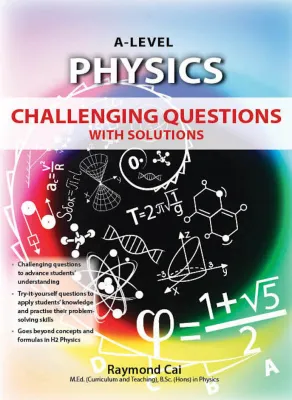
Prices are valid at publication and may change. Please refer to the product page for the latest price.
If your current grades consistently fall below the 50% mark (typically equivalent to a D7, E8, or F9 grade), your primary challenge is likely a lack of conceptual clarity. At this level, students often struggle to recall fundamental definitions, confuse related physical quantities (such as mass and weight, or speed and velocity), or fail to state basic physical laws. If you find yourself staring at a question without knowing which formula to apply, or if you frequently leave structured questions blank, your immediate need is foundational reinforcement rather than high-volume exam practice.
For mid-tier students scoring between 50% and 65% (C6 to B4 grades), the diagnostic picture is usually more nuanced. You likely understand the core concepts but struggle with the application of formulas in non-routine scenarios. Common issues at this level include mathematical calculation errors, failure to convert units to standard SI units, or difficulty with multi-step problem-solving. For example, you might know the formula for electrical power ($P = VI$) but struggle to integrate it with Ohm’s law ($V = IR$) to solve a complex circuit problem.
High-achieving students scoring 70% and above (A2 to A1 grades) face a different set of challenges. At this stage, errors are rarely due to a lack of understanding. Instead, they stem from minor lapses in precision, poor time management under exam conditions, or an inability to tackle novel, higher-order thinking questions that require synthesizing concepts from different chapters. If you are scoring in this range, you need resources that challenge your critical thinking and expose you to uncommon question formats.
Beyond grades, you must also identify secondary exam-related issues. Do you frequently run out of time during Paper 2? Do you lose marks because you misread the question instructions, perhaps describing a trend when the question asked you to explain it? Reviewing your teacher’s feedback on your scripts will help you determine whether your gaps are conceptual, mathematical, or tactical.
Understanding the Types of O-Level Physics Assessment Books
The educational market offers several distinct categories of O-Level Physics assessment books, each designed to serve a specific pedagogical purpose. Understanding these categories prevents you from purchasing redundant resources and helps you select the exact tool needed for your current study phase.

Topical practice books are organized chronologically according to the chapters in the official syllabus. These books are ideal for progressive learning throughout the academic year. As your teacher finishes a topic in class—such as Light or Thermal Physics—you can immediately reinforce your learning by completing the corresponding chapter in your topical book. This targeted drilling helps solidify concepts before moving on to new material, making these books indispensable for building a strong foundation.
Yearly past paper compilations contain actual national examination papers from previous years, presented in their original format. These compilations are essential for the final stages of exam preparation. They allow you to experience the actual flow of the paper, practice transitioning quickly between unrelated topics, and build the mental stamina required for the actual examination. Working through yearly papers also helps you become familiar with the standard phrasing of questions and the specific expectations of examiners.
Conceptual guides and summary notes focus on theory reinforcement rather than extensive question drilling. These books typically feature concise mind maps, formula sheets, definitions of key terms, and side-by-side comparisons of common student misconceptions. While they do not provide enough practice questions to build problem-solving fluency on their own, they are highly valuable for quick revision sessions, pre-exam warm-ups, or clarifying a difficult theoretical point when you do not have your full textbook on hand.
Advanced or challenging problem sets are curated specifically for high-performing students. These books feature non-routine questions, integrated problems that span multiple syllabus topics, and questions modeled after the most difficult past-year exam items. The primary goal of these resources is to stretch your analytical skills, teach you how to apply physics principles to unfamiliar real-world contexts, and build the confidence needed to secure a distinction.
Matching Book Types to Your Academic Level
Once you have assessed your current grade and understand the available book types, you can use a structured approach to match the right resource to your academic level. This targeted selection ensures that your study time is spent efficiently and that you are neither overwhelmed nor under-challenged.
For struggling or borderline students, the priority must be rebuilding confidence and establishing a solid conceptual foundation. If you are in this category, you should avoid yearly past paper compilations entirely in the initial stages of your revision. Attempting full exam papers when you cannot recall basic formulas will only lead to frustration. Instead, select a topical practice book that features comprehensive, step-by-step worked examples. Look for books that break down complex problems into smaller, manageable sub-questions. Your goal should be to master the basic calculations and recall key definitions for each chapter before attempting more complex application questions.
Mid-tier students require a balanced, dual-track revision strategy. You should use topical books to target your specific weak areas while gradually introducing exam-style practice. For instance, if your school test results indicate that you consistently lose marks in Electromagnetism, you should use a topical book to drill that specific chapter. At the same time, you can begin working through thematic past-year compilations or introductory exam papers to build familiarity with the overall paper structure. Focus on improving the precision of your structured answers, ensuring you use exact scientific keywords to secure full marks.
High-achieving students should focus almost exclusively on advanced problem sets and strict, timed yearly past papers. If you are already scoring well, standard topical books will offer little benefit and may lead to complacency. Instead, use challenging problem sets to expose yourself to novel scenarios and complex, multi-step calculations. When working through yearly past papers, simulate actual exam conditions by setting a strict timer and working in a quiet environment. This practice will help you refine your time management, train you to read questions with extreme care, and help you eliminate careless mistakes.
As the O-Level examination draws closer, your choice of assessment books must transition to reflect your changing needs. Early in the academic year, your study should be dominated by topical practice to ensure no chapter is left unmastered. In the final months leading up to the exam, your focus must shift decisively toward yearly past papers and timed mock trials. This transition ensures that you enter the exam hall with both deep conceptual knowledge and sharp exam-taking instincts.
What to Check Before Buying an Assessment Book
Before finalizing your purchase at a bookstore or online marketplace, there are several critical factors you must verify to ensure the book is a valuable addition to your study routine.
First, verify the syllabus alignment. The Singapore-Cambridge GCE O-Level Physics syllabus is subject to periodic updates by the Singapore Examinations and Assessment Board (SEAB). An outdated book may contain topics that have been removed from the current syllabus, or it may omit new learning outcomes that are now examinable. Always check the publication or revision date on the copyright page and ensure the content matches the specific syllabus code prescribed for your examination year. Never infer the exact edition or syllabus coverage solely from the book’s cover design or title.
Second, examine the quality of the answer key and content completeness. A high-quality answer key is a vital learning tool, especially for self-directed study. Verify that the full answer key is included in the purchase, as some publications require a separate purchase or online registration to access solutions. Avoid books that only provide final numerical answers or brief, one-word responses. Instead, look for books that offer detailed, step-by-step worked solutions for mathematical questions, showing how formulas are rearranged and how units are converted. For structured explanation questions, the answer key should highlight the specific keywords and phrases required to earn marks, helping you understand the exact logic examiners expect.
Third, assess the physical layout, usability, and medium of the book. Consider whether there is sufficient blank space provided for you to write down your calculations, draw free-body diagrams, or sketch ray diagrams directly on the page. If you are purchasing a digital version or an e-book, verify the file format, device compatibility, and any regional restrictions that might affect access. For physical books, ensure that all diagrams, graphs, and circuit schematics are printed clearly and are large enough to read without straining.
Finally, consider the publisher’s reputation and any supplementary features. Established educational publishers often have rigorous editorial standards, reducing the likelihood of typographical errors or incorrect answers in the key. Some modern assessment books also include helpful digital features, such as QR codes linking to video explanations of difficult problems, online diagnostic tests, or downloadable summary sheets. These extra resources can provide valuable support when you encounter a particularly challenging concept at home.
Frequently Asked Questions (FAQ)
Is it necessary to buy multiple assessment books for O-Level Physics?
While you do not need a large stack of books, relying on a single resource is rarely sufficient because different books serve different stages of your revision. A highly effective approach is to purchase two complementary books: one comprehensive topical practice book for use throughout the year, and one yearly past paper compilation for the final run-up to the exams. This combination ensures you can build a strong foundation topic by topic and then transition smoothly to full exam simulation. Avoid buying multiple books of the same type, as this often leads to resource overload, half-completed pages, and unnecessary stress.
How early should I start using yearly past paper compilations?
You should generally begin working on yearly past paper compilations once you have covered the vast majority of the O-Level Physics syllabus, which typically occurs around the middle of Secondary 4. Attempting full yearly papers too early can be counterproductive and discouraging, as many exam questions integrate concepts from multiple chapters that you may not have studied yet. A good transitional step is to use topical past-year compilations earlier in the year, allowing you to practice actual exam questions on specific topics as you learn them, before moving to full, timed yearly papers closer to your preliminary exams.
Are digital versions of assessment books as effective as physical copies?
For active practice, physical assessment books are generally more effective than digital versions. The O-Level Physics examination is a written paper that requires you to draw precise diagrams, plot graphs, and write out mathematical workings by hand. Practicing on physical paper helps you develop the spatial awareness and handwriting speed needed for the actual exam. However, digital versions, such as e-books or PDF guides, are highly convenient for carrying conceptual notes, formula sheets, or quick-reference answer keys without adding weight to your school bag, making them excellent tools for passive revision on the go.
Community discussion
Share your experience or ask a question. Comments are reviewed before publication.