
Finding the right ukulele padded bag is not as simple as matching the word “tenor” on your instrument’s label to the word “tenor” on a bag’s packaging. Standard size categories serve as general guidelines, but variations in body shape, headstock length, and bridge height across different brands can lead to a frustratingly tight or dangerously loose fit. For musicians navigating Singapore’s highly humid climate and busy public transit systems, securing a bag with the precise internal dimensions and appropriate padding thickness is essential to protect the wood from physical impacts and sudden environmental shifts.
A properly fitted padded bag acts as a crucial buffer for your instrument, shielding delicate tonewoods from structural damage during daily travel. Whether you are carrying a compact soprano to a casual gathering at East Coast Park or transporting a premium baritone to a recording studio, understanding how to measure your instrument and evaluate bag specifications will prevent costly repairs. By focusing on exact measurements rather than generic labels, you can confidently select a protective case that keeps your ukulele secure, stable, and in tune.
Understand Your Ukulele's Exact Dimensions
Relying solely on standard size classifications like “Soprano” or “Tenor” frequently results in a poor fit because manufacturers do not follow a single, universal blueprint. A pineapple-shaped soprano ukulele, for example, lacks the narrow waist of a traditional figure-eight model, requiring a wider midsection in the bag. Similarly, custom-built instruments, travel models with ultra-thin bodies, or ukuleles featuring extended headstocks and vintage-style friction pegs often deviate significantly from standard dimensions, making a generic bag choice highly risky.
Products mentioned in this guide
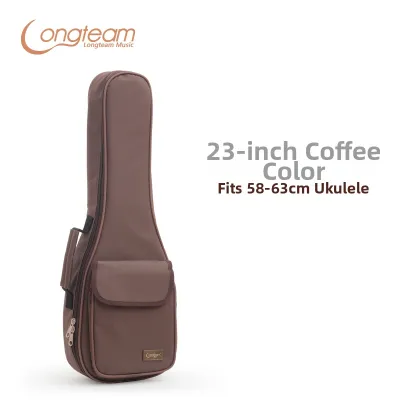

Prices are valid at publication and may change. Please refer to the product page for the latest price.
To find a bag that offers genuine protection, you must obtain precise physical measurements of your instrument. Start by measuring the total length, which is the straight-line distance from the very top tip of the headstock to the bottom edge of the lower bout. If your tuning pegs protrude past the top or sides of the headstock, ensure your measurement accounts for these outer edges, as tight bag corners can easily knock your instrument out of tune or bend the tuner posts.
Next, measure the body width at its widest point, which is typically the lower bout of the instrument. You should also measure the width of the upper bout and the narrowest part of the waist if you are considering a highly contoured or hard-shell hybrid bag. Following this, measure the body depth at the thickest part of the instrument, laying the ukulele flat on a level surface and measuring vertically to the highest point of the bridge or strings to ensure the top soundboard will not be subjected to downward pressure.
Keep these exact measurements recorded in both centimeters and inches. Having these numbers readily available allows you to compare them directly against the detailed internal specifications provided by bag manufacturers. When browsing online marketplaces or visiting local music shops in Singapore, referencing your instrument’s actual physical footprint is the most reliable way to avoid the hassle of returning an ill-fitting accessory.
Match Ukulele Sizes to Standard Padded Bag Categories
Soprano and Concert Ukulele Bags
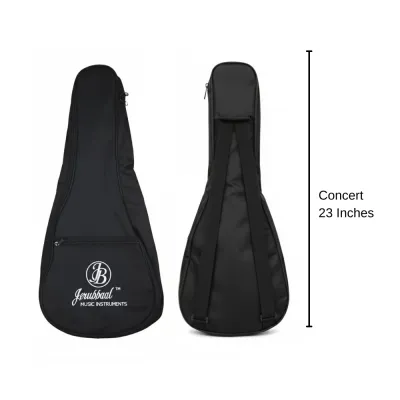
Soprano ukuleles are the smallest and most traditional models, generally measuring around 53 cm in total length, while Concert ukuleles are slightly larger, typically averaging around 58 cm with a longer scale length and a more pronounced body. This difference in scale length means a Concert neck is longer and its headstock sits higher, requiring a bag that accommodates the extra span without bending the neck joint.

Attempting to force a Concert ukulele into a snug Soprano bag is a common mistake that can cause severe, irreversible damage to the instrument. Even if you manage to stretch the fabric and force the zipper shut, the resulting tension puts continuous, localized pressure on the bridge and the delicate soundboard. Over time, this constant structural stress can lift the bridge off the body, warp the neck, or crack the soundboard, especially when exposed to the high humidity levels common in tropical environments.
A properly fitted Soprano or Concert bag should provide a small amount of clearance—ideally about 1 to 2 cm—around the headstock. This space ensures that you can zip the bag easily without the metal zipper teeth scraping against the wood or finish of your headstock. It also prevents the tuning pegs from being turned or damaged by the inner seams of the bag during transit.
Tenor and Baritone Ukulele Bags
Tenor and Baritone ukuleles feature much larger body depths, wider lower bouts, and longer necks to project their deeper, richer tones. Tenor models usually measure around 66 cm in length, while Baritone models—the largest of the standard family—frequently reach 76 cm or more, resembling small acoustic guitars in both scale and volume.
Using generic acoustic guitar bags or oversized “large” instrument cases for these ukuleles is highly counterproductive. Because standard guitar bags are proportioned for much wider and longer instruments, a Tenor or Baritone ukulele will slide freely inside the excess space, rendering the padding useless during a fall. The lack of structural support allows the headstock to collide repeatedly with the interior walls, which can loosen the tuning machines or fracture the neck joint.
When selecting a bag for a Baritone model, pay close attention to the internal depth and lower bout width. Baritone bodies are deep, often requiring at least 8 to 10 cm of vertical space to prevent the zipper track from pressing tightly against the wooden edges. If the bag lacks sufficient depth clearance, any external impact on the zipper line will be transferred directly to the wood, risking finish chips, cracks, or seam separations along the body of your instrument.
Check Internal vs. External Bag Dimensions and Padding Thickness
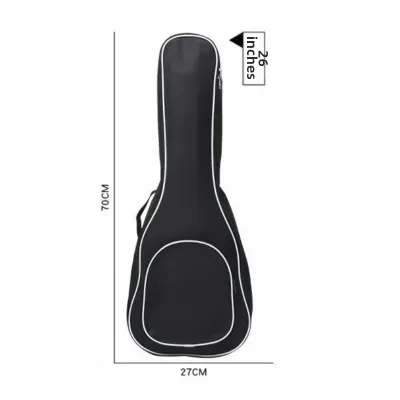
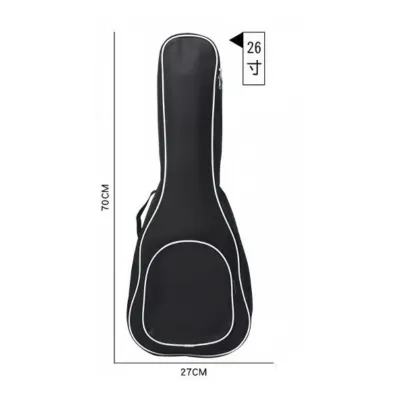
It is critical to distinguish between a bag’s external dimensions and its actual usable internal space. External dimensions are useful for determining if a bag will fit into an overhead compartment or a storage closet, but they do not represent the space available for your ukulele. A bag that appears large and protective from the outside may actually have a very cramped interior due to thick, protective walls.
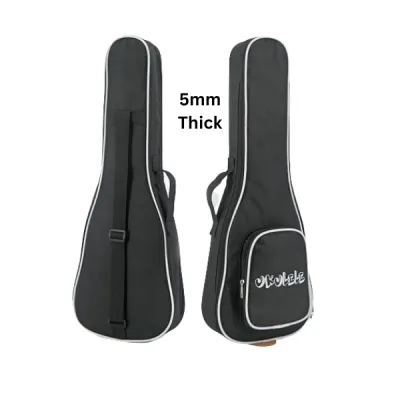
The thickness of the internal padding—typically ranging from 5mm of basic fabric lining to 20mm or more of high-density foam—directly reduces the usable space inside the bag. For instance, a bag advertised with 20mm padding will have an internal length that is at least 40mm (4 cm) shorter than its external length, and an internal width that is similarly reduced. Failing to account for this padding thickness is a primary reason why musicians accidentally purchase bags that are too tight for their instruments.
To find the true internal dimensions, always consult the manufacturer’s detailed specification sheet or product manual. If the manufacturer only lists external dimensions, you can estimate the internal space by subtracting twice the stated padding thickness, plus an additional 1 to 2 cm for seam allowances, from the external length, width, and depth. If the calculations place your ukulele’s measurements close to the estimated limit, always opt for the next size up to prevent compression.
Choosing the right padding thickness involves a direct trade-off between maximum physical protection and carrying convenience. High-density foam of 15mm to 25mm offers exceptional shock absorption, making it the preferred choice if you regularly commute on crowded MRT trains or buses where bumps are inevitable. However, this level of protection results in a bulkier, heavier bag; for simple home storage or short car trips, a lighter 10mm padded bag may offer sufficient protection while remaining highly portable and easy to store.
Evaluate Extra Features for Fit and Protection
A well-designed ukulele padded bag relies on internal structural features to keep the instrument secure, rather than relying solely on a tight fabric fit. Look for bags equipped with an internal neck support block or a padded neck cradle, which often includes a Velcro tie-down strap. This feature suspends the neck and headstock away from the back of the bag, preventing the headstock from hitting the ground if the bag is dropped vertically and isolating the neck joint from sudden rotational forces.
The material lining the interior of the bag is just as important as the padding underneath it. Ensure the bag features a soft, non-abrasive inner lining, such as microfiber, soft flannel, or brushed nylon, to prevent micro-scratches on your ukulele’s finish. Rough polyester or coarse nylon linings can act like fine sandpaper, gradually wearing away satin finishes or scratching high-gloss lacquers, particularly around the bridge, headstock, and edges of the body.
While exterior accessory pockets are highly convenient for carrying spare strings, cleaning cloths, and chord charts, they must be used with caution. Avoid overstuffing these pockets with heavy, hard, or bulky items like metal capos, large clip-on tuners, or heavy keychains. When the bag is zipped shut and carried, these hard objects can press directly through the thin fabric pocket and the bag’s main padding, exerting concentrated pressure on the fragile wooden soundboard of your ukulele and potentially causing cracks.
For larger and heavier instruments like Tenor and Baritone models, evaluate the quality of the carrying straps and handles. Look for reinforced, adjustable backpack straps with breathable mesh padding, which makes carrying the instrument comfortable during long walks in warm, humid weather. The main side handle should be heavily padded and securely stitched to the body of the bag with steel rivets or reinforced box stitching to prevent sudden handle failure while you are on the move.
Step-by-Step Guide to Testing the Fit
Before committing to a new padded bag, perform these sequential tests to verify that the fit is correct and that your instrument is fully protected. Always consult your ukulele manufacturer’s care instructions before applying any physical pressure or using bags made of materials that might react with specific wood finishes.
- Step 1: The Insertion Test. Open the bag completely and slide your ukulele inside. The instrument should settle into the bottom of the bag smoothly and naturally. If you have to wiggle, twist, or force the lower bout past the zipper line, or if the fabric must stretch tightly over the body, the bag is too small and should not be used.
- Step 2: The Clearance Check. Slowly pull the zipper closed, paying close attention to the path of the zipper teeth. The zipper must glide smoothly without catching on the edges of the ukulele's body, bridge, or headstock. There should be a thick fabric flap, known as a zipper guard, running along the inside of the zipper track to prevent the metal or plastic teeth from scratching the wood.
- Step 3: The Shake Test. Zip the bag completely, lift it by the main side handle, and give it a very gentle, controlled shake. If you feel or hear the ukulele sliding from side to side or shifting up and down inside the bag, the compartment is too large. This excess movement means the padding cannot properly absorb impacts, as the instrument will build momentum before striking the inner walls during a fall.
- Step 4: The Pressure Check. Lay the zipped bag flat on a table and gently press your hand against the outside of the bag, directly over the center of the soundboard and the back. The padding should feel firm and resilient, absorbing your hand's pressure before your fingers can detect the hard wood of the instrument underneath. If you can easily feel the wood with light pressure, the padding is either too thin or too soft to offer reliable protection.
Frequently Asked Questions (FAQ)
Can I use a tenor ukulele bag for a concert ukulele?
While a Concert ukulele will physically fit inside a larger Tenor bag, doing so is not recommended for regular transport. The excess space allows the instrument to slide around freely, which can lead to cosmetic scratches, loose tuning pegs, or structural damage if the neck collides with the inside of the bag during a sudden stop. If you must use a larger bag temporarily, wrap the ukulele in a clean, soft microfiber cloth to fill the extra space and prevent movement.
Does a thicker padded bag always mean better protection?
Thicker padding, such as 20mm or 25mm foam, offers superior shock absorption against drops and bumps, but it must be paired with a proper fit. If the thick padding reduces the internal space so much that you have to force the bag closed, it creates constant, concentrated pressure on the ukulele’s bridge, neck, and tuning pegs. This continuous stress can warp the wood or damage the joints over time, meaning the best protection comes from a balance of adequate padding and a precise, relaxed internal fit.
Community discussion
Share your experience or ask a question. Comments are reviewed before publication.