
Practising the Easttop Forerunner 2.0 chromatic harmonica with sheet music and a tuner requires a balanced approach that coordinates visual reading, physical breath control, and real-time auditory feedback. Because this specific model features a valveless design, it offers a highly responsive playing experience but demands precise breath management to keep notes perfectly in tune. By establishing a structured routine that integrates these tools, you can systematically build muscle memory, correct intonation errors, and transition smoothly from reading notation to executing clean, expressive melodies.
Using a tuner alongside sheet music acts as an objective mirror for your playing. While sheet music provides the structural roadmap of notes, rhythms, and expressions, the tuner offers immediate, unbiased feedback on how your physical body is executing those instructions. For harmonica players, who cannot see their hands or mouth positions while playing, this visual feedback is invaluable for connecting physical sensations with accurate pitch production. Over time, this practice refines your ear, helping you internalize the exact breath pressure and oral shape required for every note on the instrument.
Setting Up Your Harmonica, Tuner, and Sheet Music
Before playing a single note, organizing your physical environment is essential for maintaining proper playing posture and ensuring your feedback tools work reliably. Start by calibrating your chromatic tuner to standard concert pitch, which is typically set to A=440Hz. Harmonica reeds produce complex overtones, so your tuner must be positioned close enough to clearly capture the fundamental frequency without picking up ambient room noise or reflections from nearby hard surfaces.
Products mentioned in this guide
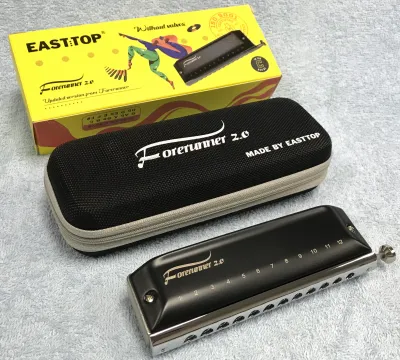
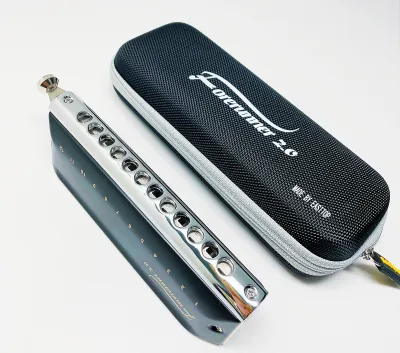
Prices are valid at publication and may change. Please refer to the product page for the latest price.
Position your music stand so that your sheet music sits directly at eye level. Looking down at a flat table or a low stand collapses your cervical spine, which constricts your throat and limits your lung capacity. Keeping your head upright opens your airway, allowing for the relaxed, diaphragmatic breathing necessary to control a valveless harmonica. Place your tuner slightly to the side of your sheet music, within your peripheral vision, so you can monitor pitch fluctuations without constantly turning your head away from the page.
In warm, humid environments like Singapore, moisture management is particularly important. High humidity can cause traditional harmonica valves to stick or buzz, which is why the valveless design of the Easttop Forerunner 2.0 is highly practical for local players. However, because there are no valves to block excess air, you must be even more diligent about clearing saliva and condensation from the chambers. Gently tap the harmonica against your palm to clear any residual moisture, and slide the button a few times to ensure smooth, silent action before you begin reading your sheet music.
A Structured Step-by-Step Practice Routine
A successful practice session relies on a logical progression that moves from physical preparation to detailed musical analysis. Rather than jumping straight into complex pieces, divide your time into distinct phases that target tone production, phrase isolation, and active pitch adjustment.

Warming Up with Long Tones
Begin your routine by playing sustained long tones across the entire range of the harmonica, starting from the middle register and moving outward. Focus on drawing and blowing steady, even streams of air through a single hole for several seconds at a time. This exercise warms up the metal reeds, stabilizes your breath pressure, and helps you establish a relaxed, comfortable embouchure.
As you hold each note, watch your tuner’s display to observe how your pitch behaves over the duration of the breath. A steady pitch should register as a solid, unmoving indicator on the screen; if the needle or light wavers, it indicates that your breath pressure is fluctuating or your jaw is tensing. Use this visual feedback to adjust your physical effort, aiming for the minimum amount of breath required to make the reed vibrate clearly and consistently.
Maintain a conscious focus on physical relaxation throughout this warm-up phase. Tension in your shoulders, neck, or facial muscles will directly alter the shape of your oral cavity, which acts as the chamber for your tone. By keeping your jaw loose and your tongue resting low, you create a larger resonant space that produces a warmer, more stable sound while preventing premature fatigue during longer reading sessions.
Breaking Down Sheet Music into Phrases
When you transition to your sheet music, resist the urge to play through an entire piece from start to finish. Instead, isolate a single phrase or a small block of two to four measures to analyze and master. Breaking the music down into manageable segments prevents cognitive overload and allows you to focus entirely on the physical mechanics of each note transition.
Prioritize clean hole isolation and precise slide transitions at a very slow, deliberate tempo. The Easttop Forerunner 2.0 requires clean lateral movement along the mouthpiece to avoid accidental double-tones, especially since there are no valves to restrict air leakage on adjacent holes. Practice moving slowly between notes, ensuring that each pitch sounds fully and cleanly before your tongue or lips shift to the next position.
Repeat these isolated phrases multiple times until the physical movements feel natural and automatic. Your goal is to build reliable muscle memory so that your hand and mouth know exactly where to go without you needing to look down at the instrument. Once you can play the phrase smoothly and accurately without hesitation, you can begin connecting it to the surrounding measures.
Using the Tuner for Active Pitch Correction
Once you can play a phrase from memory or read it smoothly, introduce the tuner to perform active, real-time pitch correction. Play through the selected passage slowly, pausing on longer notes to check their intonation on the screen. This step helps you identify which specific notes or slide transitions tend to drift sharp or flat during active play.
If you notice a note consistently registering off-pitch, experiment with subtle physical adjustments to correct the deviation. For notes that run sharp, try relaxing your breath pressure or lowering your tongue slightly to enlarge your oral cavity. For flat notes, ensure your embouchure is not pinching the mouthpiece too tightly, and verify that your air stream is directed straight into the chamber rather than at an angle.
Learning to balance your visual attention between the sheet music and the tuner is a skill that takes conscious practice. Avoid staring fixedly at the tuner’s screen, as this will break your reading flow and disrupt the rhythmic pulse of the music. Instead, keep your primary focus on the notation, using quick, peripheral glances at the tuner only during sustained notes or at the ends of phrases to verify your pitch accuracy.
Common Pitfalls When Reading Music and Monitoring Pitch
Integrating electronic feedback with traditional music reading can introduce several counterproductive habits if not managed carefully. One of the most common mistakes is developing a dependency on the tuner’s visual display, where you play solely to satisfy the needle on the screen. This habit distracts you from reading ahead on your sheet music, leading to jerky rhythms, poor timing, and a complete loss of musical expression.
Another frequent pitfall is overblowing or forcing excessive air through the harmonica to make the tuner register a note more quickly. Because the Forerunner 2.0 is valveless, pushing too much air through the chambers does not make the instrument sound better; instead, it chokes the reeds, drives the pitch flat, and subjects the internal components to unnecessary stress. Always prioritize a gentle, controlled airflow that coaxes a natural, resonant tone from the instrument.
Additionally, players often struggle when they try to force every single note on the harmonica to align perfectly with absolute equal temperament. Harmonicas possess natural tuning characteristics designed to make chords sound harmonious, which means certain individual notes may naturally register slightly sharp or flat on a standard chromatic tuner. Learn to accept these minor, built-in variations rather than straining your embouchure to correct microtonal differences that are inherent to the instrument’s design.
Evaluating Your Progress and Next Steps
To ensure your practice sessions remain effective over time, you must establish objective ways to evaluate your progress. A highly reliable method is to record audio of your practice sessions using a smartphone or a portable recorder. Listening back to your playing away from the instrument allows you to evaluate your pitch, tone quality, and rhythmic accuracy without the distraction of physical execution or real-time visual feedback.
Use these recordings to identify recurring problem areas in your sheet music, such as specific slide transitions or wide interval jumps where your pitch consistently wavers. Note these measures down and use them to create a targeted list of exercises for your next practice session. This targeted approach ensures you spend your time resolving actual weaknesses rather than simply repeating sections you can already play well.
As your pitch stability and note accuracy improve, gradually increase your practice tempo using a steady reference. Only speed up your playing when you can execute a phrase perfectly at a slower tempo with stable intonation. Building speed on top of a shaky foundation will only reinforce poor habits, whereas a patient, step-by-step progression ensures your technique remains clean, precise, and musical.
Frequently Asked Questions (FAQ)
Do I need a chromatic tuner for the Easttop Forerunner 2.0?
Yes, a dedicated chromatic tuner is highly recommended for practicing with the Easttop Forerunner 2.0. Unlike instrument-specific tuners designed for guitars or brass, a chromatic tuner detects all twelve semitones of the chromatic scale, which is essential for a three-octave chromatic harmonica. It must be capable of tracking the harmonica’s rich harmonic overtones and fast transient responses without jumping erratically between octaves. A high-quality chromatic tuner app or a dedicated needle-style electronic tuner will provide the fast, accurate visual feedback needed to monitor both natural notes and slide-activated sharps or flats.
Should I use a metronome alongside the tuner and sheet music?
Integrating a metronome into your routine is incredibly beneficial for developing a strong sense of rhythm alongside pitch accuracy. However, trying to watch a tuner, read sheet music, and listen to a metronome all at once can easily lead to cognitive overload. To avoid this, separate your focus: use the metronome during your initial phrase-breaking steps to lock in your timing, and then switch to the tuner to refine your intonation on sustained notes. Once both elements feel secure, you can combine them at a slow tempo, using the metronome as your primary guide while relying on quick, peripheral glances at the tuner to verify your pitch.
Community discussion
Share your experience or ask a question. Comments are reviewed before publication.