
Solving a Murdle puzzle requires a systematic approach of elimination, structured tracking, and objective reasoning. Instead of relying on intuition or guessing, you must translate narrative clues into concrete relationships on a logic grid. By systematically matching suspects, weapons, locations, and motives, you can eliminate impossibilities until only the single, undeniable truth remains. This guide breaks down the exact steps to master these puzzles, helping you sharpen your deductive reasoning skills and solve even the most complex mystery books with ease.
Understanding the Core Mechanics of Murdle Puzzles
Murdle puzzles are modern murder mystery logic puzzles that rely on a classic deduction format. Each puzzle presents a crime scene with a set of variables: a list of suspects, potential murder weapons, locations where the crime or suspects could be, and sometimes motives or time slots. The fundamental rule governing these puzzles is one-to-one matching. This means each suspect is associated with exactly one unique weapon, one unique location, and one unique motive. If a suspect is found to have used the candlestick, no other suspect could have used it, and that suspect cannot be linked to any other weapon.
To solve these puzzles efficiently, you must learn to separate narrative flavor text from actionable logical constraints. Murdle books are highly thematic, filled with humorous dialogue, character descriptions, and dramatic backstories. While this flavor text makes the reading experience enjoyable, it does not contain the logical data needed to solve the puzzle. Actionable constraints are the specific statements that define relationships between variables, such as “the person with the dagger was in the library.” Your first task is to strip away the creative storytelling and isolate these core logical facts.
Products mentioned in this guide
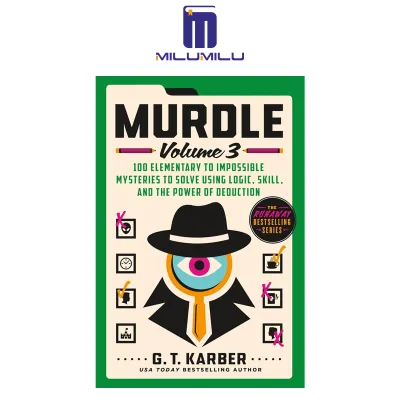
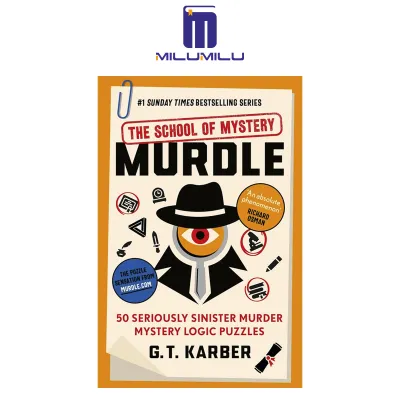
![[SG Stock] Murdle Puzzle Series Set By G. T. Karber Lot (6 Books)](https://img.lazcdn.com/g/p/04495be33b9035c8e0aae11558e0e768.jpg_400x400q80.jpg_.webp)
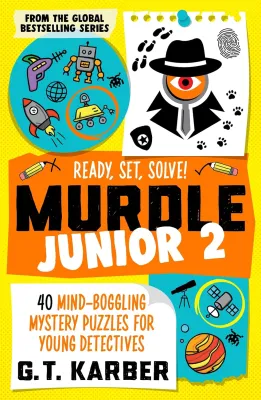
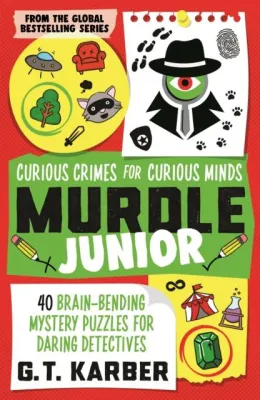
Prices are valid at publication and may change. Please refer to the product page for the latest price.
Setting Up Your Logic Grid
A logic grid is an indispensable tool that serves as your external brain, allowing you to track complex relationships without cluttering your memory. The grid is a multi-axis matrix where every variable is cross-referenced against every other variable. For a standard puzzle, this means mapping suspects against weapons, suspects against locations, and weapons against locations. You can draw this grid in a notebook, print a template, or use the pre-printed grids provided in your puzzle book.

To use the grid effectively, establish a consistent and clear notation system. The standard convention is to use a tick to represent a confirmed match and a cross to represent an eliminated possibility. When you confirm a match, that cell gets a tick, and the rest of its corresponding row and column in that sub-grid must be filled with crosses. Keeping your workspace clean and organized is vital; a single misplaced mark can cascade into a series of incorrect deductions, forcing you to restart the entire puzzle.
Step-by-Step Strategy to Crack the Case
Cracking a Murdle puzzle requires a disciplined workflow rather than a rushed, clue-by-clue approach. Before making a single mark on your grid, read through all the provided clues at least once. This initial reading gives you a holistic view of the scenario and helps you identify which clues are direct and which require other pieces of information to unlock.
Once you begin, grid filling becomes an iterative process where one deduction naturally unlocks the next. A clue that seems useless at the start of the puzzle often becomes the key to solving it once you have filled in a few ticks and crosses. Remember that a properly constructed logic puzzle never requires guessing. If you find yourself tempted to make an assumption, stop and re-examine your grid; there is always a logical path forward waiting to be discovered.
Processing Direct and Positive Clues
Direct and positive clues are the easiest to process because they explicitly confirm a relationship between two variables. Look for linguistic markers such as “was found with,” “always carries,” “was located in,” or “is the owner of.” These statements leave no room for ambiguity and allow you to make immediate updates to your logic grid.
When you encounter a positive clue, place a tick in the intersecting cell of the two matching variables. Immediately fill the remaining empty cells in that specific row and column with crosses, as no other variable can share that match. Furthermore, you must transfer this confirmed relationship across intersecting sub-grids. For example, if you know Suspect A was in the conservatory, and another clue reveals the person in the conservatory had the rope, you can immediately deduce that Suspect A had the rope.
Leveraging Negative Clues and Elimination
Negative clues are just as valuable as positive ones, as they allow you to systematically narrow down the possibilities. These clues are identified by exclusionary language such as “did not use,” “was not seen in,” “dislikes the person with,” or “has never been to.” Each negative clue allows you to place a cross in the corresponding cell, permanently eliminating that pairing.
As you populate the grid with crosses, monitor the rows and columns closely for situations where only one empty cell remains. Because of the one-to-one matching rule, if a row has crosses in every column except one, that remaining cell must be a tick. This process of elimination is the engine of logic puzzles; by proving where things cannot go, you inevitably discover exactly where they must go.
Synthesizing Intersecting Clues
As the puzzle progresses, you will need to combine multiple partial clues to deduce facts that are not explicitly stated in the text. This is known as making transitive deductions. For instance, if Clue 1 states that Suspect B was not in the kitchen, and Clue 2 states that the person with the wrench was in the kitchen, you can synthesize these facts to deduce that Suspect B did not have the wrench.
Every time you make a synthesized deduction, update your grid immediately to reflect the new information. This update often triggers a chain reaction, revealing new rows or columns with only one remaining option. After completing a major round of grid updates, make it a habit to re-read all the clues from the beginning; statements that previously made no sense will now reveal new, actionable insights.
Advanced Deductive Reasoning Techniques
When basic elimination stalls, you must employ advanced logical patterns to break through the bottleneck. One such technique is identifying “hidden pairs” or “naked pairs.” This occurs when you deduce that two specific variables must match with two other specific variables, even if you do not yet know which matches with which. For example, if you determine that only Suspect C or Suspect D could have used either the knife or the poison, you can eliminate the knife and poison as possibilities for all other suspects, clearing out those grid cells.
Conditional statements, often phrased as “if/then” scenarios, require you to map out logical consequences without assuming the initial condition is true. To process a clue like “if the suspect in the study had the lead pipe, then Suspect E is innocent,” you must test the hypothesis. If assuming the condition leads to a contradiction elsewhere in your grid, then the condition must be false, allowing you to place a cross in that cell.
Spatial and sequential constraints add another layer of complexity, often involving physical layouts or timelines, such as “the suspect with the medal arrived immediately after the suspect in the billiard room.” To translate these into grid limitations, you must map out the possible order of events or physical positions. If a suspect is known to have arrived first, they cannot be the one who “arrived immediately after” someone else, allowing you to eliminate that pairing instantly.
Common Pitfalls and How to Avoid Them
The most common pitfall in solving Murdle puzzles is the temptation to guess when the logical path is not immediately obvious. Guessing almost always leads to a corrupted grid, and because the errors compound quickly, finding where you went wrong becomes nearly impossible. If you feel stuck, it is rarely because the puzzle is broken; instead, you have likely missed a subtle deduction or failed to transfer a confirmed match across sub-grids.
Another frequent error is misreading complex phrasing or double negatives within the narrative clues. Phrases like “the suspect with the umbrella was not the one who did not go to the garden” can be intentionally confusing. Take your time to parse these sentences slowly, breaking them down into simpler logical statements before marking your grid.
If you do encounter a contradiction—such as a row with only crosses and no possible tick—use a systematic troubleshooting checklist. First, verify that you have correctly transferred all ticks to their corresponding rows and columns. Next, re-read each clue to ensure you did not misinterpret a negative statement as a positive one. If the error remains unresolved, it is usually best to erase the grid and start fresh, applying your clues with greater care.
Frequently Asked Questions (FAQ)
Do I need a specific type of pen or paper for a murdle book?
Using a high-quality pencil with a reliable eraser is highly recommended when working through a physical puzzle book. Because logic puzzles require absolute precision, a single mistaken mark can ruin your progress, and being able to cleanly erase errors prevents your grid from becoming unreadable. If the book’s layout feels cramped, you can use a ruler to keep your eyes aligned with the correct rows, or place a blank sheet of paper over completed sections to reduce visual distraction. For those who prefer a clean workspace, digital logic grid applications can also be used alongside the book to track your deductions electronically.
What should I do if I reach a contradiction in my logic grid?
If your grid reaches an impossible state, such as a suspect having two confirmed weapons or a row having no possible options left, stop immediately. Do not try to force a solution by changing random cells, as this will only compound the errors. Instead, trace back your last few moves to see if you made a mechanical error, such as forgetting to cross out a row after placing a tick. Re-read the most recent clues you processed to ensure you did not misinterpret a subtle clue, and if the source of the error cannot be found, erase the grid and begin again with a more deliberate approach.
How do I choose the right Murdle book edition to start with?
Before purchasing a Murdle book, verify the edition, language, and medium or file format to ensure it matches your preferences. If you prefer solving on physical paper, a high-quality paperback is ideal, whereas digital editions require device compatibility with your e-reader or tablet. Always check for content completeness and purchase from an authorized source to ensure you receive the full, unaltered logic grids and narrative clues. Base your choice on your current skill level, as these books often range from introductory mysteries to highly complex, multi-variable challenges.
Community discussion
Share your experience or ask a question. Comments are reviewed before publication.