
To determine whether a “Tibetan” singing bowl is an authentic, hand-hammered instrument or a mass-produced factory replica, you must evaluate its physical characteristics, acoustic profile, and the credibility of the seller. While many retail outlets and online marketplaces advertise “authentic antique” bowls, the vast majority of genuine singing bowls on the market are contemporary handcrafted pieces, while others are entirely machine-made.
True authenticity lies in the method of production: hand-hammering a traditional bronze alloy versus machine-casting or spinning brass. By carefully examining visual anomalies, listening for complex overtones, and vetting the seller’s documentation, you can confidently identify a genuine instrument that delivers the therapeutic resonance you seek.
The Reality of "Tibetan" Singing Bowls in Today's Market
The market for singing bowls is highly saturated, particularly in wellness spaces and online shops across Singapore. A common marketing tactic is labeling almost any golden-hued metal bowl as an “antique Tibetan” artifact. In reality, genuine antiques from Tibet or the broader Himalayan region are exceptionally rare and carry premium price tags. Most authentic bowls available today are actually hand-crafted in Nepal or Northern India using traditional methods, which is a perfectly respectable and genuine process.
Products mentioned in this guide
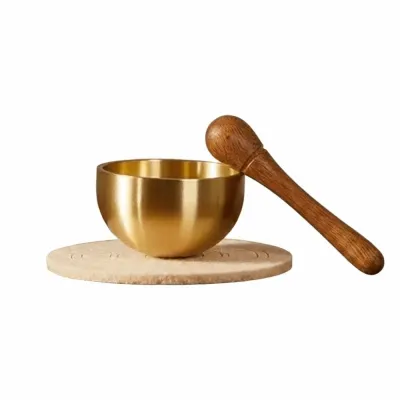
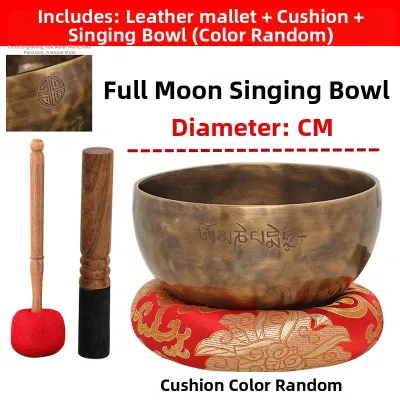
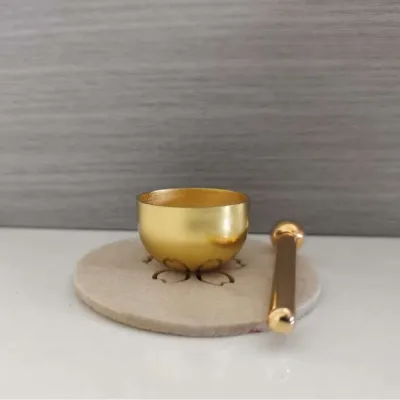
Prices are valid at publication and may change. Please refer to the product page for the latest price.
The real distinction you should focus on is not the age of the bowl, but how it was manufactured. Hand-hammered bowls are forged by teams of artisans who heat and hammer metal alloys over open flames, creating a unique molecular structure. On the other hand, mass-produced bowls are cast in molds or spun on industrial lathes, resulting in a uniform product that lacks acoustic depth.
“Authentic” in this context refers to the manufacturing method and material integrity rather than unverified antique claims. A genuine handcrafted bowl is made from a high-quality bronze alloy—traditionally a mix of copper and tin—which allows for rich vibrational resonance.
No single visual marker can guarantee authenticity, which is why a holistic evaluation of physical, acoustic, and sourcing factors is essential before making a purchase. By understanding what to look for, you can avoid paying premium prices for factory-made replicas.
Visual and Physical Markers of Handcrafted Craftsmanship
Identifying a handcrafted singing bowl requires a close physical inspection of its surface, shape, and weight. These tangible elements reveal the human labor involved in its creation.

Hammer Marks A genuine hand-hammered bowl will feature irregular, overlapping dimples that vary in size, depth, and angle across its surface. These marks are the direct result of multiple artisans taking turns striking the hot metal with hand-held hammers. In contrast, machine-made bowls are either perfectly smooth or feature highly uniform, concentric circular lines left by a lathe. If you see “hammer marks” that are perfectly spaced, identical in shape, or arranged in neat, repetitive patterns, they are likely stamped or rolled onto a machine-cast bowl to mimic a handcrafted appearance.
Asymmetry and Imperfections Handcrafted items are defined by their subtle irregularities. If you look at an authentic bowl from the top down, you will notice that it is rarely a perfect circle. The rim thickness will vary slightly around the circumference, and the lip may have minor waves or height differences. These variations are not defects; they are the natural consequences of manual shaping. If a bowl is flawlessly round with mathematically uniform wall thickness, it is almost certainly a product of modern industrial manufacturing.
Weight and Density The physical weight of a singing bowl can offer clues about its construction, though it must be interpreted carefully. Hand-hammered bowls are typically forged from bell bronze. This material and the intensive hammering process result in a dense, compact metal structure. When you hold a handcrafted bowl in your palm, it should feel surprisingly heavy and solid for its size, with a low center of gravity. Mass-produced brass bowls, especially cheaper spun varieties, often feel noticeably thin, light, and top-heavy when held.
Patina vs. Artificial Aging Authentic older bowls develop a natural patina over decades of handling and exposure to air. This patina is a soft, deep, and uneven oxidation layer that cannot be easily rubbed off. Many mass-produced bowls are artificially aged to look antique using chemical acid washes, painted-on dark finishes, or artificially induced rust. To spot these treatments, look for a strong chemical smell, powdery residue that transfers to your fingers, or high-contrast dark patches in areas that would naturally receive wear, such as the outer rim. Genuine wear is typically smoothest and lightest where the bowl is held or struck.
Sound and Vibration: The Ultimate Authenticity Test
The true soul of a singing bowl lies in its acoustic performance. Because these instruments are designed to produce therapeutic soundscapes, their auditory and tactile feedback is the most reliable way to verify authenticity.
Testing Techniques To test a bowl, place it flat on your open palm, keeping your fingers straight and away from the sides so you do not dampen the vibrations. Strike the outer wall gently with a padded mallet—usually covered in felt or suede—at a slight angle. To make the bowl “sing,” hold a wooden or suede-wrapped mallet vertically against the outer rim and glide it slowly but firmly around the circumference. Pay close attention to how quickly the sound initiates and how the vibration feels in your hand.
Overtone Complexity An authentic hand-hammered bowl is acoustically complex because its irregular shape and varied wall thickness create multiple vibrational zones. When struck, it will produce a rich tapestry of sound consisting of a deep fundamental pitch accompanied by several distinct, shifting overtones. These overtones will weave in and out, creating a soothing, multi-dimensional soundscape. A mass-produced bowl, because of its uniform shape and molecular structure, typically produces a single, flat, and unchanging pitch. The sound can feel sterile, sharp, or piercing, lacking the warm, layered depth of a handcrafted instrument.
Sustain and Decay The duration of the sound is another excellent indicator of quality. Strike the bowl once and listen to how long the resonance lasts. Authentic bronze bowls are designed to sustain their sound for a remarkably long time, often continuing to hum softly for thirty seconds to over a minute. The decay should be smooth and gradual, with the overtones fading away sequentially rather than dropping off abruptly. Machine-made bowls often have a much shorter sustain, with the sound dying out quickly or ending with an unpleasant, metallic clanking noise.
Tactile Vibration Beyond the auditory experience, a genuine singing bowl produces powerful physical vibrations. When you hold the bowl and play it, you should feel a strong, steady, and deep vibration traveling down into your palm and arm. This physical resonance is what makes singing bowls highly valued for sound therapy. If you place a small amount of water inside a handcrafted bowl and play the rim, the intense vibrations will quickly cause the water to dance, ripple, and eventually mist or “boil” in a beautiful, symmetrical pattern. Mass-produced bowls rarely generate enough physical vibration to produce this effect.
Red Flags: How to Spot Mass-Produced and Artificially Aged Bowls
When shopping for a singing bowl, keeping a checklist of common warning signs can save you from making a costly mistake. If a bowl exhibits any of the following characteristics, it is highly likely to be a factory-made replica.
Perfect Symmetry If a singing bowl looks too perfect, it probably is. Flawless circular rims, perfectly straight walls, and a completely flat base are hallmarks of machine casting or CNC (Computer Numerical Control) metal spinning. These industrial processes produce highly uniform bowls at a fraction of the time and cost of hand-forging, but they strip the instrument of its acoustic soul.
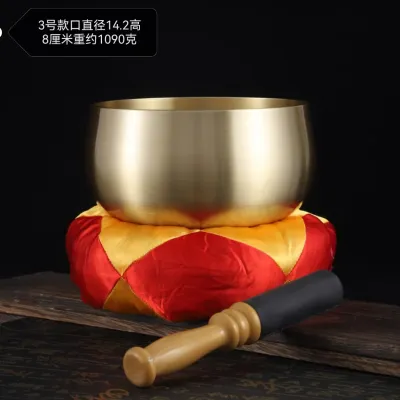
Smooth, Featureless Surfaces A completely smooth, shiny, and reflective golden surface is a common sign of a mass-produced brass bowl. While some handcrafted bowls are polished, they still retain subtle undulating textures from the hammering process. If a bowl has a mirror-like finish with absolutely no physical or visual texture, it was likely polished on an industrial buffing wheel after being cast in a factory.
Mass-Printed Decorations Be highly skeptical of bowls adorned with intricate, perfectly uniform patterns, symbols, or mantras. Many mass-produced bowls feature laser-etched designs, painted motifs, or cheap decals that mimic traditional Tibetan iconography. These decorations are often applied in bulk and can chip or peel off over time. Traditional handcrafted bowls are typically plain, relying on their natural metallic beauty. When authentic bowls do feature etchings, they are carved by hand, showing slight human imperfections, varying line depths, and a distinct organic character.
“Dead” Acoustics If striking the bowl produces a dull, flat “clank” rather than a rich, ringing tone, this is a major red flag. This “dead” acoustic profile can be caused by low-quality metal alloys, internal structural cracks, or the uniform thickness of machine manufacturing, which prevents the development of complex vibrational nodes.
Pricing and Marketing Anomalies Price is a strong indicator of manufacturing quality. Crafting a genuine hand-hammered bowl requires days of skilled labor by a team of artisans, meaning these instruments cannot be sold cheaply. In Singapore, a genuine, medium-sized handcrafted bowl typically starts around S$100 to S$300, while larger or highly refined pieces can cost significantly more. If you encounter a seller offering “rare, antique Tibetan bowls” for S$20 to S$40, or if they have hundreds of identical “one-of-a-kind” bowls in stock, you are looking at mass-produced replicas.
Choosing Reputable Sellers and Safe Purchasing Channels
Navigating the market requires finding trustworthy sources. By choosing the right purchasing channels and vetting sellers thoroughly, you can significantly reduce the risk of buying a mass-produced imitation.
Recommended Channels To ensure you are investing in a genuine instrument, purchase from specialized sound healing studios, reputable musical instrument retailers, or ethical organizations that work directly with artisan cooperatives in Nepal and India. These sellers can often provide detailed information about the specific region, workshop, or even the family of artisans who crafted the bowl.
Online Marketplace Red Flags When shopping on online marketplaces, exercise extreme caution. Avoid listings that rely solely on generic stock photos, as these are often used by multiple sellers distributing the same mass-produced factory items. A reputable seller will provide individual, high-resolution photos and detailed descriptions of the exact bowl you will receive, acknowledging that every handcrafted piece is unique.
Vetting the Seller Before making a purchase, engage with the seller and ask specific questions. Inquire about the bowl’s origin, the metals used in the alloy, and whether the bowl was hand-hammered or cast. Most importantly, ask if they can provide a high-quality audio or video recording of the exact bowl being played. A genuine seller who values sound quality will gladly share a recording so you can hear the overtones and sustain before committing.
Return Policies Always verify the seller’s return policy before finalizing your purchase. Because sound is highly subjective, you need the option to return or exchange the bowl if its physical properties or acoustic performance do not match the handcrafted description once you inspect it in person. Ensure the policy gives you at least a few days to test the bowl in your own space.
Steps to Take If You Receive a Factory-Made Replica
If you purchase a bowl advertised as handcrafted but receive a mass-produced replica, taking swift, organized action can help you secure a refund.
Documentation Start by gathering clear evidence. Take close-up, well-lit photos of the uniform lathe lines, perfect symmetry, or printed decals. Record a high-quality video of yourself striking the bowl to demonstrate its flat sound and short sustain.
Seller Communication Contact the seller promptly and professionally. State clearly that the item you received does not match the “handcrafted” or “authentic” description provided in the listing. Present your photo and video evidence, and request a full refund, including return shipping costs. Many sellers will agree to a refund to avoid negative reviews or platform penalties.
Dispute Resolution If the seller is uncooperative or refuses to accept a return, escalate the issue through the online marketplace’s dispute resolution center. If you purchased the item from a local Singapore-registered business, you are protected by the Consumer Protection (Fair Trading) Act, commonly known as the Lemon Law. You can report the misrepresentation to the Consumers Association of Singapore (CASE) or file a claim through the Small Claims Tribunals to seek a refund or replacement.
Frequently Asked Questions (FAQ)
Can a machine-made singing bowl still be used for sound therapy?
While machine-made bowls can produce a clear, consistent tone that is suitable for basic mindfulness, personal meditation, or signaling the start of a yoga class, they are generally not recommended for professional sound therapy. Sound therapy relies on complex, shifting overtones and deep physical vibrations to facilitate relaxation and entrain brainwaves. Because mass-produced bowls lack these rich harmonics and have a shorter sustain, they cannot deliver the same depth of therapeutic benefit as a handcrafted bronze bowl.
Are all singing bowls with etched mantras or symbols fake?
No, the presence of etched mantras or symbols does not automatically mean a bowl is fake. Many skilled artisans in Nepal hand-carve traditional Tibetan symbols, such as the Om Mani Padme Hum mantra or the eyes of Buddha, onto genuine hand-hammered bowls. The key is to examine the quality of the carving. Hand-etched designs will show slight variations in line thickness, depth, and spacing, reflecting the human hand at work. In contrast, mass-produced bowls feature perfectly uniform, shallow laser etchings or printed decals that look sterile and lack texture.
Does a heavier weight always mean the singing bowl is more authentic?
No, weight alone is not a reliable proof of authenticity. While hand-hammered bronze bowls are dense and have a substantial feel, factory manufacturers can easily cast thick-walled brass bowls that mimic or even exceed this weight. A heavy, machine-cast bowl will still suffer from flat acoustics, perfect symmetry, and a lack of complex overtones. Therefore, you must always evaluate a bowl’s weight in combination with other visual indicators, such as surface asymmetry, and acoustic tests like sustain and harmonic complexity.
Community discussion
Share your experience or ask a question. Comments are reviewed before publication.