
Beambles Model Problems Book 1 is suitable for your child if they are currently transitioning into primary-level model drawing, typically around the lower primary years, and need structured guidance to bridge the gap between word problems and visual representations. To confirm if this specific workbook matches your child’s current academic needs, you must evaluate their familiarity with bar models, check the book’s syllabus alignment, and assess their independent study habits.
Determining whether Beambles Model Problems Book 1 is the right investment for your child requires more than just looking at the cover. Because primary math syllabuses and individual learning paces vary, parents need to actively verify the book’s official grade alignment, assess their child’s current problem-solving foundation, and evaluate whether the workbook’s specific teaching format matches their child’s study habits. This guide provides a practical checklist to help you make an informed decision before purchasing.
How to Verify the Book's Grade Level and Edition
Before making a purchase, it is essential to confirm that the specific copy of Beambles Model Problems Book 1 you are looking at matches your child’s current school level. You can do this by inspecting the physical cover, spine, and copyright page for official grade indicators and specific semester tags. Some assessment books are split into Semester 1 and Semester 2, while others cover the entire academic year. Ensuring the book aligns with your child’s current academic term prevents them from encountering topics they have not yet been taught in school.
Products mentioned in this guide
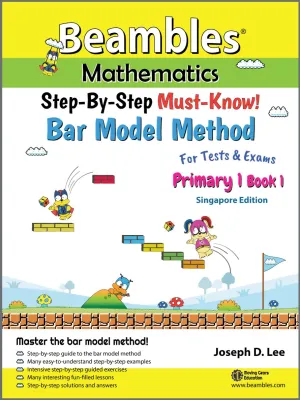
Prices are valid at publication and may change. Please refer to the product page for the latest price.
Next, verify the publication or edition year printed on the copyright page. Primary school mathematics syllabus frameworks undergo periodic reviews and updates by educational authorities to emphasize different problem-solving heuristics. Checking the edition details ensures that the model drawing methods and question types in the book align with the latest curriculum standards, preventing confusion when your child tries to apply these methods in school exams.
You should also pay close attention to the format details of the book. Confirm whether the copy you are purchasing is a physical, printed workbook or a digital download. If it is a digital version, check the device compatibility and printing permissions, as drawing models is highly tactile and usually requires physical paper. Additionally, verify that the language of instruction is English and that the terminology used matches the standard math vocabulary taught in your child’s classroom.
Finally, compare the expected retail price in S$ with official educational bookstore listings or authorized school bookshop prices. Because popular assessment books are sometimes resold on online marketplaces or third-party ecommerce platforms, prices can be artificially inflated. Checking official distributor listings helps you avoid purchasing unauthorized, outdated, or overpriced copies, ensuring you receive a complete edition with all pages and answer keys intact.
Signs Your Child Needs Extra Practice with Model Drawing
Observing how your child approaches their daily math homework can help you decide if a dedicated model-problem workbook is genuinely necessary. One of the most common signs that a child needs extra practice with model drawing is a persistent struggle with multi-step word problems. If your child can easily solve straightforward equations like ’15 + 12′ but becomes completely stuck when the same numbers are presented in a short story, they likely need help translating text descriptions into visual representations.

Another clear indicator is when a child relies heavily on guessing, mental math shortcuts, or trial-and-error rather than using structured visual tools. When faced with a complex comparison problem, a child without model-drawing training might simply add or subtract random numbers from the question in hopes of hitting the correct answer. Introducing a structured model-drawing workbook teaches them to slow down, map out the known and unknown quantities, and approach the problem systematically.
You should also assess whether your child understands basic arithmetic operations but fails to apply them correctly to complex, real-world scenarios. For instance, they might know how to perform division, but they cannot identify when a word problem requires sharing quantities unequally. Model drawing acts as a cognitive bridge, allowing children to see the physical ‘blocks’ of a problem, which makes it much easier to determine which mathematical operation to use.
Evaluating the Book's Structure and Learning Approach
To ensure that Beambles Model Problems Book 1 is a productive tool rather than a source of frustration, you must evaluate its internal layout and teaching style. Start by checking if the book provides step-by-step worked examples and visual model breakdowns before introducing independent practice exercises. A good instructional workbook should not simply present questions; it must actively teach the reader how to construct the bar models, showing how each part of the word problem corresponds to a specific segment of the drawing.
The physical page layout is another critical factor, especially for younger learners who are still developing their fine motor skills. Open the book to inspect the working space. There should be adequate blank space on each page for your child to draw clear, proportional bar models and write out their complete mathematical workings. Cramped pages can discourage children from drawing models altogether, leading them to scribble calculations in the margins or skip the visual steps entirely.
Additionally, confirm that the workbook includes a comprehensive answer key featuring detailed, step-by-step solutions rather than just final numerical answers. When a child gets a problem wrong, simply knowing the final number does not help them identify where their logic failed. A detailed answer key allows you, or your child during self-grading, to compare their drawn model with the correct visual representation, making it easy to spot errors in partitioning, labeling, or calculation.
Integrating the Workbook into Your Child's Study Routine
Once you have verified the book’s suitability, the next step is integrating it into your child’s study routine in a way that encourages steady progress without causing academic burnout. Rather than assigning entire chapters at once, consider using the book for daily, bite-sized practice. Completing just one or two model problems a day keeps the concepts fresh in your child’s mind and builds long-term retention far more effectively than cramming before a major test. Alternatively, you can reserve the workbook for targeted weekend revision or specific pre-exam preparation.
It is equally important to set clear stopping conditions during study sessions. If your child shows signs of cognitive fatigue, such as frustration, loss of focus, or repetitive calculation errors, it is time to close the book and take a break. Model drawing requires high levels of spatial and logical reasoning; forcing a tired child to complete complex visual problems can lead to a negative association with mathematics. If the problems consistently exceed their current comprehension level, temporarily step back to simpler exercises.
As your child’s confidence and accuracy with the visual model method grow, you can gradually adjust the pacing and frequency of the exercises. You might start by guiding them through the worked examples together, then transition to letting them draw the models independently while you check their progress. Over time, the goal is to help them internalize the model-drawing process so they can confidently apply these visual heuristics to unfamiliar problems during school assessments.
Frequently Asked Questions (FAQ)
What exactly is the 'model method' in primary math?
The model method is a visual problem-solving heuristic widely used in primary mathematics education. Instead of jumping straight to abstract algebraic equations, children draw rectangular bars to represent different quantities. This visual approach helps students break down part-whole relationships and comparison problems, making it easier to see how different numbers relate to one another. By turning abstract text into concrete visual blocks, children can easily identify which arithmetic operations are needed to solve the problem.
Is this book useful if my child already scores well in school exams?
Yes, this workbook can still offer significant value for high-achieving students, provided you use it as a tool for deepening their conceptual understanding. For children who already score well, the book can be used to provide exposure to higher-order thinking questions and non-routine problem-solving scenarios. Before purchasing, it is wise to check the difficulty level of the later chapters to gauge if the workbook provides a sufficient challenge, ensuring it stretches their mathematical reasoning rather than just repeating concepts they have already mastered.
Community discussion
Share your experience or ask a question. Comments are reviewed before publication.