
Deciding on an instrument to begin your musical journey requires balancing physical constraints, learning goals, and financial investment.
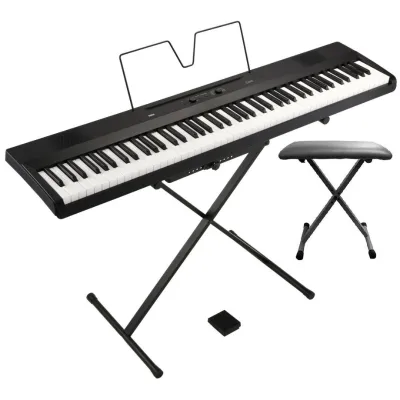
The korg liano is a highly portable, 88-key digital piano designed specifically to lower the barriers of entry for aspiring keyboardists.
This instrument stands out for its remarkably slim profile and lightweight design, making it an appealing option for modern living spaces where a bulky acoustic piano or a heavy console digital piano is impractical.
Products mentioned in this guide
Prices are valid at publication and may change. Please refer to the product page for the latest price.
For casual learners, adult hobbyists, and space-conscious students, this model offers a streamlined, distraction-free platform to master the basics of keyboard geography, note reading, and simple chord progressions.
However, the suitability of this instrument depends heavily on your long-term musical ambitions.
If your primary goal is to progress through classical conservatory grades that demand the physical heft of graded hammer-action keys, or if you require advanced music production tools, you will likely need to look toward heavier, mid-range alternatives.
Understanding these trade-offs early prevents the frustration of outgrowing your instrument too quickly.
Evaluating the Korg Liano Key Action for Beginner Technique
A digital piano’s key action is the single most critical factor in developing proper playing habits, building finger strength, and ensuring a smooth transition to an acoustic instrument.
Traditional acoustic pianos rely on a complex system of wooden hammers and gravity, creating a distinct physical resistance that is heavier in the bass register and lighter in the treble.
For beginners, practicing on an action that mimics this behavior is vital for cultivating finger independence, control over dynamics, and proper hand posture.
Without sufficient resistance, players often develop a flat-fingered technique that is difficult to correct later.
When evaluating the korg liano, it is essential to understand that it does not feature a traditional weighted hammer action.
Instead, the manufacturer equips this model with its proprietary Light Touch (LS) action.
This is a semi-weighted, velocity-sensitive keyboard mechanism that feels significantly lighter and springier than a graded hammer-action digital piano.
Before finalizing a purchase, always verify the exact key mechanism specifications on the manufacturer’s official documentation, as terms like “piano-style keys” can sometimes obscure the lack of physical hammer weights.
For a beginner, the LS action offers both distinct advantages and clear limitations.
On the positive side, the lighter resistance is highly forgiving for young children with developing hand muscles or casual players who find heavy actions fatiguing.
It allows for effortless playability and rapid note repetition, which is excellent for synth-style or organ-style performances.
On the negative side, it does not prepare your fingers for the physical demands of an acoustic piano.
If you switch to an acoustic instrument during a lesson or exam, you may find the keys feel incredibly heavy and difficult to control.
To determine if this action suits your physical needs, perform a hands-on evaluation using this step-by-step checklist:
- Key Resistance: Press several keys slowly to the bottom of the keybed. Observe whether the resistance feels uniform and spring-like, or if there is a progressive weight that mimics a physical hammer swinging upward.
- Mechanical Noise: Play the keyboard with the volume turned completely off. Listen closely to the physical thud or clack of the keys to ensure the mechanical noise is minimal and will not distract you or others during silent practice sessions.
- Dynamic Response: Turn the volume back up and strike a single key repeatedly, moving from a whisper-soft touch to a forceful strike. Verify that the instrument translates your physical velocity into smooth, predictable volume changes rather than abrupt jumps in sound.
Sound Quality and Practice Features for New Players
An engaging sound engine is what keeps a beginner motivated to sit down and practice day after day.

If a digital piano sounds artificial or thin, the learning process can quickly feel clinical and uninspiring.
A high-quality primary piano sample, captured from a well-maintained acoustic grand piano, helps students develop an ear for tonal color and resonance.
Beyond the core tone, a digital piano must possess sufficient polyphony to handle complex passages.
Polyphony refers to the maximum number of individual notes or voices the instrument can produce simultaneously; if this limit is too low, older sustained notes will abruptly cut off when new notes are played.
The korg liano addresses these sonic requirements by offering a respectable 120-voice polyphony limit, which is more than sufficient for beginner to intermediate repertoires.
Even when holding down the sustain pedal and playing dense chords across the keyboard, you will not experience distracting note drop-offs.
The instrument features eight built-in sounds, led by a clear, resonant Italian grand piano sample.
This primary tone is complemented by electric pianos, organs, strings, and a harpsichord, providing enough variety to explore different musical genres without overwhelming a new learner with unnecessary electronic sound effects.
In addition to sound quality, practical learning aids are crucial for structuring your practice sessions.
The Liano includes a built-in metronome with adjustable tempo and time signatures, which is indispensable for developing a steady sense of rhythm.
It also features basic reverb and chorus effects to add depth to the sound, along with pitch calibration tools.
While it lacks an onboard multi-track MIDI recorder, its seamless digital connectivity compensates for this omission.
When purchasing this digital piano, pay close attention to the included accessories and connectivity options.
The Liano comes packaged with a basic, lightweight sheet music stand and a compact PS-3 sustain pedal.
This pedal is a simple switch-type plastic button that is prone to sliding around on smooth floors.
For a more realistic learning experience, you should check the manufacturer’s accessory list and consider upgrading to a heavy-duty, half-damper compatible pedal, such as the Korg DS-1H.
This upgrade allows you to practice advanced pedaling techniques, where the sustain effect varies depending on how far down you press the pedal.
Space, Portability, and Setup Considerations
One of the most compelling reasons to choose a portable digital piano over a traditional console model is the physical footprint.
Traditional cabinet-style digital pianos are heavy, semi-permanent pieces of furniture that require significant floor space and multiple people to move.
In contrast, the korg liano features an exceptionally slim profile, measuring just 7.3 centimeters in thickness and weighing a mere 6.0 kilograms.
This ultra-lightweight design makes it incredibly easy to move around a home, store under a bed, or transport to rehearsals and lessons.
For residents in compact urban environments, such as apartments or HDB flats in Singapore, this small footprint is a major advantage.
However, the local tropical climate introduces specific environmental challenges that you must manage to protect your investment.
High ambient humidity and extreme temperature fluctuations can accelerate the degradation of internal electronic components, corrode copper contacts, and cause the plastic casing or keybed to warp.
To safeguard the instrument, avoid placing it in direct sunlight near windows, keep it away from direct air conditioning drafts, and consider using a fitted dust cover when the piano is not in use.
Maintaining a stable indoor climate is key to ensuring the longevity of the key sensors.
Setting up your digital piano correctly is also essential for preventing physical strain and injury during long practice sessions.
Ensure you place the instrument on a sturdy, level keyboard stand that does not wobble when you play energetically.
A double-brace X-stand or a dedicated table-style stand is highly recommended over flimsy single-brace options.
Adjust your bench height so that your forearms are parallel to the floor when your fingers rest on the keys, keeping your shoulders relaxed and your back straight.
Finally, route the power supply cables safely along the stand legs to prevent accidental tripping, which could pull the lightweight piano off its stand.
Assessing the Value and Exploring Alternatives
When evaluating the financial commitment of a first digital piano, it is helpful to look at the market in broad price bands.
The korg liano typically sits in the entry-level budget tier, generally priced between S$500 and S$600.
At this price point, buyers should expect a trade-off between extreme portability and realistic mechanical key action.
Mid-range models priced above S$800 often introduce fully weighted graded hammer actions, larger speaker systems, and more robust wooden cabinets, but they sacrifice the lightweight portability that defines the Liano.
To help guide your purchase decision, consider this clear decision matrix based on your specific learning goals and physical constraints:
- Choose the Korg Liano if: You have a strict budget under S$600, live in a highly space-constrained home, need a lightweight instrument that you can easily carry on public transport or store away daily, or prefer a lighter key touch for casual, hobbyist playing.
- Consider alternative models if: You are committed to a formal classical curriculum, require a key action that closely mimics the heavy resistance of an acoustic grand piano, or need a comprehensive suite of onboard recording and music production tools.
Before making your final purchase, always verify the warranty terms and after-sales support options available through authorized local dealers in Singapore.
Purchasing from an authorized distributor ensures that you receive a genuine product with a valid manufacturer’s warranty, protecting you against potential electronic or mechanical defects.
Confirm the location of the local service center and clarify whether the warranty covers both parts and labor, as this peace of mind is invaluable for a beginner’s first instrument.
Frequently Asked Questions (FAQ)
Do I need an external amplifier or headphones?
The built-in speaker system of the korg liano consists of two 8-watt circular speakers with a bass reflex design.
While this setup is perfectly adequate for personal practice in a quiet bedroom or a small living room, it lacks the power and projection to fill a large room or compete with other acoustic instruments in a band setting.
For late-night practice sessions, investing in a high-quality pair of stereo headphones is highly recommended.
Headphones allow you to focus entirely on your playing without distracting family members or neighbors.
If you do need to perform for a larger audience, you can connect the piano’s headphone/line-out jack to an external keyboard amplifier or a pair of powered studio monitors.
Can it connect to piano learning apps on a tablet?
Yes, the Liano features a highly versatile USB Type-B port that functions as a USB-to-Host interface.
This port is capable of transmitting both MIDI data and digital audio signals simultaneously.
To connect the piano to a tablet or smartphone, you must verify the device compatibility and obtain the appropriate adapter cable, such as a USB-B to USB-C cable or an Apple Lightning-to-USB Camera Adapter.
Once connected, you can use the piano with popular interactive learning applications, sheet music readers, and digital audio workstations (DAWs) on both iOS and Android platforms, allowing for real-time feedback on your playing accuracy.
Is a three-pedal unit necessary for a beginner?
For the first few years of learning the piano, a three-pedal unit is not necessary.
The three pedals on a grand piano serve distinct functions: the right pedal is the sustain (or damper) pedal, the middle is the sostenuto pedal, and the left is the soft (or una corda) pedal.
Beginners almost exclusively use the sustain pedal to connect notes and create a smooth, flowing sound.
The soft and sostenuto pedals are reserved for advanced classical repertoire and subtle tonal shading.
A single high-quality sustain pedal plugged into the back of your digital piano is more than sufficient to support your learning journey through the early and intermediate grades.
Community discussion
Share your experience or ask a question. Comments are reviewed before publication.