
The Short Answer: Who Should Read It First?
For anyone standing at the crossroads of their financial journey, wondering how to transition from passive saving to active wealth building, the sheer volume of investment advice can feel paralyzing. John C. Bogle’s classic text, The Little Book of Common Sense Investing, stands as a monumental recommendation in personal finance circles. If you are a beginner seeking a low-cost, long-term, and passive investing foundation, the direct answer is a resounding yes: this book is an exceptional starting point. It strips away the unnecessary complexity of the financial industry and replaces it with a straightforward, mathematically proven strategy designed to build sustainable wealth over time.
However, this book is not a universal solution for every financial aspiration. If your goals involve day-trading tactics, individual stock-picking formulas, short-term market timing, or advanced derivatives strategies, you should look elsewhere. Bogle’s philosophy is the antithesis of speculative trading; it offers no get-rich-quick schemes or secret formulas to outsmart the market. Instead, it focuses entirely on wealth preservation, steady compounding, and the quiet discipline of buying and holding the entire market. If you are willing to trade the excitement of active trading for the high statistical probability of long-term financial security, this book will serve as your ultimate guide.
Core Philosophy: What You Will Learn from The Little Book of Common Sense Investing
The foundational premise of The Little Book of Common Sense Investing is elegant in its simplicity: trying to beat the market is a loser’s game, while owning the entire market is a winner’s game. Bogle, the founder of Vanguard and the pioneer of the retail index fund, argues that the most effective way to invest in equities is to buy a broad-market index fund and hold it forever. Instead of trying to find the needle in the haystack—the single stock or actively managed mutual fund that might outperform the market—you simply buy the entire haystack. By owning a slice of every major corporation, you participate directly in the long-term growth of the global economy.
Products mentioned in this guide
![[eBook] John C. Bogle - The Little Book of Common Sense Investing (2007)](https://img.lazcdn.com/g/p/e6e589361ae0689704e0ee06a261c4cd.jpg_400x400q80.jpg_.webp)
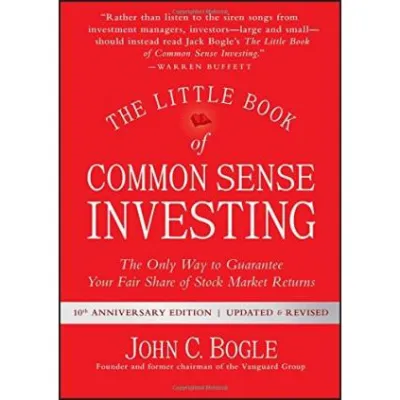
![The Little Book of Common Sense Investing: The Only Way to Guarantee Your Fair Share of Stock Market Returns [Hardcover] by John C. Bogle by John C. Bogle](https://img.lazcdn.com/g/p/a8a4df7b5258806b1094f597920a7b3c.jpg_400x400q80.jpg_.webp)
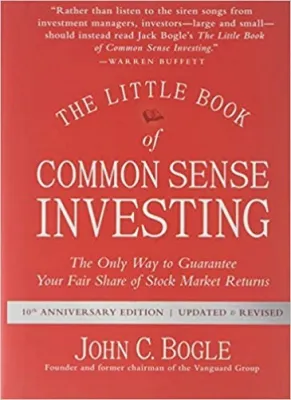
Prices are valid at publication and may change. Please refer to the product page for the latest price.

A significant portion of the book is dedicated to exposing the severe, long-term drag of investment costs on your portfolio. Bogle introduces the mathematical reality of compounding costs, contrasting it with the compounding of returns. In the financial world, active mutual funds often charge high management fees, transaction costs, sales loads, and administrative expenses. While a 2% annual fee might sound trivial, Bogle demonstrates that over an investment horizon of thirty or forty years, these seemingly small charges can quietly confiscate more than half of your potential terminal wealth. By choosing low-cost index funds, you minimize these intermediary costs, ensuring that the vast majority of market returns remain in your own pocket.
Furthermore, Bogle explains the concept of market efficiency and why consistently “beating the market” is statistically improbable for the vast majority of investors. Before costs, the collective performance of all active investors must equal the market average. After costs, however, active investing inevitably becomes a net-negative game compared to passive indexing. The book supports these assertions with decades of historical market data and established financial theory. It is crucial to understand that Bogle does not guarantee future returns or attempt to predict short-term market movements; instead, he provides a structural framework demonstrating why a low-cost, passive approach remains the most mathematically sound strategy for retail investors.
Self-Diagnosis: Does It Match Your Current Knowledge Level?
Signs You Are the Ideal Reader
You are the ideal reader for this book if you are relatively new to the world of investing and find yourself overwhelmed by the endless financial jargon used by Wall Street and modern online commentators. If you are currently keeping your money in standard savings accounts—which often fail to keep pace with inflation—and want to transition to market-based investments, Bogle provides a clear, logical, and reassuring path forward. This book is perfect for those who prefer an evidence-based, data-backed framework over emotional speculation, social media hype, or unpredictable market timing.
Additionally, this book is highly suited for individuals who are willing to accept market average returns in exchange for significantly lower risk, minimal effort, and peace of mind. In a financial landscape where retail investors are constantly pressured to find the “next big thing,” Bogle’s message is a comforting reminder that accepting the market average is actually a highly successful strategy. If you want to build wealth quietly in the background of your life without turning investing into a stressful second job, you will find this book’s depth and pacing to be incredibly liberating.
Signs You Might Need a Different Starting Point
Conversely, you might need a different starting point if you already possess a solid grasp of fundamental personal finance concepts. If you are already highly familiar with asset allocation, expense ratios, market capitalization, portfolio rebalancing, and the differences between exchange-traded funds (ETFs) and mutual funds, the core chapters of this book may feel highly repetitive. Bogle repeats his central arguments multiple times throughout the text to emphasize his points, which can feel slow-paced for intermediate or advanced investors who are ready for more technical material.
Furthermore, this book will not satisfy readers who are strictly looking for active trading strategies. If your interest lies in technical analysis, chart patterns, options trading, macroeconomic forecasting, or complex individual stock valuation models (such as discounted cash flow analysis), Bogle’s passive philosophy will directly conflict with your goals. The book does not teach you how to analyze financial statements or pick individual winners; it actively discourages those practices. If you are unwilling to adopt a passive “buy and hold” mentality, this text will serve more as an ideological critique of your preferred style rather than a practical manual.
Aligning the Book with Your Investment Goals
When the Passive Approach Fits Your Life
Aligning your reading choices with your personal lifestyle and financial temperament is essential for long-term success. The passive strategy advocated by Bogle is a perfect fit if you prefer a “set-and-forget” approach to wealth accumulation. Busy professionals, particularly those navigating fast-paced corporate environments in major financial hubs like Singapore, often lack the time or energy to monitor stock tickers throughout the day. By adopting an index-based strategy, you can establish an automated investment routine that requires minimal daily monitoring, allowing you to reclaim your screen time and focus on your career, family, and personal passions.
This approach is also ideal if your primary financial goals are decades away, such as building a substantial retirement nest egg, funding a child’s future university education, or securing long-term financial independence. Because Bogle’s strategy relies on the slow, steady compounding of market returns, it performs best over extended time horizons. It is designed to minimize emotional decision-making, helping you resist the urge to engage in panic selling during periods of high market volatility. When you understand that you own the entire market, short-term downturns feel less like a personal crisis and more like a temporary fluctuation in a long-term upward trajectory.
When Your Goals Require a Different Focus
On the other hand, if your immediate financial goals require short-term income generation or rapid capital appreciation, the passive index approach will not align with your timeline. Passive investing is fundamentally a long-term wealth accumulation tool, not a source of immediate liquidity or quick profits. If you need to access your capital within the next two to five years, placing it entirely in the equity market—even through a diversified index fund—exposes you to the risk of short-term market downturns from which you may not have time to recover.
Additionally, if you are eager to explore alternative asset classes, this book’s narrow focus on traditional equities and bonds will leave you looking for more information. Bogle’s framework does not cover direct real estate investing, physical commodities, cryptocurrency, or private equity. If you are seeking specialized knowledge on advanced financial topics, such as tax-loss harvesting, complex estate planning, or structured debt instruments, you will need to supplement this book with more specialized resources. The Little Book of Common Sense Investing is designed to establish a solid foundation, but it does not pretend to be an exhaustive encyclopedia for every niche financial instrument.
Practical Next Steps: Reading and Applying the Concepts
When you sit down to read The Little Book of Common Sense Investing, it is best to focus on the overarching arguments regarding the critical importance of keeping investment costs low and the undeniable power of compounding. Do not let yourself get bogged down or discouraged by the dense historical US market data tables and charts scattered throughout the chapters. While these statistics are invaluable for proving Bogle’s points, the core takeaway remains the same: minimize your fees, diversify broadly, and stay the course.
For international readers, particularly those based in Singapore, translating these US-centric concepts into a practical portfolio requires a few important adjustments. Bogle’s examples are heavily focused on US-domiciled Vanguard mutual funds and the S&P 500. While the logic is identical, local retail investors face different tax realities and product availabilities. For instance, Singapore does not impose a capital gains tax, which is highly advantageous for long-term investors. However, Singapore-based investors are subject to a 30% dividend withholding tax on US-domiciled ETFs. To apply Bogle’s low-cost, passive philosophy efficiently, local investors often choose Irish-domiciled UCITS ETFs (which track global indexes like the MSCI World or the S&P 500). Because of the tax treaty between the US and Ireland, these funds reduce the dividend withholding tax rate to 15%, preserving more of your compounding returns over the long run.
To translate the book’s principles into immediate, actionable steps, consider the following checklist:
- Audit your current portfolio: Review the expense ratios of any mutual funds, unit trusts, or investment-linked policies (ILPs) you currently hold. If you find fees exceeding 1% or 2% annually, assess whether these costs are justified by consistent outperformance.
- Determine your asset allocation: Decide on an appropriate mix of equities and bonds based on your age, risk tolerance, and investment timeline.
- Select low-cost platforms: Research reputable online brokerages available in Singapore that offer low transaction fees and access to global markets, specifically those listing Irish-domiciled UCITS ETFs.
- Automate your investments: Set up a regular, monthly contribution plan to automatically purchase your chosen index funds, allowing you to practice dollar-cost averaging without emotional interference.
Frequently Asked Questions (FAQ)
Is the 10th Anniversary Edition significantly different from the original?
Yes, the 10th Anniversary Edition contains valuable updates that make it the preferred version for modern readers. While the core investment philosophy remains unchanged, this updated edition includes extensive new data, fresh charts, and Bogle’s reflections on the 2008 global financial crisis and the subsequent market recovery. It also features new chapters addressing asset allocation and retirement planning in greater depth. Before making a purchase, always verify the edition, language, medium or file format (such as hardcover, paperback, or digital e-book), regional restrictions, device compatibility, and authorized distribution source to ensure you are receiving the complete, updated text.
Do I need a finance background to understand the math in this book?
Absolutely not. One of the greatest strengths of this book is its accessibility to everyday retail investors. Bogle purposely avoids complex mathematical formulas, advanced calculus, and intimidating financial modeling. The math utilized throughout the text is limited to basic arithmetic, simple percentage calculations, the logic of compound interest, and basic probability. Bogle explains every concept clearly using real-world analogies, such as comparing the financial market to a casino or a national sports league. If you understand how a basic savings account earns interest and how fees reduce your total balance, you have more than enough mathematical background to fully comprehend and apply the lessons in this book.
Community discussion
Share your experience or ask a question. Comments are reviewed before publication.