
Choosing your first keyboard is a pivotal step in your musical journey, and the roland fp 30x stands out as one of the most frequently recommended instruments for beginners. This portable digital piano directly addresses the two most critical needs of a developing player: an authentic, weighted key touch that mimics an acoustic piano and a highly responsive sound engine. By prioritizing these foundational elements over unnecessary digital gimmicks, it provides an excellent platform for building proper finger strength and musical expression.
This model is ideal for learners who are serious about developing classical or modern piano techniques and want an instrument that will remain relevant as their skills mature. The compact footprint makes it especially suitable for space-conscious homes, such as apartments in Singapore, where a traditional acoustic piano is physically or acoustically impractical. However, if your primary goal is electronic music production, synthesizer sound design, or auto-accompaniment backing styles, you may find other keyboard categories better suited to your creative workflow.
Evaluating a digital piano requires looking past the spec sheet to understand how its features translate to daily practice. By analyzing the key action, sound engine, connectivity options, and physical setup requirements, you can determine whether this instrument aligns with your long-term learning goals and living environment.
Products mentioned in this guide
![Roland FP10 FP30X Portable Digital Piano 88 Keys Weighted Keyboard FP-10 FP-30X FP 10 30 [LIMITED STOCK]](https://img.lazcdn.com/g/p/b40c0a5d1400f3afb2c14a886464b0ef.jpg_400x400q80.jpg_.webp)
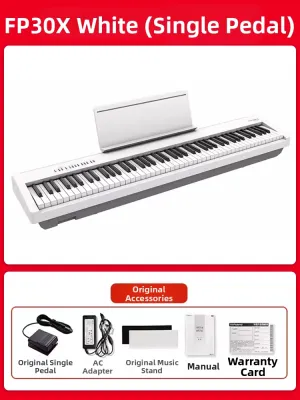
Prices are valid at publication and may change. Please refer to the product page for the latest price.
Building Proper Technique with the Roland FP-30X: Assessing the Key Action
For any aspiring pianist, the physical feel of the keys is the single most important factor in developing proper technique. The roland fp 30x is equipped with the proprietary PHA-4 Standard keyboard action, which features fully weighted keys that simulate the mechanical resistance of an acoustic piano. This resistance is graded, meaning the keys in the lower register feel slightly heavier than those in the higher register, exactly like the hammers of a grand piano.
Developing finger independence and strength requires an instrument that demands physical effort to produce sound. Playing on unweighted or semi-weighted plastic keys can lead to poor habits, such as flat-fingered playing or an inability to control volume dynamics. When you transition from a cheap, spring-loaded keyboard to an acoustic piano, the lack of developed finger muscles can make the acoustic instrument feel heavy, unresponsive, and exhausting to play.
When testing this key action in a showroom, pay close attention to the texture and the physical feedback of the keys. The PHA-4 action features a synthetic ivory feel on the key surfaces, which provides a subtle grip that helps absorb moisture from your fingertips during long practice sessions. You should also test the key return speed by playing rapid, repeating notes; observe whether the key rises quickly enough to support your next strike without feeling sluggish or bouncy.
Another critical mechanical detail to look for is the escapement simulation. In an acoustic grand piano, the escapement mechanism allows the hammer to release from the key mid-stroke, creating a subtle “click” or let-off sensation when you press a key slowly. The PHA-4 action replicates this physical sensation near the bottom of the key travel. Recognizing this feel allows you to practice delicate, soft passages (pianissimo) with greater control, a skill that is essential for intermediate and advanced classical repertoire.
Ear Training and Motivation: Evaluating Sound Quality
An expressive key action is only half of the equation; it must be paired with a sound engine that responds dynamically to your physical touch. This digital piano utilizes Roland’s SuperNATURAL Piano technology, which goes beyond simple static audio recordings. Instead of playing back the exact same sample at different volume steps, the sound engine models the complex physical interactions of an acoustic piano, resulting in smooth, continuous tonal transitions from the softest keystroke to the most vigorous fortissimo.

This dynamic responsiveness is crucial for early ear training. As a beginner, you must learn to listen to the tonal color of the notes you produce, not just their volume. A high-quality sound engine teaches you how to vary your physical attack to create warm, mellow tones or bright, cutting sounds. If a digital piano lacks this expressive range, your practice sessions can quickly become monotonous, draining your motivation to sit down and play.
For home practice, the built-in speaker system must deliver clear, balanced audio without distorting at higher volumes. This model features dual 11-watt speakers housed underneath the chassis. While these speakers are more than sufficient to fill a standard living room or bedroom in a Singapore apartment with rich sound, their downward-firing placement means the surface you place the piano on will affect the overall tone. Placing the instrument on a solid wooden stand will yield a cleaner, more resonant sound than placing it on a hollow desk.
Because consistent practice often requires quiet study, headphone performance is a vital consideration. The instrument includes a 3D Headphone Ambience effect that redistributes the sound field when you plug in headphones. This feature makes the sound feel as though it is coming from the body of the piano rather than being pumped directly into your ears, reducing ear fatigue during extended practice sessions. When selecting headphones, look for open-back or high-quality closed-back studio monitor headphones to preserve the natural decay and spatial depth of the piano tones.
Practice Routines: Connectivity and Built-in Learning Tools
Modern digital pianos offer a range of connectivity options designed to make daily practice more engaging and structured. The inclusion of both Bluetooth Audio and Bluetooth MIDI is a significant advantage for self-directed learners. Bluetooth MIDI allows you to connect the keyboard wirelessly to a tablet or smartphone, enabling seamless integration with popular interactive learning applications, sheet music readers, and digital audio workstations.
Using the dedicated companion app, the Roland Piano App, you can control the instrument’s settings directly from your touch screen, access built-in rhythm accompaniments, and log your daily practice time. The app also includes sight-reading exercises and a library of classical pieces with on-screen sheet music. Before purchasing, always check the app store on your specific mobile device to verify operating system compatibility and ensure a stable connection with the instrument.
Beyond external apps, the built-in practice tools provide immediate support for timing and self-evaluation. The integrated metronome is an indispensable tool for developing a steady internal rhythm, allowing you to adjust tempo and time signatures easily. Additionally, the onboard MIDI recorder lets you record your performance with a single button press. Listening back to your own playing is one of the most effective ways to identify uneven timing, missed notes, and phrasing errors that you might not notice while actively playing.
For collaborative learning or lessons, the Twin Piano mode splits the 88-key keyboard into two identical 44-key zones, each with the exact same octave range. This allows a teacher and student, or parent and child, to sit side-by-side on the same instrument and play the same passages together without needing to shift octaves. It is a simple but highly effective feature for home tutoring and interactive instruction.
Fitting Your Space: Setup, Ergonomics, and Portability
Before bringing a digital piano home, you must evaluate how its physical dimensions and accessory requirements fit into your living space. As a portable slab-style digital piano, this model measures approximately 130 cm in width and 28.4 cm in depth, making it significantly more compact than a traditional console-style digital piano with a permanent wooden cabinet. This space-saving design is highly advantageous for compact urban apartments where floor space is at a premium.
However, portability should not come at the expense of proper ergonomics. To prevent wrist strain, back pain, and long-term repetitive strain injuries, you must maintain a correct playing posture. This requires placing the keyboard at the correct height (typically around 72 to 74 cm from the floor to the top of the white keys) and using a stable, height-adjustable bench. Resting the keyboard on a standard dining table or a flimsy desk is rarely ergonomic and can hinder your technique.
When planning your budget, consider the physical support system for the instrument. While a portable, double-braced X-stand offers flexibility and is easy to fold away, it can wobble during vigorous playing and leaves little legroom for pedal operation. For a more stable and aesthetically pleasing home setup, investing in the dedicated wooden stand (KSC-70) is highly recommended. This stand anchors the keyboard securely, eliminates lateral movement, and allows you to attach the optional three-pedal unit (KPD-70) for a true acoustic-style pedal configuration.
If you plan to move the instrument frequently for rehearsals or gigs, keep in mind that it weighs approximately 14.8 kg. While it is portable enough to fit into a car backseat or a padded gig bag, it is heavy enough to require careful lifting. If you anticipate moving the piano daily, you will need to balance the benefit of its authentic, heavy key action against the physical effort required to transport it.
When to Skip This Model and Explore Alternatives
While this digital piano is an outstanding option for many, it is not a universal fit for every beginner. Understanding the limitations of this model can help you avoid a mismatch with your specific creative goals. You may want to look at alternative instruments if your musical interests lie outside of traditional piano study:
- The Electronic Music Producer: If your primary goal is to produce electronic music, create complex synthesizer patches, or control virtual instruments in a digital audio workstation (DAW), a dedicated MIDI controller keyboard with pitch wheels, faders, and drum pads will serve you better than a weighted 88-key digital piano.
- The Arranger Enthusiast: If you want to perform with automatic, multi-instrument backing bands, explore hundreds of non-piano sounds, and create complex arrangements on the fly, an arranger keyboard or workstation with a lightweight key action is a more appropriate choice.
- The Traditionalist: If you have the space, budget, and a climate-controlled environment that can handle humidity fluctuations, a traditional acoustic upright piano offers an organic physical resonance and mechanical complexity that no digital instrument can fully duplicate.
By identifying your primary musical direction early, you can choose the category of instrument that will most effectively support your creative expression and keep you motivated to practice.
Frequently Asked Questions (FAQ)
Do I need to buy a separate sustain pedal and stand?
Yes, for the best learning experience, you should plan to purchase a sturdy stand and an upgraded sustain pedal. While the instrument often comes bundled with a basic plastic footswitch, these small switches tend to slide around on tiled or wooden floors and do not mimic the physical resistance or travel of an acoustic piano pedal. Upgrading to a piano-style damper pedal, such as the Roland DP-10, allows you to practice half-pedaling techniques. Additionally, a dedicated wooden or heavy-duty Z-stand is essential to prevent the keyboard from wobbling while you play.
Can this digital piano be used for basic music production?
This digital piano can easily function as a high-quality MIDI controller for music production. It features a USB-to-Host port that allows you to connect directly to a computer, tablet, or smartphone to send MIDI data into your preferred DAW. This setup lets you use the weighted keyboard to play and record software-based virtual instruments. Keep in mind, however, that it lacks physical production controls like pitch bend wheels, modulation wheels, assignable faders, or drum pads, which are standard on dedicated MIDI controllers.
Community discussion
Share your experience or ask a question. Comments are reviewed before publication.