
Choosing the right format for the Kamus Dewan—the definitive reference for the Malay language—depends heavily on your study environment, learning habits, and how you process information. While the traditional physical volume offers an immersive, distraction-free environment that aids long-term retention, the digital application provides speed and portability for quick references on the go. Evaluating your daily routine and learning objectives will help you determine which format best supports your path to Malay language proficiency.
Understanding the Core Learning Experience
Focusing on the cognitive aspects of language acquisition reveals distinct differences between physical and digital mediums. Physical books engage multiple senses, creating a tactile connection to the text. Flipping through pages helps build a spatial map in your mind, allowing you to remember where a word or definition was located on a page. This physical interaction can reinforce memory retention, making it easier to recall complex vocabulary during deep study sessions.
Furthermore, physical dictionaries facilitate serendipitous learning. As you flip through the pages to find a specific word, your eyes naturally scan adjacent entries, exposing you to related terms, synonyms, and idioms that you might not have searched for intentionally. This organic discovery process is often lost in digital searches, which direct you strictly to a single query result.
Products mentioned in this guide
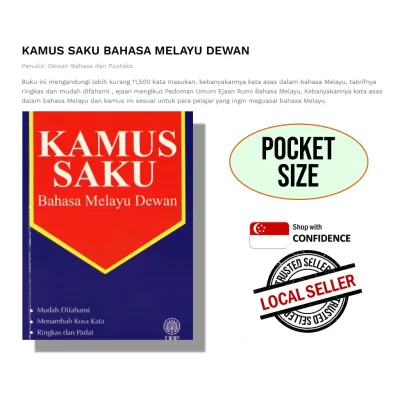
![[SINGAPORE SELLER] Kamus Pelajar Bahasa Melayu Dewan Edisi Kedua (MOE APPROVED FOR PSLE)](https://img.lazcdn.com/g/p/765d85a4b312a69f440dc22605b2a13b.png_400x400q80.png_.webp)
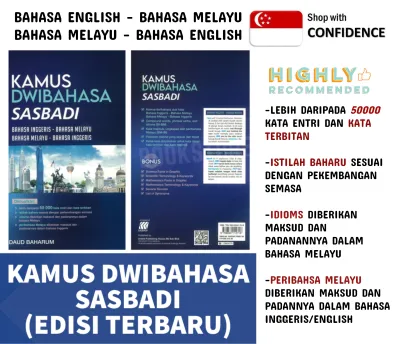
![[SG SELLER] KAMUS MELAYU - INGGERIS DEWAN | Kamus Linguistik (Dewan Bahasa Pustaka)/ MALAY ENGLISH DICTIONARY](https://img.lazcdn.com/g/p/60cb8a5c1938178e447e912eafbd47e8.png_400x400q80.png_.webp)
Prices are valid at publication and may change. Please refer to the product page for the latest price.
Conversely, digital screens present challenges such as screen fatigue and cognitive fragmentation. When studying on a smartphone or tablet, notifications from messaging apps or social media can easily disrupt your focus. The constant blue light exposure during extended reading sessions can also lead to eye strain, making it harder to sustain long periods of linguistic analysis.
The physical dictionary excels when you need to perform deep structural analysis of the Malay language. It allows you to see surrounding words, root words, and derivative prefixes or suffixes in a single, cohesive layout. This contextual exposure is highly beneficial for understanding word families and grammatical patterns. On the other hand, a digital app is optimized for rapid, isolated vocabulary lookups, which is ideal when you need a quick definition but do not require a deep dive into linguistic structures.
Portability, Search Speed, and Daily Convenience
The physical Kamus Dewan is a substantial, heavy volume that requires a dedicated space on your desk. Carrying this hardcopy dictionary in a backpack or briefcase requires significant physical effort and occupies valuable space. For students commuting on public transport or moving between classrooms, the sheer weight can be a major deterrent, often leading to the book being left at home.

Additionally, consulting a large physical volume requires a flat, stable surface like a desk or table to read comfortably. Attempting to balance a heavy book on your lap while taking notes can be physically awkward and tiring. In contrast, a digital application can be operated comfortably while standing, walking, or sitting in cramped spaces, making it highly adaptable to diverse physical environments.
The digital application solves this portability issue entirely, fitting the entire dictionary database into a device you already carry. Search speed is virtually instantaneous; typing a keyword reveals definitions in seconds, often with automatic highlighting of root words. However, this convenience relies entirely on device battery life and hardware performance. If your phone or tablet runs out of power, your primary learning tool becomes inaccessible.
Your typical study environment plays a decisive role in this choice. In a quiet library or a dedicated home study room, the physical book provides a stable, reliable reference that requires no power source or internet connection. During a daily commute on a crowded train or bus, or during quick intervals between meetings, the digital app is far more practical, allowing you to look up words instantly with one hand.
Feature and Specification Verification Checklist
Before committing to either format, it is essential to verify specific product details to ensure you are getting the correct edition for your needs. The physical and digital versions may differ in content updates, layout, and supplementary materials.
First, verify the official publisher and edition details. The authoritative publisher is Dewan Bahasa dan Pustaka. Check the publication year and edition number to ensure the content aligns with your school curriculum or professional requirements.
Linguistic standards and vocabulary evolve over time, meaning older editions may lack contemporary terminology or reflect outdated spelling conventions. Verifying the publication year ensures that your reference material matches modern educational standards, which is particularly critical if you are preparing for official language examinations or professional translation work.
For the digital application, inspect the storefront listing carefully. Verify the operating system compatibility to ensure it runs smoothly on your specific smartphone or tablet. Check the app’s offline access conditions, as some digital versions require an active internet connection to load definitions, while others allow complete offline downloads. Additionally, review the data privacy requirements and permissions requested by the app.
For the physical book, check the binding durability and paper quality. A thick reference book requires strong binding to withstand years of frequent page-flipping. Verify if the physical copy includes supplementary appendices, such as lists of proverbs or grammar guides, which are sometimes omitted or formatted differently in digital versions.
| Decision Factor | Physical Book | Digital Application |
|---|---|---|
| Search Method | Manual page flipping, alphabetical index | Instant keyword search, root word filtering |
| Portability | Heavy, requires dedicated desk or bag space | Extremely high, fits on mobile devices |
| Power Dependency | None, usable in any lighting or power state | High, requires battery and device compatibility |
| Annotation Style | Physical margin notes, highlighting, bookmarks | Digital bookmarks, copy-paste, search history |
| Content Updates | Fixed until the next printed edition | Periodic digital updates and patches |
Decision Framework: Which Kamus Dewan Should You Get?
To finalize your decision, apply a structured framework based on your primary learning habits. Choose the physical book if your priority is a distraction-free study environment where you can engage in deep, tactile learning. It is also the ideal choice if you want a permanent, reliable archive that does not depend on software updates, subscription models, or device battery life.
Choose the digital app if your daily routine demands high portability and instant reference capabilities. The digital format is highly suited for learners who study during commutes, require rapid search functions to keep up with reading materials, or benefit from interactive features like digital search history and quick cross-referencing.
Always verify compatibility before making a purchase. Ensure your mobile device meets the operating system requirements of the official app, or check that the physical edition’s publication year matches the specific syllabus prescribed by your educational institution.
Keep in mind that neither format may fully satisfy your needs if you require highly specialized regional dialects, classical literary terms, or advanced linguistic corpora. In such cases, you may need to supplement your chosen Kamus Dewan with specialized academic glossaries or online linguistic databases.
Frequently Asked Questions (FAQ)
How do I verify I am buying the official authorized version?
To ensure you are purchasing an official, authorized version of the dictionary, look for the official publisher logo of Dewan Bahasa dan Pustaka on the cover and title page of the physical book. For digital versions, only download the application from recognized official digital storefronts, and verify that the developer or publisher listed matches the official statutory body. Avoid purchasing unauthorized digital copies or PDFs from third-party sellers on online marketplaces, as these may contain incomplete text or formatting errors.
Does the digital version include the same appendices as the physical book?
The inclusion of supplementary materials can vary significantly between formats. While the physical book typically contains comprehensive appendices, including guides on spelling systems, pronunciation, and historical prefaces, some digital applications may streamline or omit these sections to optimize screen layout and file size. Before purchasing, check the digital app’s product description or user manual to verify if these supplementary linguistic resources are fully integrated.
Can I use the digital app without an active internet connection?
Offline usability depends entirely on the specific digital application you choose. Some official apps download the entire dictionary database directly to your device during installation, allowing full offline access without using mobile data. Other versions may require an active internet connection to retrieve search results or play audio pronunciations. Always check the app store listing’s technical specifications and user reviews to confirm offline capabilities before buying.

Community discussion
Share your experience or ask a question. Comments are reviewed before publication.