
Preparing for O-Level quiz competitions in Singapore requires a strategic approach to selecting study materials. To excel as a true quiz champ, students must look beyond standard classroom textbooks and seek out specialized preparation books that sharpen rapid-recall abilities, deepen conceptual understanding, and expand general knowledge. The ideal preparation library balances rigorous academic syllabus guides with broad-ranging trivia compilations and timed mock papers. By evaluating books based on syllabus alignment, question diversity, and explanation quality, students can systematically build the cognitive agility needed to perform under pressure.
Understanding O-Level Quiz Competition Requirements
Quiz competitions designed for O-Level students in Singapore demand a unique blend of academic precision and broad intellectual curiosity. Unlike standard school examinations, which primarily assess a student’s ability to explain concepts and solve structured problems within a generous timeframe, quiz competitions prioritize speed, breadth, and immediate recall. To select the right preparation books, you must first understand the specific format of the competition your school is entering.
Academic quizzes are typically anchored directly to the secondary school syllabus, covering core subjects such as Physics, Chemistry, Biology, Mathematics, History, Geography, and Literature. However, the questions in these competitions often push the boundaries of the standard curriculum, testing niche applications of scientific laws or obscure historical details that standard textbooks might only mention in passing. If the competition focuses on academic subjects, your preparation books must offer deep, conceptual extensions of the standard syllabus rather than simple summaries.
Products mentioned in this guide
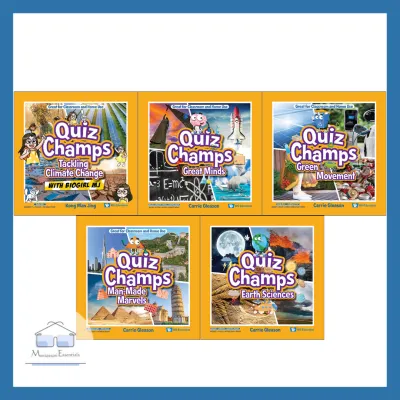
![[SG STOCK] WS E - Quiz Champs All Titles - Age 6-12+ Children STEM Knowledge & Quiz Activity Primary School Science Book](https://img.lazcdn.com/g/p/c86ec9763585927c8a6c88d999ba06e1.png_400x400q80.png_.webp)
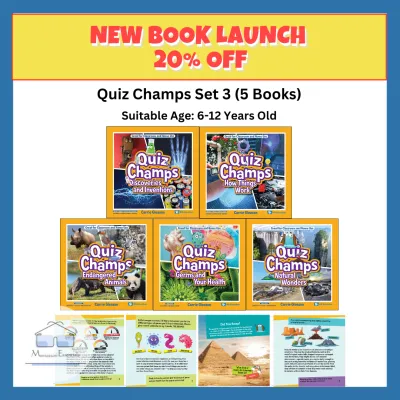
Prices are valid at publication and may change. Please refer to the product page for the latest price.
Conversely, general knowledge or trivia-based competitions require an entirely different preparation strategy. These events test students on current affairs, global politics, art history, sports, and pop culture. Preparing for this style of competition using only school textbooks is ineffective. Instead, students need resources that compile diverse facts, historical timelines, and global statistics into accessible, highly structured formats.
The cognitive load of a quiz competition also differs significantly from a written exam. During a live buzzer round, a student has only seconds to process a question, identify the core concept, and formulate an answer. This requires highly developed rapid-recall skills and the ability to recognize patterns in how questions are phrased. Consequently, the best preparation books are those that train the brain to retrieve information instantly, using short-form questions, flashcard-style layouts, and rapid-fire drills.
Furthermore, team dynamics play a crucial role in these competitions. Many local events require students to collaborate in real-time or divide subject specialties among team members. Your study materials should reflect this structure, allowing individual team members to specialize in specific domains—such as physical sciences or humanities—while maintaining a shared baseline of general knowledge.
Key Criteria for Evaluating Quiz Prep Books
When browsing local bookstores or online marketplaces for quiz preparation materials, it is easy to be overwhelmed by the sheer volume of study guides available. To make an informed decision, you must establish a clear set of evaluation criteria that filters out low-quality or irrelevant publications.

The first and most critical criterion is syllabus alignment and the publication year. Singapore’s secondary school curriculum undergoes periodic updates to ensure relevance and academic rigor. A book published a decade ago may contain outdated scientific terminology, obsolete historical perspectives, or mathematical methods that are no longer aligned with current standards. Always check the copyright page to verify that the content matches the current O-Level syllabus requirements, especially for subject-specific quiz rounds.
The second criterion is the variety and progression of question formats. A high-quality quiz prep book should not rely solely on standard multiple-choice questions. While multiple-choice formats are excellent for testing foundational knowledge, competitive quizzes often feature rapid-fire short answers, fill-in-the-blank statements, and complex structured reasoning questions. Look for books that organize questions by difficulty level, allowing students to build confidence with basic recall before tackling advanced, multi-step analytical problems.
Furthermore, the quality of the answer key and explanations is a major differentiator between mediocre and exceptional prep books. A simple answer key that only lists the correct option is of limited use for competitive preparation. Excellent books provide detailed, step-by-step explanations for why an answer is correct, along with context on why other options are incorrect. This level of detail is invaluable for self-directed learning and team study sessions, as it helps students understand the underlying logic of the question and avoid similar mistakes in the future.
Another practical feature to look for is a comprehensive index and cross-referencing system. During team study sessions, students often need to quickly look up related facts or verify a specific piece of information. A well-indexed book saves valuable study time and allows for seamless navigation between different topics, making group discussions much more efficient.
Finally, consider the layout and readability of the book. Quiz preparation is an intensive process, and books with dense, poorly formatted text can quickly lead to cognitive fatigue. Look for publications that use clear headings, bullet points, tables, and diagrams to break up complex information. A clean, visually engaging layout makes it easier for students to scan pages quickly during rapid review sessions.
Types of Prep Resources for Quiz Competitions
Building a balanced study library is essential for comprehensive preparation. Rather than relying on a single comprehensive guide, successful teams usually combine several types of books, each serving a distinct role in the learning process. By diversifying your resources, you can ensure that both academic depth and general knowledge breadth are thoroughly covered.
This multi-faceted approach also prevents study sessions from becoming monotonous. Alternating between broad trivia drills, deep academic problem-solving, and timed mock exams keeps students engaged and helps develop different cognitive pathways.
General Knowledge and Trivia Compilations
General knowledge compilations serve as the foundation for non-syllabus trivia rounds, which are common in many inter-school competitions. These books focus on broad-reference topics, offering encyclopedic coverage of world geography, international organizations, historical milestones, and major scientific discoveries.
When selecting trivia books, look for those that integrate current affairs and modern global developments. A good general knowledge book should help students connect historical events to contemporary issues, fostering a holistic understanding of the world. These resources are particularly useful for building lateral thinking skills, as they expose students to cross-disciplinary facts that rarely appear in standard academic curricula.
Additionally, these compilations often use engaging formats such as thematic quizzes or sidebars. This makes them excellent resources for quick, informal study sessions during school transits or short breaks, allowing students to absorb facts incrementally without feeling overwhelmed.
Subject-Specific Deep Dives
For competitions that feature heavy academic segments, subject-specific deep dives are indispensable. These books go far beyond standard classroom textbooks, offering advanced problem-solving strategies and conceptual clarity in specific disciplines like the physical sciences or humanities.
These resources are designed to challenge high-achieving students by introducing complex scenarios that require the application of multiple syllabus concepts simultaneously. For instance, a chemistry quiz book might require students to deduce reaction mechanisms under unusual conditions, while a history guide might ask for comparative analyses of different geopolitical eras. Using these books helps students develop the deep subject mastery needed to handle the most challenging questions in a competition.
Furthermore, subject-specific guides often include advanced diagrams and structural models that help students visualize complex concepts. This visual reinforcement is critical for rapid recall, as it allows students to mental-map scientific processes or historical timelines during the high-pressure environment of a live round.
Mock Quizzes and Past Competition Papers
No preparation strategy is complete without practical, hands-on experience under simulated competition conditions. Mock quiz books and compilations of past competition papers are designed specifically to help students adapt to the intense pacing and pressure of live events.
These books typically organize questions into timed practice sets, mimicking the structure of actual tournament rounds. They often include guidelines for team-strategy formats, helping students practice delegating topics and coordinating buzzer strategies. Exposure to historical question styles also helps students familiarize themselves with the specific phrasing and tricks commonly used by quiz masters, reducing anxiety on the day of the competition.
Regularly practicing with mock papers also helps students build physical stamina. Live competitions can be mentally exhausting, often lasting several hours across multiple preliminary and final rounds. Simulating these conditions at home or in school prepares students to maintain their focus and accuracy even when fatigue begins to set in.
Pre-Purchase Checklist for Books and Digital Formats
Before finalizing your purchase at a local bookstore or on an online marketplace, it is crucial to perform a thorough quality check. Investing in the wrong edition or a damaged book can disrupt your study schedule and lead to unnecessary expenses. Use this checklist to verify the suitability of any prep book before buying.
First, verify the exact edition and publication year. Publishers frequently release updated editions of popular prep books to correct errors, update facts, and align with syllabus changes. Check the International Standard Book Number (ISBN) and compare it with the official reading list provided by your competition organizers or teachers. Ensure that the book is specifically designed for the Singapore O-Level context, as international editions may use different terminology or cover topics not relevant to local competitions.
Second, inspect the physical condition of the book if purchasing a hard copy. Check the binding to ensure that pages are secure and will not fall out during frequent use. Flip through the pages to confirm there are no printing errors, missing pages, or ink smudges that obscure the text. If you are purchasing a used book, check for excessive highlighting or handwritten notes that might distract you or reveal the answers prematurely during practice sessions.
Third, if the book includes digital access codes or supplementary online media, verify that these codes are unused and valid. Many modern prep books offer companion websites with interactive quizzes, digital flashcards, or video explanations. If you are buying a secondhand copy, these digital codes may have already been redeemed, depriving you of valuable study tools.
Fourth, consider your budget and the return policies of the seller. High-quality academic prep books in Singapore typically range from S$15 to S$40 per volume. When purchasing online, ensure the seller offers a clear return or exchange policy in case the book arrives damaged or does not match the description.
Finally, confirm the language and file format if you are purchasing a digital version (such as an e-book). Ensure that the file format is compatible with your e-reader, tablet, or laptop, and check whether the digital layout preserves the formatting of tables and diagrams. Most importantly, double-check that the book includes a complete, unabridged answer key, as some digital editions split the questions and answers into separate purchases.
Frequently Asked Questions (FAQ)
How far in advance should students start using quiz prep books?
Students should ideally begin using quiz preparation books at least three to six months before the competition date. This timeline allows for a structured, phased approach to learning rather than last-minute cramming. During the initial phase, students should focus on baseline assessments, using general knowledge compilations and subject-specific books to identify gaps in their understanding. The middle phase should be dedicated to deep reading and expanding factual knowledge across diverse topics. In the final month leading up to the competition, the focus should shift entirely to intensive mock practice, using timed papers to build speed, refine buzzer strategies, and adapt to the high-pressure environment of the live event.
Are digital quiz platforms a complete replacement for physical prep books?
While digital quiz platforms offer excellent interactive features, they are best used as a complement to physical prep books rather than a complete replacement. Physical books provide a tactile reading experience that has been shown to improve long-term memory retention and reduce screen fatigue during long study sessions. They also allow students to easily flip back and forth between questions and detailed explanations, which is essential for deep conceptual review. However, digital platforms excel at simulating the rapid-fire, timed nature of live buzzer rounds and offer instant feedback. A hybrid approach—using physical books for deep, focused study and digital tools for quick daily drills—typically yields the best results for competitive preparation.
Community discussion
Share your experience or ask a question. Comments are reviewed before publication.