
In Singapore’s primary education system, Primary 5 (P5) is widely regarded as the most challenging transitional year. This is the period when the academic workload intensifies, and the complexity of the curriculum shifts dramatically to align with the rigorous standards of the Primary School Leaving Examination (PSLE). To help your child navigate this steep learning curve, selecting the right P5 exam papers and assessment books is one of the most effective strategies you can employ.
The “best” exam papers are not simply the most difficult ones you can find on the shelves of local bookstores. Instead, the most effective materials are those that match your child’s current learning profile, target their specific conceptual gaps, and systematically build their confidence. By understanding how to evaluate and select these resources across Mathematics, Science, English, and Chinese, you can transform study sessions from stressful drills into highly targeted, diagnostic learning experiences.
Understanding the Role of P5 Exam Papers in PSLE Preparation
Many parents purchase thick stacks of past-year school exam papers and mock test booklets without a clear strategy. To maximize their value, it is essential to distinguish between topical assessment books and full, simulated exam papers. Topical books are designed for immediate reinforcement after a specific chapter is taught in school, helping to solidify foundational concepts. In contrast, full exam papers require students to retrieve information from multiple disparate topics simultaneously under timed conditions, which is a highly sophisticated cognitive skill.
Products mentioned in this guide
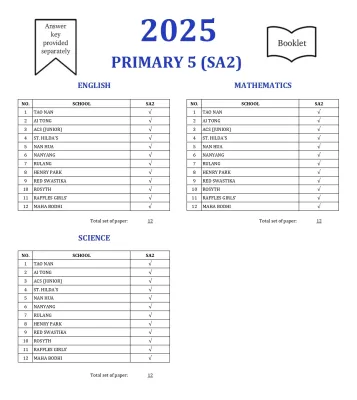
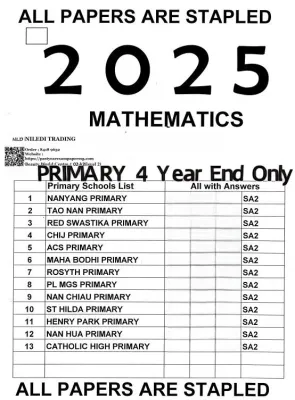
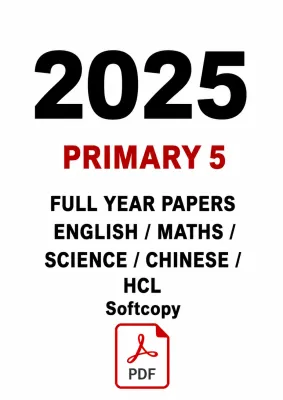
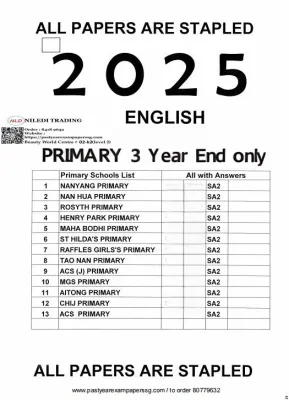
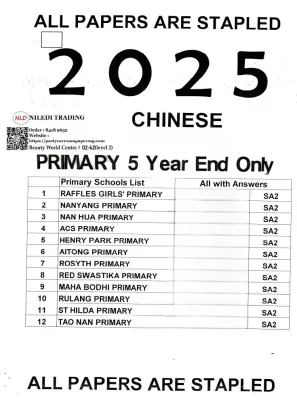
Prices are valid at publication and may change. Please refer to the product page for the latest price.
The transition from Primary 4 to Primary 5 introduces a significant jump in both cognitive demand and question formatting. In lower primary, assessments often focus on direct recall and straightforward, single-step problem-solving. At the P5 level, however, exam papers introduce multi-step non-routine problems, open-ended scientific inquiries requiring precise vocabulary, and advanced linguistic synthesis. This shift can be jarring for students who previously excelled by relying on rote memorization.
Consequently, parents should view P5 exam papers primarily as diagnostic tools rather than mere grading exercises. Instead of focusing solely on the final score, use these papers to identify recurring patterns of error, such as conceptual misunderstandings, careless calculation habits, or poor time management. When approached with this diagnostic mindset, a completed paper with several mistakes becomes a valuable roadmap for improvement rather than a source of academic frustration.
Key Criteria for Evaluating P5 Assessment Books
When browsing the extensive assessment book sections of local bookstores or online marketplaces, it is easy to feel overwhelmed by the sheer volume of choices. To make an informed decision, you need a standardized checklist to evaluate the quality and suitability of any P5 exam paper before making a purchase.

Syllabus Alignment and Currency The first and most critical criterion is strict alignment with the latest Ministry of Education (MOE) syllabus and PSLE formatting. The Singapore curriculum undergoes periodic updates to emphasize critical thinking and real-world applications. Always check the publication or latest revision date on the copyright page. An outdated book may still feature question formats or topics that have been phased out, leading to unnecessary confusion for your child.
Depth and Quality of Answer Keys A high-quality assessment book is only as good as its answer key. Avoid publications that offer only a bare list of final answers or multiple-choice options without explanation. For Mathematics and Science, the answer key must provide comprehensive, step-by-step workings, alternative solving methods, and visual model drawings. For languages, look for detailed explanations of grammar rules and annotated model compositions that explain why certain phrases or structures are highly effective.
Inclusion of Pedagogical Aids The best exam papers go beyond testing by incorporating active learning aids. Look for books that feature “common mistake highlights,” “examiner’s notes,” or “concept maps” at the beginning of chapters or within the solutions. These features help students understand the “why” behind their mistakes, teaching them to think like an examiner and avoid common pitfalls during actual school assessments.
Layout, Spacing, and Print Quality The physical layout of an assessment book significantly impacts a child’s learning experience. Books with cramped text, tiny fonts, and insufficient blank space for working out answers can cause visual fatigue and increase anxiety. Ensure the paper quality is sturdy enough to withstand frequent erasing, and verify that there is ample, clear space next to each question for your child to write down their full working steps neatly.
Subject-Specific Selection Guide
Every subject in the P5 curriculum demands a distinct set of cognitive skills and exam strategies. A book that is excellent for reinforcing mathematical heuristics may not follow the best pedagogical approach for teaching scientific inquiry. To build a well-rounded study plan, you must understand the unique evaluation dimensions and skill shifts that occur in P5 for each of the four core subjects.
Mathematics: Problem-Solving Heuristics and Application
In Primary 5 Mathematics, the curriculum shifts heavily toward complex, multi-step word problems that require the application of specific problem-solving heuristics. Students can no longer rely on simple arithmetic; they must master methods such as the assumption method, working backwards, excess and shortage, and advanced model drawing.
When evaluating P5 Math exam papers, look for resources that categorize practice questions by heuristic types or problem models before presenting mixed mock papers. This structure allows students to master one problem-solving tool at a time. The answer key is particularly crucial here: verify that it provides visual model drawings and, where applicable, alternative algebraic or ratio-based solving methods to accommodate different learning styles.
Furthermore, ensure the papers include a healthy balance of intermediate and challenging word problems. High-quality papers will feature non-routine questions that test a student’s ability to transfer mathematical concepts to unfamiliar, real-world scenarios. This prepares students for the cognitive flexibility required in high-stakes exams.
Science: Open-Ended Questions and Scientific Keywords
The primary challenge in P5 Science is transitioning from basic factual recall to answering complex, open-ended questions (OEQs) with precision. Many students understand the scientific concepts but lose marks because they fail to use specific scientific keywords or structure their answers logically.
To address this, select Science papers that feature answer keys utilizing structured answering frameworks, such as the Claim-Evidence-Reasoning (CER) or Cause-and-Effect templates. The solutions should explicitly highlight the essential keywords (such as “exposed surface area,” “rate of heat transfer,” or “presence of oxygen”) that examiners require to award full marks.
Additionally, high-quality Science papers must test experimental design and data analysis. Look for questions that present graphs, tables, and diagrams of unfamiliar experiments. These questions should challenge students to identify independent and dependent variables, explain the purpose of a control setup, and draw accurate conclusions based solely on the provided data.
English: Grammar, Vocabulary, and Composition Techniques
The P5 English paper demands a sophisticated command of grammar, a mature vocabulary, and advanced writing techniques. The jump in difficulty is particularly evident in Paper 1 (Writing) and Paper 2 (Language Use and Comprehension).
When choosing English assessment books, look closely at the quality of the model compositions provided for Paper 1. The best books do not just print a high-scoring essay; they provide a detailed breakdown of the writing techniques used, such as character development, sensory descriptions, and plot pacing. They should also offer guided planning templates to help students structure their own narratives.
For Paper 2, prioritize books that offer detailed grammatical explanations for the MCQ and Synthesis & Transformation sections. Understanding why a particular conjunction or pronoun is used in a complex sentence is far more valuable than simply memorizing the correct answer. If the book includes oral examination practice, ensure it provides realistic stimulus-based conversation prompts with sample high-scoring student responses and examiner prompts.
Chinese: Comprehension, Vocabulary, and Composition
For Chinese, P5 requires a significant expansion of vocabulary, including a wider range of idioms and precise expressive phrases. The comprehension passages become longer, featuring deeper metaphorical meanings and requiring more sophisticated written answers.
Select Chinese assessment books that include comprehensive vocabulary lists and idiom guides aligned with the current instructional materials. The best books will provide contextual examples and practice exercises specifically designed to help students integrate these advanced vocabulary words into their writing and oral communication.
For the composition section, look for guided prompts that scaffold the writing process, offering thematic vocabulary lists, structural outlines, and model essays annotated with good phrases. For comprehension, ensure the practice passages cover a variety of text types—such as narrative essays, informational texts, and practical writing—and include a high proportion of inference-based questions that challenge students to read between the lines.
How to Build a Condition-Based Shortlist for Your Child
With a clear understanding of what makes a high-quality assessment book, the final step is to create a customized selection and study schedule tailored to your child’s unique academic needs. No single book is perfect for every student; instead, you should build a progressive shortlist based on their current proficiency.
Step 1: Map Weak Areas to Specific Book Features Begin by analyzing your child’s recent school test papers to identify their primary learning gaps. If your child struggles with basic concept retention or consistently scores below 60%, avoid full exam papers for now. Instead, shortlist topical assessment books that offer focused, bite-sized drills to rebuild their foundational knowledge. If your child has a strong grasp of concepts but struggles with exam stamina or time management, prioritize books containing full-length, timed mock exam papers.
Step 2: Establish a Progressive Difficulty Schedule Introduce assessment materials in a structured, progressive sequence to prevent cognitive overload and maintain motivation.
- Phase 1 (Foundational): Use topical books to master individual chapters as they are taught in school. Focus on accuracy rather than speed.
- Phase 2 (Thematic/Revision): Introduce mid-year revision papers that combine several topics. This helps your child practice retrieving different concepts in a single sitting.
- Phase 3 (Exam Simulation): In the weeks leading up to major school examinations, transition to full-length, timed mock papers. Replicate actual exam conditions by removing all notes and strictly enforcing time limits.
Step 3: Implement a Structured Review Routine Completing an exam paper is only half the battle; the real learning happens during the review process. Set aside dedicated time to go through completed papers together. Use the detailed answer keys to analyze mistakes, categorizing them into “careless errors” (which require better focus) and “conceptual gaps” (which require re-teaching). Have your child maintain a “mistake log” where they rewrite the questions they got wrong and attempt them again a week later to ensure the concept has been fully mastered.
Frequently Asked Questions (FAQ)
Should I buy P5 exam papers from multiple publishers?
Yes, purchasing materials from different publishers can be highly beneficial, provided it is done strategically. Different publishers often have distinct editorial strengths and varying levels of difficulty. For instance, one publisher might produce exceptionally challenging, non-routine mathematical heuristic problems, while another might excel at providing highly structured, step-by-step templates for science open-ended questions. By mixing publishers, you expose your child to a wider variety of question styles and layouts, which prevents them from becoming overly accustomed to a single formatting style.
However, to avoid redundant purchases and student burnout, always compare the tables of contents and sample pages before buying. If two books from different publishers cover the exact same topical drills with similar question formats, purchasing both will offer little additional educational value. Instead, select one publisher for foundational topical practice and another for advanced, full-length exam simulations.
How often should my child complete a full P5 exam paper?
The ideal frequency depends heavily on your child’s current academic stamina, school workload, and proximity to major school examinations. During regular school terms, completing a full-length exam paper every week is generally counterproductive and can quickly lead to academic burnout. Instead, focus on daily, bite-sized practice sessions of 20 to 30 minutes using topical assessment books to reinforce daily school lessons.
As major assessments approach, such as the Mid-Year or End-of-Year examinations, you can gradually introduce full-length paper simulations. A reasonable pace is to have your child complete one full exam paper per subject every one to two weeks, preferably during weekends when they are well-rested. Always ensure there is sufficient time between papers to thoroughly review mistakes and reinforce weak concepts; practicing fewer papers deeply is far more effective than rushing through dozens of papers superficially.
Community discussion
Share your experience or ask a question. Comments are reviewed before publication.