
Finding the right Primary 5 (P5) exam papers and assessment books is a critical step in preparing your child for the Primary School Leaving Examination (PSLE). At this level, the academic rigor increases significantly as schools introduce more complex topics and demanding question formats. The most effective exam papers are not simply the hardest ones available; rather, they are the materials that align precisely with your child’s current learning needs, target their specific weaknesses, and strictly adhere to the latest Ministry of Education (MOE) syllabus.
To help your child navigate this transition successfully, you need a structured approach to selecting practice materials. By evaluating their current academic standing and understanding what to look for in each subject, you can purchase resources that build confidence, conceptual mastery, and exam stamina without causing unnecessary stress.
Assessing Your Child's Level Before Buying P5 Assessment Books
Before purchasing any practice papers, you must evaluate your child’s current academic standing. Relying on a single end-of-year grade from Primary 4 may not reflect their current coping mechanism in P5. Instead, analyze their recent weighted assessments and continuous assessment results to pinpoint their exact proficiency level.
Products mentioned in this guide
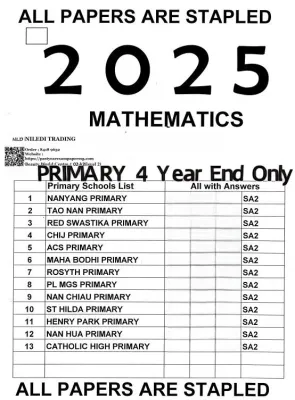
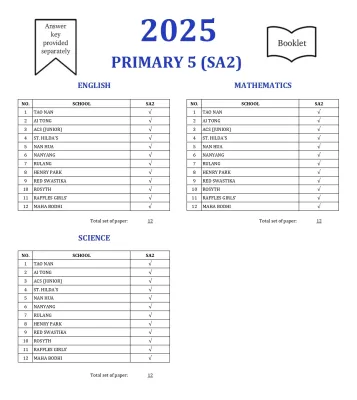
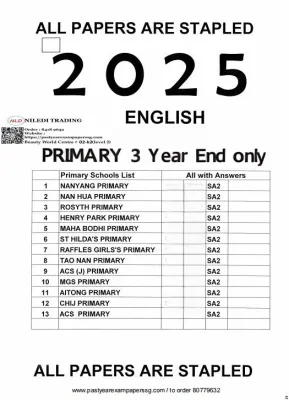
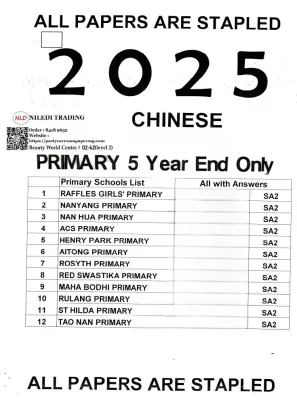
Prices are valid at publication and may change. Please refer to the product page for the latest price.
Foundational Reinforcement Tier If your child is scoring below 60%, they are likely struggling with core concepts. Avoid full-length exam papers at this stage. Focus instead on topical assessment books that break down chapters into bite-sized exercises. These books should feature guided examples and basic practice questions to rebuild confidence and plug fundamental knowledge gaps.
Standard Practice Tier For children scoring between 60% and 80%, they generally understand the basics but make careless mistakes or struggle with mid-difficulty questions. Look for books that offer thematic revision. These materials should bridge the gap between simple recall and complex application, helping them transition smoothly to full-length papers.
Advanced Problem-Solving Tier If your child is consistently scoring above 80%, they require materials that feature non-routine questions, challenging heuristics, and higher-order thinking tasks. These papers stretch their analytical skills and prepare them for the highly competitive components of the school examinations.
Buying overly difficult papers too early is a common pitfall. It often leads to unnecessary frustration, academic anxiety, and a sharp decline in motivation. Ensure the selected material offers a progressive difficulty curve to keep your child engaged and confident.
What to Look for in P5 Math Exam Papers and Practice Books
Primary 5 Mathematics introduces abstract concepts such as ratio, percentage, and rate, alongside more complex fraction problems. To tackle these effectively, your choice of practice materials must balance topical revision with full-length exam papers. Topical books are essential during the first half of the year to build deep conceptual understanding, while full-length papers are crucial later on to build mental stamina and time-management skills.

When evaluating Math assessment books, flip to the answer key first. The quality of a Math book lies in its solutions. Avoid books that only provide the final numerical answers. Instead, look for resources that offer detailed, step-by-step worked solutions utilizing recognized heuristic methods, such as model drawing, units and parts, systematic listing, and algebraic representation. These explanations allow parents and children to trace the logical flow of a problem and identify exactly where a step went wrong.
Furthermore, ensure the practice papers include a healthy mix of Paper 1 (short-answer and multiple-choice questions where calculators are prohibited) and Paper 2 (structured and long-answer questions where calculators are allowed). The Paper 2 section must feature non-routine problem sums that test spatial visualization and logical reasoning, as these are the primary differentiators in school examinations.
Selecting P5 Science Assessment Books for Concept Mastery
Mastering P5 Science requires more than just memorizing facts; it demands the ability to apply scientific concepts to unfamiliar scenarios. Therefore, the best Science assessment books are those that prioritize open-ended questions and teach students how to construct precise, keyword-rich answers.
Look for materials that explicitly guide students through experimental setup analysis. A high-quality Science paper will include questions that require identifying independent variables (the factor changed), dependent variables (the factor measured), and constant variables (factors kept the same to ensure a fair test). It should also feature data interpretation exercises, such as analyzing line graphs, bar charts, and classification tables, which are standard features in modern school assessments.
Verify that the terminology used in the answer keys aligns strictly with the latest MOE Science syllabus. For instance, explanations for physical science topics (like electricity and water cycle) and life science topics (like plant and human reproduction) must use precise scientific vocabulary. Look for answer keys that highlight key phrases and explain why certain terms are accepted while others are rejected, helping your child avoid losing marks on technicalities.
Choosing P5 English Practice Papers for Core Language Skills
The P5 English curriculum demands a high level of linguistic precision and critical thinking. When selecting practice papers, look for materials that target specific components of the examination paper, particularly Paper 2 (Language Use and Comprehension) and Paper 1 (Writing).
For comprehension, evaluate the quality of the passages and the variety of question types. The passages should be engaging and age-appropriate, featuring both narrative and factual texts. Ensure the exercises include a good mix of literal questions, direct vocabulary-in-context queries, and complex inference questions that require students to read between the lines and justify their answers using evidence from the text.
For writing and grammar, look for books that offer comprehensive model essays and guided composition prompts. The composition section should align with the continuous writing format, providing three thematic pictures and encouraging structured planning. Additionally, the book must provide ample practice for Synthesis and Transformation, focusing on challenging structures such as active-to-passive voice conversion, direct-to-indirect speech, and the correct usage of complex connectors.
Finding Suitable P5 Chinese Exam Papers for Mother Tongue
Primary 5 Chinese represents a significant step up in vocabulary and comprehension difficulty. To support your child, select practice materials that focus heavily on vocabulary acquisition, reading comprehension, and writing structure.
Look for books that provide targeted Hanyu Pinyin practice and comprehensive vocabulary lists that align directly with the chapters of the standard primary school textbook. Having these lists handy allows students to revise characters, word pairings, and sentence structures before attempting the practice papers.
For the writing component, prioritize books that offer structured model compositions, guided writing frameworks, and realistic picture-based composition prompts. The model essays should be annotated with good vocabulary, idioms, and expressive phrases, showing students how to elevate their writing.
Finally, ensure the materials include oral communication practice resources, such as video-based or picture-based discussion prompts, alongside comprehension passages of varying difficulty levels to build both receptive and expressive language skills.
How to Effectively Use P5 Exam Papers at Home
Simply buying the right exam papers is not enough; how your child uses them determines their academic progress. To maximize the value of these resources, establish a structured practice routine at home.
Simulate Exam Conditions When your child is ready for full-length papers, set up a quiet study space free from digital distractions. Enforce strict time limits matching the actual school exam durations. This practice helps your child build the mental stamina required to stay focused for over an hour and teaches them how to pace themselves across different sections.
Conduct Post-Paper Error Analysis Do not just mark the paper, record the score, and move on. Sit down with your child to analyze every mistake. Categorize errors into careless mistakes (such as misreading the question or calculation errors) and conceptual gaps (such as not understanding a scientific concept or a grammatical rule). Keep an error log where your child rewrites the corrected steps or explanations.
Use the Marking Scheme Constructively Teach your child how to read the marking scheme to understand mark allocation. In Science and Math, showing them where half-marks or full marks are awarded helps them realize the importance of writing down intermediate steps and including essential keywords, turning the marking process into an active learning experience.
Frequently Asked Questions (FAQ)
When is the best time to start using full P5 exam papers?
Introduce full-length exam papers in the second half of the primary school year. During the first half of P5, focus entirely on topical assessment books to ensure your child masters new concepts as they are taught in school. Attempting full papers too early can be counterproductive, as your child will encounter topics they have not yet covered, leading to unnecessary confusion and frustration. Once the syllabus is mostly complete, transition to full papers to build exam stamina and time-management skills.
Should I buy school past-year papers or published assessment books?
A combination of both resources provides the most balanced preparation. Published assessment books are excellent for structured, topical revision and targeted skill-building, as they often contain detailed explanations and pedagogical tips. On the other hand, compiled past-year papers from various primary schools expose your child to a wider variety of questioning styles, layout formats, and difficulty levels. Since P5 does not have official national preliminary papers, these compiled school papers serve as an excellent benchmark for actual exam standards.
Community discussion
Share your experience or ask a question. Comments are reviewed before publication.