
Preparing for the Singapore-Cambridge GCE O-Level Principles of Accounts (POA) examination requires more than just memorizing accounting theories and double-entry rules. To secure a strong grade, you must develop a deep familiarity with the exam format, master the art of ledger balancing under time pressure, and understand how marks are allocated for specific accounting treatments. This is where high-quality POA exam paper bundles become indispensable tools in your study arsenal.
Choosing the right practice bundle involves evaluating how closely the materials align with the current syllabus, whether they offer step-by-step solutions, and how well they match your current stage of revision. A well-structured bundle does not merely present questions; it serves as a diagnostic tool that highlights conceptual gaps and trains you to present your financial statements with the precision required by examiners. By focusing on authentic, syllabus-compliant resources, you can transform your study sessions from passive reading into active, exam-targeted preparation.
Understanding the O-Level POA Exam Requirements
To select an effective POA exam paper bundle, you must first understand the specific demands of the Singapore-Cambridge GCE O-Level syllabus. The POA curriculum is designed to test both your theoretical understanding of accounting principles and your practical ability to apply these concepts to real-world business scenarios. The core components of the syllabus span several critical areas, including the preparation of financial statements for sole proprietorships, accounting for partnerships, and basic corporate accounting. Each of these topics requires a distinct set of analytical skills, from adjusting ledger entries for accruals and prepayments to calculating profit-sharing ratios and understanding share capital.
Products mentioned in this guide
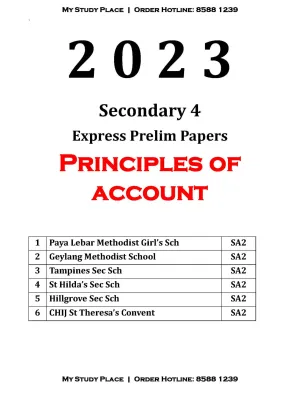
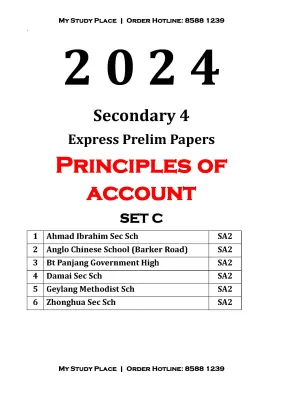
Prices are valid at publication and may change. Please refer to the product page for the latest price.
Furthermore, the examination structure is divided into distinct question formats that test different cognitive levels. You will encounter structured questions that require you to prepare ledger accounts, journal entries, and financial statements from a given trial balance. Alongside these, data-response questions assess your ability to analyze financial information, interpret ratios, and make informed business recommendations based on accounting data. A comprehensive practice bundle must feature a balanced mix of both formats, ensuring you are not caught off guard by the analytical demands of the data-response sections.
Another critical factor is syllabus currency. Accounting standards and educational curricula undergo periodic updates to reflect modern business practices and international accounting standards. For instance, terminology, presentation formats for financial statements, and the inclusion or exclusion of specific topics can change over time. Practicing with outdated papers can lead to confusion, as you might spend valuable time learning formats or rules that are no longer accepted. Therefore, you must verify that any exam paper bundle you purchase is explicitly updated for the current syllabus year, ensuring every hour of practice directly supports your upcoming exam.
Essential Features to Look for in POA Exam Paper Bundles
When evaluating different POA exam paper bundles, the quality of the answer key is often more important than the questions themselves. A high-quality bundle must include detailed marking schemes that show step-by-step workings for every calculation. In accounting, final figures like net profit or total assets are built upon a series of preceding calculations. If you make an early error, your final balance sheet will not balance, but you can still secure substantial method marks if your subsequent logic is correct. A marking scheme that only provides the final numbers is of limited use; you need to see exactly how those numbers were derived, including the specific ledger adjustments and formulas used.

The organization of the practice papers is another essential feature to consider. Depending on where you are in your academic year, you will benefit from different structures. Early in your revision, a bundle organized by topical categories is highly beneficial. This allows you to drill down into specific weak areas, such as depreciation methods or inventory valuation, immediately after studying them in class. As the exam approaches, however, you will need to transition to full-year past papers. These full papers simulate the actual exam experience, forcing you to switch context rapidly between different topics and manage your time across the entire paper.
Finally, look for bundles that offer high-value supplementary features. Some of the most effective practice books include highlights of common student mistakes, which warn you about frequent pitfalls like reversing debit and credit entries or misclassifying expenses. Others may feature examiner reports or brief summaries of key accounting concepts and formulas at the start of each section. These additions turn a simple collection of test papers into a comprehensive learning guide, helping you understand not just what the correct answer is, but why students often lose marks on those specific questions.
Comparing Different Types of POA Practice Bundles
As you shop for POA preparation materials, you will encounter several types of bundles, each suited to different study habits and timelines. Comprehensive past-year compilation bundles are the gold standard for late-stage revision. These collections typically feature actual past examination papers from recent years, allowing you to experience the exact tone, difficulty level, and layout of the official papers. Using these compilations is the most effective way to practice time management, helping you gauge how much time to allocate to complex financial statement preparation versus shorter theoretical questions.
In contrast, topical practice books are designed for targeted skill-building. If you consistently struggle with specific topics like manufacturing accounts, cash flow statements, or correction of errors, a topical bundle allows you to practice dozens of variations of these specific questions. This repetitive, focused drilling helps build muscle memory for complex ledger entries and ensures you master the underlying accounting principles before attempting a full-length mock exam. Many students find that a combination of both types—using topical books throughout the school term and switching to past-year compilations during the final lead-up to the exam—offers the most balanced preparation.
You must also decide between physical and digital bundle formats. Physical books remain highly popular for POA preparation because of the nature of the subject. Accounting exams require you to draw up ledger columns, write out detailed journal entries, and construct large financial statement tables. Physical books provide the necessary margin space and layout to practice these handwritten workings comfortably. On the other hand, digital bundles offer convenience and portability, allowing you to access papers on a tablet or laptop. If you choose a digital format, you can optimize its effectiveness by printing out the worksheets or using a tablet stylus to write out your ledger accounts by hand, thereby preserving the tactile practice of manual accounting.
Strategies for Integrating Exam Papers into Your Revision Plan
Simply completing paper after paper will not guarantee a top grade; you must integrate these bundles into a structured, deliberate revision plan. A phased approach is highly recommended. Begin your revision by using topical questions to reinforce your understanding of individual classroom lessons. Once you have achieved conceptual clarity across all major topics, transition to timed, full-paper simulations. Set a timer, clear your study desk of all textbooks, and attempt a complete past paper under strict exam conditions. This practice is crucial for building the mental stamina required to stay focused during the actual multi-hour examination.
When you finish a practice paper, your work is only half done. You must actively engage with the marking scheme during your review. Instead of merely checking whether your final balance sheet matches the answer key, trace the logical flow of every accounting entry. If you find a discrepancy, work backward through your calculations to identify the exact point where the error occurred. Did you misinterpret a transaction, apply the wrong depreciation method, or make a simple arithmetic slip? Understanding the root cause of your mistake is the key to preventing it from happening again.
To consolidate your learning, maintain a dedicated error log throughout your revision period. Every time you make a mistake in a practice bundle, document the question, the correct accounting treatment, and a brief note explaining your error. In the final weeks leading up to the O-Level exam, this log becomes an invaluable, highly personalized study guide. Reviewing your error log ensures that your final revision sessions are focused directly on your historical weak points, maximizing the efficiency of your study time.
Sourcing and Verifying Authentic POA Materials
To ensure your preparation is effective, you must source authentic, high-quality POA materials. It is highly recommended to purchase your exam paper bundles from established educational publishers, major retail bookshops, or authorized online bookstores in Singapore. These reputable sources work closely with experienced educators to ensure that the questions, marking schemes, and terminology used are accurate and fully aligned with the official syllabus guidelines.
Before finalizing your purchase, perform a quick verification check on the book’s details. Look at the cover or the copyright page to confirm the publication year and the specific syllabus code. This step is vital, as older editions may still be on the shelves but might not reflect recent syllabus adjustments or modern presentation formats for financial statements. Ensure that the bundle explicitly states it is designed for the current O-Level Principles of Accounts syllabus.
Be cautious of unauthorized digital downloads or unofficial online listings. While these resources may seem convenient or cost-effective, they often suffer from significant quality issues. Unofficial scans may have missing pages, illegible financial data tables, or incomplete marking schemes that omit the crucial step-by-step workings you need to learn. Investing in official, professionally published bundles ensures you are practicing with complete, accurate, and reliable materials that will genuinely support your academic success.
Frequently Asked Questions (FAQ)
How many years of past papers should a comprehensive POA bundle include?
A comprehensive POA bundle should ideally cover the most recent five to ten years of past papers. Focusing on the most recent five years is particularly important, as these papers reflect the current syllabus structure, modern accounting terminology, and the exact style of questions you will face. However, older papers can still serve as valuable supplementary material. While some formats or topics in older papers may be outdated, the core double-entry principles, ledger posting rules, and basic financial statement structures remain highly relevant for targeted topical practice.
Are digital POA exam paper bundles as effective as physical books?
Digital POA bundles can be highly effective if used correctly, but they require a deliberate approach. Because the O-Level POA exam is a written paper requiring precise layout of ledger accounts and financial statements, practicing on a screen alone is insufficient. To make the most of digital bundles, you should print out the practice sheets or use a tablet with a stylus to write out your workings by hand. This method ensures you develop the necessary spatial awareness and speed for drawing up accounts, which is difficult to replicate through typing or passive reading.
What should I do if my POA bundle does not include detailed workings in the marking scheme?
If your practice bundle only provides final answers without step-by-step workings, you can still reconstruct the solution. Start by cross-referencing the question with your standard POA textbook to identify the relevant accounting formulas and ledger rules. If you cannot resolve the discrepancy on your own, consult your school teachers or a qualified tutor. They can help break down the calculation steps and demonstrate the correct methodology. Additionally, consider forming a study group with classmates to compare your workings and collectively figure out the logical steps behind complex adjustments.
Community discussion
Share your experience or ask a question. Comments are reviewed before publication.