
The 12-hole chromatic harmonica is a remarkably versatile instrument, capable of playing all twelve semitones of the chromatic scale across three full octaves. Unlike its diatonic counterpart, which is often limited to a single key without advanced bending techniques, the chromatic harmonica uses a mechanical slide button to access sharps and flats instantly. To unlock this expressive potential, players must choose a notation system that translates written music into physical actions. Whether you are a classical enthusiast, a jazz improviser, or a hobbyist looking to play familiar melodies, selecting the right sheet music format is the first step toward mastering the instrument.
Understanding Notation Options for Chromatic Harmonicas
Choosing how to read music for the 12-hole chromatic harmonica depends on your musical background, preferred genres, and long-term goals. There are three primary notation systems used by players: standard staff notation, harmonica-specific tablature (tabs), and numbered musical notation (often referred to as Jianpu). Each system offers distinct advantages and trade-offs, making them suitable for different stages of a musician’s journey.
Standard staff notation, written on the treble clef, is the universal language of music. It represents pitch and rhythm precisely, allowing you to play any piece written for violin, flute, or voice. Because standard sheet music does not rely on instrument-specific shortcuts, learning it opens up a vast library of classical, jazz, and popular music. It also makes collaborating with other instrumentalists straightforward, as everyone reads from the same musical foundation.
Products mentioned in this guide

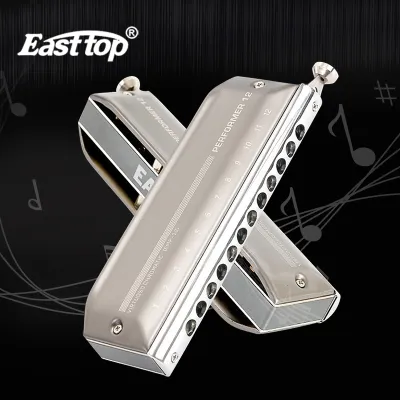

Prices are valid at publication and may change. Please refer to the product page for the latest price.
Harmonica tablature, or tabs, is a highly practical, instrument-specific system. Instead of representing pitch directly, tabs use numbers and symbols to tell you exactly which hole to blow into or draw from, and when to press the slide button. This system requires no prior music theory knowledge, making it an excellent choice for beginners who want to play recognizable tunes quickly. However, tabs often lack detailed rhythmic information, meaning you must already know the melody to play the piece accurately.
Numbered musical notation, or Jianpu, represents pitches using numbers from 1 to 7, corresponding to the solfège scale (Do, Re, Mi, Fa, Sol, La, Ti). Dots placed above or below the numbers indicate octaves, while underlines and dashes represent note duration. This system is widely used in traditional Asian music and is highly compatible with the chromatic harmonica, particularly for players who prefer a relative pitch system over absolute note reading.
How to Read Standard Staff Notation
Applying standard staff notation to a 12-hole chromatic harmonica is a rewarding process that connects written pitches directly to the physical layout of the instrument. Most standard 12-hole chromatic harmonicas are keyed in C, meaning that with the slide button open, the instrument naturally plays the C major scale. The three octaves of the instrument map cleanly onto the treble clef, starting from middle C (C4) up to C7.

To begin mapping notes, it is helpful to divide the 12 holes into three distinct octaves. Holes 1 through 4 cover the low octave, starting at middle C. Holes 5 through 8 cover the middle octave, which is the most common range for vocal melodies. Holes 9 through 12 cover the high octave. Within each four-hole group, the breath pattern repeats: blow on hole 1 is C, draw is D, blow on hole 2 is E, draw is F, blow on hole 3 is G, draw is A, draw on hole 4 is B, and blow on hole 4 is C. Notice that the pattern shifts slightly at the end of each octave, where two blow notes or two draw notes sit next to each other.
When reading standard sheet music, accidentals—sharps and flats—indicate that you need to press the slide button. On a standard C-keyed chromatic harmonica, pressing the slide raises any note by a half-step. For example, if you see an F-sharp on the staff, you play the note F (draw on hole 6 in the middle octave) and press the slide button. If you see a B-flat, you can play B (draw on hole 8) and press the slide, or use the enharmonic equivalent, which is A-sharp.
Reading standard notation provides immense benefits when playing with other musicians. It allows you to read lead sheets, classical sonatas, or jazz standards without needing specialized harmonica arrangements. Furthermore, standard notation clearly communicates complex rhythms, rests, and dynamics, which are often omitted or simplified in tablature. This precision is essential for developing professional-level phrasing and timing.
Using Harmonica Tablature and Numbered Notation
For players who want a more direct path to playing melodies without learning to read staff notation, harmonica tablature and numbered notation are highly effective alternatives. These systems bypass the abstract representation of pitch and focus instead on the physical mechanics of the instrument or relative pitch relationships.
Chromatic harmonica tablature typically uses numbers from 1 to 12 to represent the holes. To indicate breath direction, tabs use simple visual cues: a positive number or a number without markings usually represents a blow note, while a negative number, a circled number, or a number with a minus sign represents a draw note. The slide button is represented by a specific symbol, such as an asterisk, a plus sign, or a right-pointing arrow next to the hole number. For example, a draw on hole 5 with the slide button pressed might be written as -5* or -5+.
While tabs are incredibly accessible, they have notable limitations. Because they rarely include precise rhythmic notation, players must rely on their memory of the song’s rhythm to play it correctly. This makes tabs less useful for learning unfamiliar pieces or complex classical compositions. Additionally, tabs do not convey musical structure, harmony, or articulation, which can lead to a mechanical playing style if not paired with active listening.
Numbered musical notation, or Jianpu, bridges the gap between tabs and standard notation. Because it uses numbers to represent scale degrees, it is highly adaptable to different keys. For a chromatic harmonica player, reading Jianpu requires understanding how the numbers 1 through 7 map to the holes of the instrument in a given key. While it requires a bit more mental translation than simple tabs, it provides a much clearer representation of rhythm and octave shifts, making it a robust system for intermediate players.
Handling the Slide Button in Written Music
The slide button is the defining mechanical feature of the chromatic harmonica, transforming a simple diatonic instrument into a fully chromatic one. Managing this slide smoothly is one of the greatest physical challenges for players, and understanding how it is represented in written music is crucial for developing clean technique.
In standard staff notation, the slide button is not explicitly marked. Instead, the player must recognize accidentals on the staff and instantly translate them into slide actions. This requires a strong mental map of the instrument. For instance, seeing a C-sharp requires the immediate physical reaction of blowing on hole 5 (or hole 1 or 9) while pressing the slide. Over time, this translation becomes subconscious, allowing the player to execute rapid chromatic passages without hesitation.
In contrast, tablature explicitly marks every slide engagement. These markings must be read ahead of time to prepare the hand movement. Some tab systems use brackets or lines to show that the slide should remain held down over a sequence of notes, which is highly useful for playing in keys with multiple sharps or flats, such as B major or F-sharp major. Keeping the slide depressed for consecutive notes reduces unnecessary hand movement and prevents choppy phrasing.
To practice slide transitions effectively, focus on maintaining a consistent embouchure and breath pressure while moving the slide. A common mistake is to stop blowing or drawing when pressing the button, which creates a disjointed sound. Practice slow scales, such as the C chromatic scale, ensuring that the transition between open and closed slide notes is seamless. Using a metronome during these exercises helps build the precise coordination needed between your breath, mouth positioning, and slide finger.
Where to Find Sheet Music and Learning Resources
Finding high-quality sheet music and instructional materials is essential for progressing on the 12-hole chromatic harmonica. Because the instrument has a unique range and layout, selecting the right resources requires careful attention to format, key, and arrangement style.
When searching for standard sheet music, look for pieces written for instruments with a similar range, such as the violin, flute, or oboe. These instruments read treble clef and generally stay within the three-octave range of a standard 12-hole harmonica. Classical solo pieces, jazz lead sheets from fake books, and vocal melody books are excellent sources of material. Ensure that the sheet music is in a key you feel comfortable playing, especially if you are still mastering slide transitions.
For dedicated chromatic harmonica tabs, specialized music publishers and online community archives are invaluable. Many experienced players share transcriptions of popular songs, jazz solos, and classical arrangements specifically formatted for the 12-hole chromatic harmonica. When downloading or purchasing these tabs, verify that they are specifically labeled for a 12-hole chromatic rather than a 10-hole diatonic or a 16-hole chromatic, as the hole numbering and layout differ significantly.
Before purchasing physical method books or digital sheet music, always verify the edition, language, and compatibility with your specific instrument. Some method books are written entirely in standard notation, while others include both notation and tabs. If you are buying digital sheet music from an online marketplace, check if the file format is compatible with your tablet or e-reader, and ensure that the arrangement is complete rather than a simplified excerpt. Utilizing structured method books written by professional instructors is highly recommended, as they provide a logical progression of exercises that bridge the gap between reading notation and physical execution.
Frequently Asked Questions (FAQ)
Can I play diatonic harmonica tabs on a 12-hole chromatic harmonica?
Yes, you can play diatonic harmonica tabs on a 12-hole chromatic harmonica, but it requires some mental adjustment. A standard 10-hole diatonic harmonica is tuned to the Richter system, which has a different hole layout and breath pattern in the lower octave compared to the Solo tuning of a 12-hole chromatic harmonica. Specifically, holes 1 through 3 on a diatonic harmonica do not match the note layout of holes 1 through 3 on a chromatic harmonica.
Additionally, diatonic tabs often call for bending notes to achieve accidentals. On a chromatic harmonica, you do not need to bend notes to get these pitches; instead, you simply press the slide button. While you can adapt diatonic tabs in the middle and upper registers (holes 4 to 10 on a diatonic correspond roughly to holes 5 to 12 on a chromatic), it is generally much more practical to find or transcribe chromatic-specific arrangements to avoid confusion and ensure accurate pitch delivery.
Do I need to learn standard music notation to play the chromatic harmonica?
You do not strictly need to learn standard music notation to play the chromatic harmonica, especially if your goal is to play simple melodies, folk songs, or blues for personal enjoyment. For these purposes, harmonica tablature or learning by ear is entirely sufficient and allows you to start playing immediately without the steep learning curve of music theory.
However, if you plan to play classical music, complex jazz standards, or perform in an ensemble, learning standard notation becomes essential. Standard notation allows you to communicate with other musicians, read complex rhythms, and access an unlimited library of music. If you are hesitant, a good approach is to start with tablature to build physical familiarity with the instrument, and then gradually transition to standard notation by reading simple melodies on the treble clef.
Community discussion
Share your experience or ask a question. Comments are reviewed before publication.