
Quick Answer: Which Book Fits Your Current Financial Stage?
When embarking on a journey toward financial literacy, two titles consistently dominate bestseller lists and recommendation threads: Morgan Housel’s The Psychology of Money and Robert Kiyosaki’s Rich Dad Poor Dad. Both books have transformed how millions of readers view wealth, but they approach the subject from entirely different angles. If you are standing in a bookstore or browsing an online marketplace trying to decide which one to purchase first, the answer is not a simple matter of which book is objectively superior. Instead, the ideal starting point depends on your current financial situation, your emotional relationship with wealth, and what you hope to achieve in your immediate financial life.
Choosing the psychology of money as your first read is highly recommended if your primary goal is to build long-term, sustainable habits, understand your emotional biases, and develop a calm, rational approach to saving and investing. This book does not promise quick riches; rather, it focuses on the behavioral discipline required to keep and grow the money you already have. On the other hand, Rich Dad Poor Dad is the better choice if you feel trapped in a conventional career path, lack basic motivation to improve your financial standing, and need a powerful paradigm shift regarding how money, assets, and liabilities function.
It is equally important to recognize what neither book will provide. If you are searching for a step-by-step technical guide detailing how to pick individual stocks, execute day trades, construct an advanced investment portfolio, or navigate complex tax structures, neither of these titles will fulfill that need. They are foundational texts designed to shape your mindset and philosophy rather than technical manuals for market execution.
Products mentioned in this guide
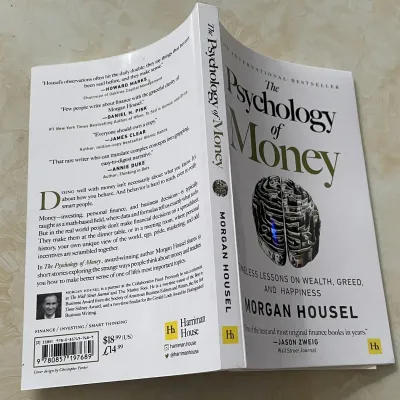
Prices are valid at publication and may change. Please refer to the product page for the latest price.
Core Philosophies: Behavioral Mindset vs. Asset Accumulation
To understand which book to read first, one must contrast their core philosophies. In The Psychology of Money, Morgan Housel argues that financial success is not a hard science driven by mathematical formulas or high intelligence. Instead, it is a soft skill where your behavior is far more important than what you know. Housel uses engaging historical anecdotes and psychological insights to demonstrate that people do not make financial decisions purely on a spreadsheet; they make them at the dinner table, influenced by their unique personal histories, pride, and emotional triggers.

Key concepts in Housel’s work include the distinction between being rich (having a high current income) and being wealthy (having unseen assets and the freedom to control your time). He emphasizes the immense power of compounding, which requires patience and survival rather than chasing high-risk, short-term returns. For Housel, the ultimate financial goal is not luxury, but “room for error”—creating a financial buffer that allows you to survive the inevitable volatility of markets and life without being forced to liquidate your investments.
Conversely, Rich Dad Poor Dad by Robert Kiyosaki focuses on the structural mechanics of wealth accumulation and financial literacy. Kiyosaki presents his ideas through the narrative of his childhood, contrasting the financial advice of his highly educated but financially struggling biological father (“Poor Dad”) with that of his friend’s entrepreneurial father (“Rich Dad”). The central thesis of the book is that the poor and middle class work for money, while the rich have money work for them.
Kiyosaki introduces a simple yet powerful definition of assets and liabilities: an asset is anything that puts money in your pocket, while a liability is anything that takes money out of your pocket. Through this lens, he challenges conventional wisdom, famously arguing that a primary residence is not an asset but a liability due to the ongoing expenses it demands. His philosophy strongly champions financial independence through business ownership, intellectual property, and real estate investing, encouraging readers to break free from the traditional employee mindset.
Ultimately, these two philosophies do not contradict each other; they operate in harmony. Kiyosaki’s work acts as an accelerator, teaching you how to shift your perspective to generate wealth through cash-flowing assets. Housel’s work acts as a stabilizer, teaching you the emotional discipline and humility required to preserve and compound that wealth over a lifetime. Without Kiyosaki’s paradigm shift, you might never start building assets; without Housel’s behavioral guardrails, you risk losing everything to greed, impatience, or panic.
Target Audience and Prerequisite Knowledge
Determining which book matches your current life stage and financial literacy level is crucial for maximizing their value. The Psychology of Money is an exceptionally accessible book that suits readers of all backgrounds, from teenagers receiving their first allowance to seasoned investment professionals. Because Housel focuses on human psychology and decision-making rather than technical jargon, readers require absolutely zero prior knowledge of economics or finance. The book’s universal truths about greed, fear, and satisfaction resonate regardless of your net worth or geographic location.
Rich Dad Poor Dad is primarily targeted at beginners, young adults, or anyone who feels stuck in the traditional “rat race” of working a nine-to-five job to pay off perpetual debts. While it does not require a background in finance, it does demand a willingness to challenge deeply ingrained societal norms. Readers who are highly risk-averse or firmly committed to traditional career and housing paths may find Kiyosaki’s provocative style challenging. It requires an open mind to look past the simplified, sometimes aggressive rhetoric to extract the valuable core lessons on cash flow.
To help you evaluate your current starting point, consider this self-assessment checklist:
- Are you struggling with overspending, emotional shopping, or maintaining a consistent savings rate? If so, your primary challenge is behavioral. You will benefit most from reading The Psychology of Money first to address the underlying psychological triggers of your spending and saving habits.
- Do you save money consistently but feel terrified of investing it, or do you view the stock market as a form of gambling? Again, Housel’s book is the ideal starting point, as it demystifies market history and explains why volatility is a fee for long-term returns rather than a fine for doing something wrong.
- Do you feel that working harder at your job is the only way to improve your financial situation, yet you remain trapped in a cycle of rising expenses? This is a structural mindset issue. You should read Rich Dad Poor Dad first to understand how to break the link between your time and your income.
- Are you eager to learn how to acquire cash-flowing properties or start a side business, but don't know how to conceptualize the difference between income and capital? Kiyosaki’s framework will provide the motivational spark and basic conceptual vocabulary you need to begin this transition.
Reading Experience and Actionability
The structural design and writing style of each book significantly impact how you absorb and apply their lessons. The Psychology of Money is structured as a collection of twenty short, highly polished essays. Housel’s writing is elegant, understated, and deeply reflective. He avoids prescriptive, dogmatic advice, choosing instead to share compelling historical narratives—ranging from the behavior of early twentieth-century billionaires to the evolution of the American consumer—to let readers draw their own conclusions.
The actionability of Housel’s book is internal and systemic. It prompts deep self-reflection, encouraging you to define what “enough” means to you and to design a personal financial system that prioritizes peace of mind over maximum mathematical optimization. It teaches you to automate your savings, accept reasonable returns rather than chasing extreme gains, and build a portfolio that allows you to sleep soundly at night.
In contrast, Rich Dad Poor Dad relies on a highly engaging, narrative-driven parable. Kiyosaki’s tone is urgent, motivational, and occasionally confrontational. He uses simple diagrams to make complex financial concepts immediately understandable to a layperson. This simplicity is the book’s greatest strength, making it incredibly memorable and inspiring for those who have never engaged with financial literature before.
However, the external actionability of Kiyosaki’s advice presents a distinct challenge. Implementing his strategies—such as purchasing investment properties, utilizing corporate structures for tax advantages, or using high debt leverage—requires navigating complex, real-world legal and financial systems. This is where a critical reading boundary is absolutely essential.
Before attempting to execute any specific strategy mentioned in Rich Dad Poor Dad, readers must verify these concepts against current market realities and local regulations. For instance, if you are reading this in Singapore, the local real estate landscape is governed by strict frameworks such as the Total Debt Servicing Ratio (TDSR), progressive Seller’s Stamp Duty (SSD), and substantial Additional Buyer’s Stamp Duty (ABSD) for multiple property purchases. Furthermore, the role of Central Provident Fund (CPF) savings in purchasing property introduces unique local variables. Kiyosaki’s broad advice on buying real estate with minimal down payments or using aggressive debt leverage can carry extreme risks under these local regulations.
Whether you are reading a physical copy, an e-book, or listening to an audiobook, always ensure you verify the specific edition, language, medium/file format, regional restrictions, and authorized sources before purchasing. Different editions, such as the original text versus updated anniversary editions, may contain distinct prefaces or revised chapters. Verifying the publisher details on authorized online platforms helps you avoid low-quality, unauthorized digital copies or physical prints that may omit key diagrams or financial tables.
Side-by-Side Comparison at a Glance
To help you make an immediate decision, the table below summarizes the key differences between these two personal finance classics across several critical dimensions.
| Feature | The Psychology of Money | Rich Dad Poor Dad |
|---|---|---|
| Author | Morgan Housel | Robert Kiyosaki |
| Core Theme | Behavioral psychology, emotional discipline, and sustainable habits | Financial literacy, asset accumulation, and entrepreneurial mindset |
| Best Suited For | Building a stable, long-term relationship with money | Shifting your paradigm about work, income, and wealth creation |
| Reading Style | Reflective, story-driven, and structured as short essays | Narrative, motivational, and structured as a personal parable |
| Primary Action Type | Internal habit adjustment and building a resilient personal system | External strategy execution, such as business creation or investing |
| Key Takeaway | Doing well with money is about behavior; wealth is what you do not see | The rich do not work for money; they acquire assets that generate cash flow |
Building Your Personal Finance Reading Roadmap
Rather than viewing these books as competitors, you should treat them as complementary steps in your financial education. Designing a personalized reading roadmap can help you absorb their lessons in the most logical sequence, minimizing risk while maximizing your motivation.
The "Mindset First" Approach
For the vast majority of readers, starting with The Psychology of Money is the safest and most logical path. Before you learn how to generate large sums of money or invest in volatile assets, you must first master the emotional discipline required to manage what you already have. If you jump straight into aggressive investment strategies without understanding your behavioral biases, you are highly susceptible to making costly mistakes.
For example, Kiyosaki’s enthusiastic advocacy for real estate and business ventures can inspire readers to take significant financial risks. However, if those readers have not yet internalized Housel’s lessons on “room for error” and the unpredictable nature of market cycles, they may overleverage themselves, panic during a market downturn, or fail to maintain an adequate emergency fund. Reading Housel first installs the behavioral brakes and safety systems your financial vehicle needs before Kiyosaki helps you step on the gas.
The "Motivation First" Approach
Alternatively, if you find yourself completely disengaged from your finances, living paycheck to paycheck without any interest in saving, or feeling deeply cynical about your career prospects, the “Motivation First” approach may be necessary. In this scenario, starting with Rich Dad Poor Dad can act as the disruptive wake-up call you need to shake off financial apathy.
Kiyosaki’s stark contrast between the lives of his two dads is designed to provoke discomfort and inspire action. Once this book has successfully disrupted your traditional views on employment and motivated you to take control of your financial destiny, you will be in a much better frame of mind to appreciate the sober, stabilizing wisdom of Housel’s work.
Next Steps After Reading
Once you have completed both books, your financial education should transition from high-level philosophy to practical, localized execution. If you started with Housel and find yourself with a highly disciplined saving mindset, your next step should be to read practical guides on low-cost index fund investing, retirement planning, or budgeting systems.
If you started with Kiyosaki and are eager to explore business or real estate investing, your next step must involve deep, localized research. Seek out resources that explain the specific tax codes, corporate registration processes, and property laws of your country. For readers in Singapore, this means studying the guidelines set by the Inland Revenue Authority of Singapore (IRAS) and the Monetary Authority of Singapore (MAS). Grounding Kiyosaki’s high-level concepts in local regulatory realities is the only way to transition safely from theory to profitable execution.
Frequently Asked Questions (FAQ)
Is 'Rich Dad Poor Dad' still relevant for modern investors?
The core principles of Rich Dad Poor Dad—specifically the definition of assets versus liabilities and the emphasis on building cash flow—remain highly relevant. However, the specific real estate tactics, corporate tax loopholes, and historical examples Kiyosaki shares must be treated as conceptual illustrations rather than literal instructions. Modern financial markets, banking regulations, and tax laws have evolved significantly since the book’s publication in 1997. Readers should focus on the book’s motivational framework while relying on updated, localized professional advice for actual investment strategies.
Does 'The Psychology of Money' teach you how to invest in stocks?
No, The Psychology of Money does not provide technical stock analysis, specific stock recommendations, or portfolio allocation formulas. Instead, it teaches you the critical behavioral skills required to succeed as a long-term investor. Housel explains how to handle market volatility, why patience and compounding are your greatest assets, and how to avoid the emotional pitfalls of greed and panic. It is designed to help you survive the psychological challenges of investing, making it the perfect companion to more technical investing guides.
Community discussion
Share your experience or ask a question. Comments are reviewed before publication.