
Quick Answer: Which Format Fits Your Practice Style?
Choosing the right physical ukulele chords chart is not about finding a single “best” product, but rather matching the format to your specific practice environment, mobility needs, and learning habits. Because different formats solve different spatial and logistical challenges, your choice will directly impact how often you practice and how quickly you memorize new shapes.
- Choose a Wall Poster if you have a dedicated practice corner, want constant visual reinforcement, and prefer a completely hands-free reference. A poster allows you to maintain correct playing posture because you can glance at the wall without looking down or breaking your strumming rhythm.
- Choose a Card Set if you travel frequently, want to isolate specific chord families for focused memorization, or need a modular system that fits easily into your gig bag. This format is ideal for active recall and targeted drilling sessions where you want to eliminate visual distractions.
- Choose a Booklet or Fold-Out Guide if you study at a desk, need a comprehensive library of chords in a compact format, or want to protect your reference materials from wear and tear. Booklets offer high information density and often include valuable music theory context that posters and cards omit.
Breaking Down the Three Physical Chord Chart Formats
While digital chord apps and online databases are incredibly convenient, physical chord charts offer distinct advantages for dedicated practice. They eliminate screen glare, prevent battery drain, and keep you focused by removing the constant distraction of smartphone notifications. By choosing a physical format, you create a tangible, tactile connection to your instrument that supports deeper focus. Each of the three primary formats—wall posters, card sets, and booklets—serves a unique role in a player’s musical development.

Wall Posters: High Visibility for Dedicated Practice Corners
A high-quality wall poster serves as a permanent visual anchor for your practice space. When you hang a chord chart on the wall, you create a dedicated zone that mentally prepares you to play every time you enter the room. The primary advantage of a poster is its high visibility; the large print allows you to read chord diagrams from several feet away, making it easy to check a finger placement mid-song without interrupting your performance. This hands-free nature is excellent for maintaining proper physical alignment, as looking down at a flat surface on a desk can cause neck strain and disrupt your wrist position.
Products mentioned in this guide

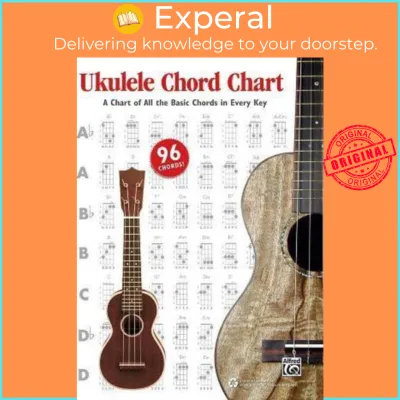


Prices are valid at publication and may change. Please refer to the product page for the latest price.
However, wall posters require a significant amount of dedicated wall space, which can be a limiting factor depending on your living situation. In Singapore, where many musicians live in compact HDB flats or rented apartments, finding open wall space that is not already occupied by furniture or shelving can be a challenge. Furthermore, permanent mounting methods like nails, tacks, or heavy adhesives can damage drywall or peel paint, which is a major concern for renters who want to preserve their security deposits. To enjoy the benefits of a wall poster without risking damage to your walls, it is highly recommended to use damage-free adhesive strips, magnetic poster hangers, or lightweight frames designed for temporary mounting.
This format is ideal for absolute beginners who are building basic muscle memory and practice in the same location every day. Having the most common major, minor, and seventh chords displayed in large, clear print right in front of you reduces the friction of starting a practice session, making it easier to build a daily playing habit.
Card Sets: Portable and Modular for On-the-Go Learning
Card sets, which typically consist of individual flashcards or ring-bound chord decks, offer a highly modular and portable alternative to traditional static charts. The standout feature of a card set is its ability to support active recall and spaced repetition. Instead of staring at a massive grid of dozens of chords, you can pull out just three or four cards representing the specific chord progression you are practicing today. By isolating these shapes, you eliminate visual clutter and train your brain to focus on the exact finger transitions you need to master.
The physical design of card sets makes them incredibly easy to slip into the accessory pocket of a standard ukulele gig bag. This portability is a massive benefit for students who take their instruments to weekly lessons, community club jam sessions, or outdoor gatherings. If you buy a ring-bound set, you can even clip it directly to your instrument case so you never leave home without it. The main drawback, however, is that loose cards can easily be misplaced or damaged if they are not kept organized in a dedicated pouch or binder. Additionally, because the cards are small, the text and diagrams are naturally smaller, which might cause eye strain for some players.
Card sets are highly recommended for intermediate players who are working on specific chord families, such as learning seventh chords, minor sevenths, or jazz voicings. They are also excellent for traveling musicians and students who need a portable, high-quality reference that does not require a music stand or wall space to use effectively.
Booklets and Fold-Out Guides: Compact and Systematic for Desk Study
Booklets, pocket dictionaries, and laminated fold-out guides represent the middle ground between the high visibility of a poster and the extreme portability of a card set. These guides are designed for systematic study, offering an incredible amount of information packed into a highly dense, structured format. A typical booklet does not just show you how to play a C major chord; it will show you multiple voicings up the neck, alternative fingerings, scale diagrams, and the theoretical relationships between different chord families.
For players who prefer to practice at a desk or use a dedicated music stand, a booklet or fold-out guide is an indispensable tool. Laminated fold-out guides are particularly popular because they can open up to display a wide array of chords like a mini-poster, yet fold down to the size of a standard notebook for easy storage in a drawer or case. This lamination also provides excellent durability, protecting the paper from creasing, tearing, or staining over years of frequent use. The primary challenge with bound booklets is keeping them open to the correct page while you play. Thick books have a tendency to spring shut, which means you will need to invest in page clips, a weighted book holder, or a sturdy music stand to keep your hands free.
This format is best suited for serious students, analytical learners, and players who want a comprehensive reference library. If you enjoy planning your practice sessions in advance, analyzing chord progressions, or studying music theory alongside your physical playing, a booklet or fold-out guide provides the depth of information you need.
Head-to-Head Comparison: Space, Routine, and Durability
To help you visualize how these three formats compare across the most critical decision factors, the table below outlines the key trade-offs of each option.
| Feature | Wall Poster | Card Set | Booklet / Fold-Out |
|---|---|---|---|
| Visibility & Readability | High; large diagrams readable from a distance | Moderate to low; small print requiring close viewing | Moderate; clear layout but requires close proximity |
| Portability | None; designed to remain fixed in one location | High; fits easily in gig bags and accessory pockets | Moderate; portable but requires flat surface or stand |
| Space Required | Large wall area; requires mounting solutions | Minimal; easily stored in drawers or small pouches | Minimal; sits on a desk, music stand, or shelf |
| Durability & Material | Variable; paper can tear, laminated versions last | High; thick cardstock or plastic resists wear | High; laminated fold-outs are highly spill-resistant |
| Best Practice Scenario | Standing/Room practice | On-the-go drilling, active recall, and travel | Desk study, theory reference, and session planning |
Managing Your Living Space
When deciding on a format, your physical living environment should play a major role in your choice. In high-density urban environments, such as apartments and HDB flats, visual clutter can quickly make a living space feel cramped. A large, brightly colored chord poster hanging on a bedroom wall might not align with a minimalist aesthetic or a shared living arrangement. If you prefer to keep your practice space tidy and multi-functional, a fold-out guide or a card set is an excellent alternative. These formats can be easily tucked away in a drawer, placed on a bookshelf, or kept inside your ukulele case when you are finished playing, keeping your living area free from permanent visual distractions.
In Singapore, where residential properties like HDB flats and condominiums are designed with highly efficient but compact layouts, managing physical space is a constant consideration. A massive poster measuring 60cm by 90cm can easily dominate a small bedroom or study room, clashing with your interior decor or taking up wall space that could be used for shelving or artwork. If you share your home with family members or roommates, a giant chord chart in a common area might not be appreciated by everyone. In these situations, the modularity of a card set or the compact nature of a fold-out guide becomes highly advantageous. You can easily keep your practice tools organized and out of sight when not in use, maintaining a clean, clutter-free living environment. On the other hand, if you are setting up a dedicated creative space, a poster can serve as an inspiring focal point that clearly defines the purpose of that room.
Climate and Long-Term Durability
Another practical consideration that is often overlooked is how local environmental conditions affect physical materials. The tropical climate of Singapore presents unique challenges for preserving physical learning materials. With average relative humidity levels often hovering around 80% to 90% year-round, paper products are highly susceptible to moisture absorption. Standard, untreated paper chord charts can quickly become limp, warp at the edges, or develop unsightly yellow foxing spots over time. In worst-case scenarios, damp paper can even become a breeding ground for mold or attract silverfish, which can ruin your reference materials.
This makes material choice a critical factor when shopping for a ukulele chords chart. Fully laminated options, synthetic waterproof paper, or heavy-duty plastic cards are highly superior choices for tropical environments. They are completely impervious to humidity, resist tearing, and can be wiped down with a damp cloth to remove dust or fingerprints, ensuring your chart remains pristine and legible for many years.
What to Check Before Buying: Tuning, Layout, and Print Quality
Before you purchase any physical ukulele chord chart, it is essential to verify its technical specifications and physical quality. Buying a chart without checking these details can lead to immediate frustration, as an inaccurate or poorly designed chart will hinder your progress rather than help it.
1. Verify the Tuning Standard
The single most important technical check is the tuning standard printed on the chart. The vast majority of ukuleles—including soprano, concert, and tenor sizes—are tuned to standard re-entrant GCEA tuning (where the fourth string is tuned to a high G). However, there are several variations you must be aware of:
- Standard Re-entrant GCEA: This is the default tuning for almost all modern ukulele chord charts. If you play a standard soprano, concert, or tenor ukulele, this is the format you need. The "re-entrant" aspect means the strings do not go strictly from lowest pitch to highest pitch; instead, the fourth string (G) is pitched higher than the third string (C).
- Linear GCEA (Low G): Some players prefer to string their tenor or concert ukuleles with a low G string, replacing the high G with a thicker string tuned an octave lower. While the physical chord fingerings remain identical to standard GCEA, the musical voicing has a deeper, more guitar-like bass response. Standard charts work perfectly fine for low G, but specialized charts that highlight bass lines or linear fingerings can offer additional value.
- D-Tuning (ADF#B): Popular in some vintage instruction books, traditional Canadian school programs, and common in parts of Europe, D-tuning pitches the entire instrument one whole step higher than standard GCEA. A standard GCEA chart will not work for a D-tuned ukulele, as the chord names and fingerings will not match the pitches you hear.
- Baritone Ukulele Tuning (DGBE): Baritone ukuleles are the largest of the common ukulele sizes and are tuned exactly like the top four strings of a standard acoustic guitar. Because of this, you must buy a dedicated baritone ukulele chord chart; a standard GCEA chart is completely incompatible and will result in incorrect notes and chords.
Before clicking “buy,” double-check the product description or cover images to ensure the chart explicitly states it is designed for your specific instrument size and tuning.
2. Assess Diagram Clarity and Notation
A good chord diagram should be intuitive and easy to read at a single glance. When evaluating a physical chart, look closely at the design of the chord diagrams. High-quality charts include several critical pieces of visual information:
- Finger Placement Numbers: The dots on the fretboard grid should contain numbers (1, 2, 3, or 4) indicating which finger to use. 1 represents your index finger, 2 is your middle finger, 3 is your ring finger, and 4 is your pinky. Charts that only feature blank dots force you to guess the hand shape, which can lead to poor fretting technique.
- Open and Muted String Indicators: Look for clear markings at the top of each diagram. An "O" indicates an open string that should be played, while an "X" indicates a string that must be muted or not strummed. These indicators are crucial for playing clean, accurate chords.
- Nut and Fret Markers: The thick line at the top of the diagram represents the nut of the ukulele. For chords played higher up the neck, the chart should clearly indicate the starting fret number (e.g., "5fr" or "5th") next to the grid so you know exactly where to position your hand.
3. Check the Print Finish and Anti-Glare Properties
The physical finish of the chart is just as important as the content printed on it. Many manufacturers apply a high-gloss finish to their posters and cards to make the colors appear more vibrant. However, glossy surfaces act like mirrors under bright indoor lighting, creating distracting reflections that can completely obscure the chord diagrams from certain angles.
To avoid this issue, look for charts that specify a matte or satin finish. Matte-laminated surfaces diffuse light rather than reflecting it, allowing you to read the chord shapes clearly even under direct overhead ceiling lights or bright sunlight streaming through a window. This is especially important for wall posters, which are fixed in place and cannot be easily tilted to avoid glare.
4. Evaluate Content Completeness and Progression
Finally, make sure the chart’s content matches your current skill level and learning goals. A beginner does not need a chart filled with complex jazz voicings, altered chords, or obscure inversions; doing so only creates visual clutter and makes it harder to find the essential shapes.
For a beginner or early intermediate player, a great chart should focus heavily on the core chord families: major, minor, dominant seventh, major seventh, and minor seventh chords. It should also include a few common barre chords (like B flat or B minor) to help you transition into intermediate playing. If you are an advanced player, look for a comprehensive booklet or detailed fold-out guide that specifically offers alternative voicings up the neck, movable chord shapes, and chord construction theory.
Final Selection Rules for Your Ukulele Journey
To finalize your decision, consider which of the following profiles best matches your current lifestyle, living space, and learning style. By aligning your purchase with your daily habits, you ensure that your physical chord chart becomes a highly utilized tool rather than an unused accessory collecting dust.
The Apartment Beginner
If you are just starting your ukulele journey and live in a compact home or shared apartment, choose a laminated fold-out guide. This format gives you the comprehensive visual layout of a poster when opened on your desk or music stand, but it can be folded down and neatly tucked away in a drawer or gig bag when your practice session is over. It keeps your living space clean while providing a durable, humidity-resistant reference that will not warp over time.
The Commuting Student
If you regularly take your ukulele to lessons, jam sessions, school, or outdoor meetups, invest in a ring-bound card set. This modular format allows you to carry your chord library wherever you go without adding bulk to your gear. You can easily clip the ring to your gig bag, pull out only the cards you need for your current lesson, and practice active recall on the train or bus without needing a music stand or a large flat surface.
The Dedicated Hobbyist
If you have a permanent practice corner, a sturdy music stand, and want to absorb chord shapes passively throughout the day, purchase a high-quality, matte-laminated wall poster. Mount it at eye level using damage-free adhesive strips to protect your walls. Having a large, clear visual reference constantly visible in your room will reduce the effort required to start practicing, help you maintain excellent playing posture, and serve as a beautiful, musical decoration for your home.
Ultimately, physical chord charts are not meant to completely replace digital tools, but rather to complement them. By using a physical chart during your focused practice sessions, you can step away from screens, eliminate digital distractions, and immerse yourself fully in the joy of playing the ukulele.
Community discussion
Share your experience or ask a question. Comments are reviewed before publication.