
Assessing your specific practice environment and the media you use is the first step in choosing the right music stand holder. Whether you rely on heavy paper scores, a digital tablet, or a hands-free page turner, the correct accessory depends entirely on your physical setup and performance demands rather than a one-size-fits-all solution. Finding the right balance between stability, accessibility, and ease of use can transform your practice sessions and live performances from stressful balancing acts into seamless musical experiences.
Assess Your Current Music Stand and Practice Setup
Before purchasing any accessory, you must evaluate the physical characteristics of your current music stand and the environment where you play. Music stands vary widely in construction, from lightweight folding wire stands to heavy-duty orchestral stands with solid wooden or metal desks. The structural integrity of your stand directly dictates the weight and type of holder it can safely support without tipping over.
Begin by examining the physical dimensions of your stand. Measure the diameter of the vertical pole, as most clamp-on accessories are designed to grip specific cylindrical ranges. Note whether the pole is round or has flat, faceted sides, which can cause standard round clamps to slip or twist. Additionally, inspect the lip of the desk—its depth and thickness determine whether a sheet music clip or a ledge-mounted tablet holder can grip the surface securely.
Products mentioned in this guide
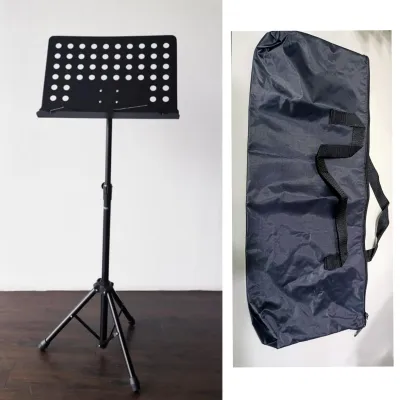
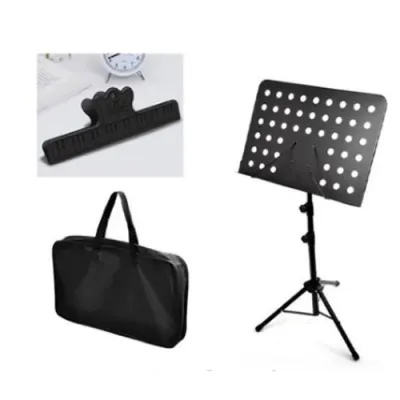
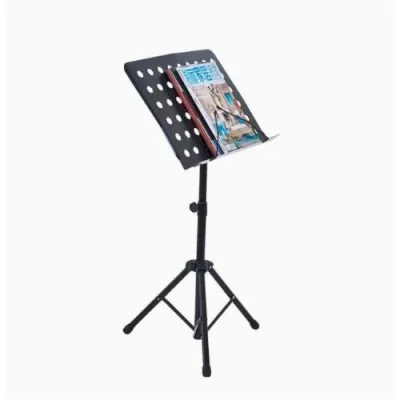
Prices are valid at publication and may change. Please refer to the product page for the latest price.
Environmental factors also play a critical role in your decision. If you frequently perform outdoors, in drafty rehearsal halls, or near air conditioning vents, wind resistance becomes a primary concern. For indoor settings, overhead stage lighting or bright windows can create distracting glare on digital screens or glossy paper, making adjustable mounts with tilt and swivel capabilities essential for maintaining visibility.
Sheet Music Clips: Securing Traditional Paper Scores
For musicians who prefer the tactile feel of physical paper, sheet music clips are highly practical tools for keeping scores flat and legible. These accessories are specifically designed to secure thick books, loose sheets, or laminated charts against the desk of your stand. They prevent pages from flipping unexpectedly due to drafts, air conditioning, or outdoor breezes, allowing you to focus entirely on your performance.

When selecting a sheet music clip, pay close attention to the clamping mechanism. Spring-loaded clips offer strong tension and are excellent for holding open thick anthologies, but they require sufficient physical strength to operate quickly during fast page turns. Magnetic clips offer a sleek, low-profile alternative that snaps directly onto steel music stands, though they will not work on aluminum, wooden, or plastic desks unless you install a matching adhesive metal strip.
While highly effective, traditional clips have distinct limitations that you must consider. A clip with a wide profile can easily obstruct marginal notes, performance cues, or the bottom system of music on shorter pages. Furthermore, high-tension metal clamps can leave permanent indentations, creases, or tears on fragile antique scores or borrowed library materials. They are also entirely incompatible with digital screens, as the pressure can damage the display or trigger accidental touch inputs.
Tablet Mounts: Transitioning to Digital Sheet Music
Transitioning to a digital library offers incredible convenience, but it requires a dedicated tablet mount to protect your expensive device from accidental drops. A proper mount integrates your tablet directly into your stand setup, positioning your digital scores at a comfortable viewing angle. Unlike resting a tablet loosely on the music ledge, a secure mount prevents the device from sliding off when you interact with the screen.
To ensure compatibility, you must match the mount to your tablet’s exact physical dimensions and weight. Measure your device with its protective case installed, as many heavy-duty cases add significant thickness that standard cradles cannot accommodate. The mount’s joints, arms, and clamping brackets must be robust enough to support the weight of your tablet without sagging or slipping over time, especially when you tap the screen to turn pages.
The mounting interface itself must match your stand’s geometry. Most tablet mounts utilize a clamp that attaches directly to the vertical pole of the music stand, which helps lower the overall center of gravity and reduces the risk of the stand tipping over. Look for mounts that offer multi-axis adjustments, including tilt, swivel, and 360-degree rotation. This flexibility allows you to switch instantly between portrait and landscape orientations while positioning the screen to eliminate harsh reflections from overhead lights.
Page Turner Holders: Enabling Hands-Free Performance
For musicians performing complex pieces or playing instruments that require both hands at all times, a page-turning system is a highly effective solution. These setups typically rely on a Bluetooth pedal placed on the floor, allowing you to turn digital pages with a simple tap of your foot. However, managing these devices and integrating them into your physical performance space requires careful planning.
While the pedal itself rests on the floor, some performance environments make foot operation impractical, such as tight orchestra pits, standing performances, or setups where the musician is seated on a high stool. In these scenarios, specialized elevated trays or brackets can mount the page-turning device directly to your music stand’s pole or desk. This elevation brings the controller within easy reach of your hand or allows for alternative triggering methods.
When integrating a page turner, you must verify the spatial and physical compatibility between your stand, your instrument, and the accessory. Ensure that any cables or wireless transmitters have a clear line of sight and do not interfere with your footwork or instrument keys. If you use low-profile sheet music clips alongside a digital setup, confirm that the clips do not obstruct your hand movements when you need to manually override the digital page turner during a performance.
Decision Guide: Matching the Accessory to Your Needs
Choosing the right music stand holder involves aligning your primary performance medium with your physical environment. To help you identify the most practical solution, consider how different setups serve specific musical roles and environments.
| User Profile | Primary Medium | Key Environmental Challenge | Recommended Holder Type |
|---|---|---|---|
| Orchestral & Ensemble Players | Heavy paper scores, bound books | Drafty stages, tight seating | Wide, low-profile spring clips or magnetic strips |
| Gigging & Solo Musicians | Digital tablets, setlists | Variable stage lighting, frequent travel | Pole-mounted tablet holder with multi-axis tilt |
| Students & Home Practice | Mixed paper and digital sheets | Limited space, multi-instrument use | Dual-purpose ledge clips or basic clamp-on tablet mount |
Before making a purchase, always perform a few quick measurements. Verify the outer diameter of your music stand’s vertical pole using a caliper or a simple tape measure, and compare this to the clamp specifications of your chosen holder. Weigh your tablet with its case on a kitchen scale to ensure it falls well within the maximum weight capacity specified by the mount manufacturer.
In some cases, you may not need to purchase a new accessory at all. If you only practice indoors in a draft-free room, standard household items like clean clothespins or elastic bands can temporarily secure loose sheets without scratching your stand. Similarly, if your music stand has a deep, sturdy wooden ledge, a simple non-slip silicone mat can keep a tablet stable without the need for a mechanical clamp, saving you money and reducing setup time.
Frequently Asked Questions (FAQ)
Can I use a tablet mount on any music stand?
Most tablet mounts are designed with adjustable C-clamps that fit standard round metal poles, but they may not be universally compatible with every stand design. If you use a lightweight folding wire stand, the thin poles may not provide enough surface area for a secure grip, and the weight of the tablet can easily make the entire setup top-heavy and prone to tipping. For stands with square, flat, or exceptionally thick wooden shafts, you must verify that the mount’s clamping mechanism includes flat adapters or a wide enough jaw opening to clamp securely without slipping.
Will a sheet music clip damage my original scores?
High-tension metal spring clips can easily crease, indent, or tear delicate paper, especially if you slide them on and off quickly during a performance. If you are working with rare, fragile, or borrowed library scores, avoid strong mechanical clamps entirely. Instead, opt for long, lightweight acrylic music clips that distribute pressure evenly across the page, or use magnetic strips on a steel stand. Alternatively, placing your scores inside clear plastic protective sleeves within a three-ring binder allows you to clip the binder itself rather than the delicate paper.
Do I need a specific holder for a Bluetooth page turner pedal?
Standard Bluetooth page-turning pedals are designed to sit flat on the floor and do not require a stand-mounted holder for normal operation. However, if you perform in a highly cramped space where floor space is unavailable, or if you play an instrument while seated on a high stool where your feet cannot comfortably reach the floor, a specialized clamp-on accessory tray can be useful. These small metal or plastic trays attach directly to your music stand’s vertical pole, elevating the pedal or controller to hand level so you can trigger page turns manually.
Community discussion
Share your experience or ask a question. Comments are reviewed before publication.