
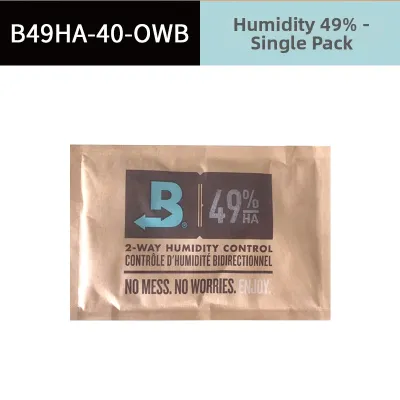
To choose the right Boveda humidity level for your guitar, you must match the relative humidity (RH) percentage of the pack to your instrument’s construction, your local climate, and your storage setup. For the vast majority of acoustic and classical guitars, the standard 49% RH pack is the ideal baseline. This formulation is specifically engineered to maintain delicate tonewoods within the universally recommended 45% to 55% RH range. If you own an electric guitar, store your instruments in an exceptionally humid environment, or use a case that naturally runs damp, the 45% RH pack offers a slightly drier target that prevents moisture-related swelling without under-humidifying the wood.
Selecting the correct humidity level is one of the most critical aspects of guitar maintenance. Wood is a hygroscopic material, meaning it constantly absorbs and releases moisture to match its surrounding environment. When a guitar is exposed to extreme humidity fluctuations, the wood expands and contracts, leading to structural damage, playability issues, and compromised tone. By understanding how different guitar types react to moisture and how to match them with the appropriate two-way humidity control packs, you can safeguard your investment and keep your instrument performing at its best.
Identify Your Guitar's Baseline Humidity Needs
Before purchasing any humidity control products, you must understand the specific moisture requirements of your instrument. Acoustic, classical, and electric guitars are constructed differently, and their tolerance for environmental changes varies significantly. Acoustic and classical guitars are highly vulnerable to humidity shifts because they are built from thin, lightweight pieces of unfinished or lightly finished tonewoods. The top, back, and sides of these instruments are designed to vibrate freely, which requires the wood to be thin—often only a few millimeters thick. This thinness makes them incredibly sensitive to the surrounding air.
Products mentioned in this guide

Prices are valid at publication and may change. Please refer to the product page for the latest price.
Solid-body electric guitars, on the other hand, are constructed from thick, dense slabs of wood. While they are far more resilient than their acoustic counterparts, they are not entirely immune to humidity damage. The neck of an electric guitar, typically made of maple or mahogany, remains highly sensitive to moisture changes. If the neck absorbs too much moisture or dries out excessively, it can bow or warp, throwing off the intonation and action. Additionally, the fingerboard, which is often left unfinished, can shrink or expand, leading to playability issues.
To find the exact humidity range your guitar requires, always consult the manufacturer’s guidelines. Most major guitar manufacturers recommend maintaining a relative humidity level between 45% and 55%. You can typically find this information in the owner’s manual, on the manufacturer’s official website, or by contacting their customer support. Some high-end classical guitars built in drier European climates may have slightly lower target ranges, while instruments built in humid tropical regions might tolerate slightly higher baselines.
Monitoring your guitar for physical signs of humidity imbalance is crucial for early intervention. When a guitar is under-humidified (too dry), the wood shrinks. You may notice sharp fret ends protruding from the sides of the fingerboard, a sunken or flat soundboard, buzzing strings due to lowered action, or visible cracks in the wood and finish. Conversely, when a guitar is over-humidified (too wet), the wood swells. This can cause the top to bulge, the action to become uncomfortably high, the bridge to lift off the soundboard, and the overall tone to sound dull or muddy. In extreme cases, excessive moisture can lead to mold growth inside the body and weaken the glue joints holding the bracing together.
Match Boveda RH Percentages to Your Instrument
Once you understand your guitar’s baseline needs, you can select the appropriate Boveda relative humidity percentage. The brand offers two primary formulations for musical instruments: 49% RH and 45% RH. Choosing between them depends on your guitar type, your local climate, and how your storage case behaves.

The 49% RH pack is the standard choice for acoustic and classical guitars. Because these instruments rely on precise moisture levels to maintain their structural integrity and acoustic projection, the 49% formulation provides a safe, middle-of-the-road target. It is designed to add moisture when the air inside the case is dry and absorb excess moisture when the air is damp, keeping the environment consistently close to the ideal 49% mark. If you live in a temperate climate with moderate seasonal shifts, this is almost always the correct pack to choose for any hollow-body or acoustic instrument.
The 45% RH pack is tailored for specific scenarios where a slightly drier environment is beneficial. This formulation is highly recommended for solid-body electric guitars, which do not require as much moisture as acoustic instruments to stay stable. It is also the preferred choice for guitarists living in consistently high-humidity regions, such as Singapore, where the ambient relative humidity frequently exceeds 80%. In these tropical climates, even a well-sealed guitar case can trap excess moisture. Using a 45% pack helps pull that excess moisture out of the air more aggressively, preventing the wood from swelling and protecting metal hardware from corrosion.
It is vital to avoid using higher RH formulations, such as 72% or 75% packs, inside a guitar case. These higher percentages are designed for entirely different applications, such as seasoning wooden cigar humidors or preserving herbal products. Introducing a 72% or 75% pack into a guitar case will rapidly over-humidify the instrument. The excessive moisture will cause the tonewoods to swell dramatically, softening the water-soluble glues used in guitar construction and potentially causing the internal bracing to separate from the top or back. Always stick to the dedicated 45% or 49% instrument packs to ensure your guitar remains within a safe, stable range.
Assess Your Case Seal and Storage Environment
Two-way humidity control packs do not operate in a vacuum; their effectiveness depends heavily on the physical environment in which they are placed. To ensure the packs can regulate the humidity successfully, you must store your guitar in a high-quality hard case with a proper seal. A well-fitted hardshell case creates a microclimate, isolating the instrument from the rapid humidity fluctuations of the surrounding room. Soft gig bags, even those with thick padding, are typically made of porous fabrics that allow air and moisture to pass through freely, making it nearly impossible for the packs to maintain a stable RH level.
Your local climate and indoor living conditions also dictate how hard the packs must work. For example, if you live in a tropical environment like Singapore, the ambient air is naturally saturated with moisture. However, if you frequently run air conditioning in your home, the indoor air can quickly become exceptionally dry. These rapid transitions between humid outdoor air and dry, air-conditioned indoor air place a heavy workload on the humidity packs. The packs will constantly shift between absorbing and releasing moisture, which can shorten their overall lifespan.
To verify that your setup is functioning correctly, never rely solely on the percentage printed on the Boveda pack. Instead, place a calibrated digital hygrometer inside your guitar case. A reliable digital hygrometer, which typically costs around S$15 to S$30, provides real-time readings of the actual relative humidity surrounding your instrument. Position the hygrometer in an open area of the case, such as near the neck joint or headstock, rather than burying it under accessories. Regularly check the readings to ensure the internal environment remains stable between 45% and 55% RH, regardless of the weather outside.
Select the Right Pack Size and Placement Strategy
Choosing the correct physical size and quantity of Boveda packs is just as important as selecting the right RH percentage. For musical instruments, Boveda primarily utilizes their larger Size 70 packs (often sold in starter kits containing multiple packs). While smaller sizes, such as size 4 or size 8 packs, are highly effective for small woodwind cases or pocket-sized containers, they do not contain enough active ingredients to regulate the large volume of air inside a standard guitar case. Using packs that are too small will result in rapid depletion and inconsistent humidity control.
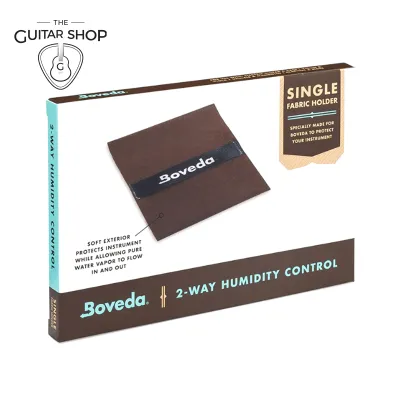
When deploying the packs, proper placement is essential to protect your guitar’s finish. You should never place a bare humidity pack in direct contact with the wood or finish of your instrument. The semi-permeable membrane of the pack contains a saltwater solution that, while safe when contained, can potentially react with delicate guitar finishes—especially traditional nitrocellulose lacquers or French polish. Always use the manufacturer’s dedicated fabric holders or sleeves, which act as a protective barrier while allowing moisture vapor to pass through freely.
The ideal placement strategy involves distributing the packs to ensure even humidity throughout the case. For acoustic guitars, place one holder containing two packs directly inside the soundhole, suspended by the strings. This targets the unfinished interior of the guitar, where the wood is most receptive to moisture. Place a second holder containing one or two packs in the headstock compartment of the case to regulate the neck area. For electric guitars, place the holders in the open cavities of the case near the body and the headstock, ensuring they do not press tightly against the instrument.
To maintain continuous protection, you must learn to recognize the physical cues that indicate a pack is depleted. A fresh pack feels soft, gel-like, and completely pliable. As the pack releases its moisture over time, the internal solution will begin to crystallize, feeling slightly grainy or crunchy. Eventually, when the pack has exhausted its moisture reserve, it will turn completely hard, rigid, and solid. Once a pack reaches this fully hardened state, it can no longer release moisture and must be replaced immediately to prevent your guitar from drying out.
Maintain Your Setup and Avoid Common Mistakes
Achieving long-term humidity stability requires consistent maintenance and avoiding several common user errors. One of the most critical rules of two-way humidity control is to never mix different Boveda RH levels within the same case. For example, placing a 45% pack and a 49% pack in the same compartment will cause them to fight each other. The 49% pack will attempt to release moisture to raise the humidity, while the 45% pack will work to absorb that moisture to lower it. This constant tug-of-war will exhaust both packs within a matter of weeks, rendering them useless.
Similarly, you should never combine Boveda packs with other humidification methods, such as wet sponges, clay humidifiers, or water-filled reservoirs. Two-way packs are designed to self-regulate, but introducing an uncontrolled source of liquid water disrupts their chemistry. The packs will quickly become oversaturated as they attempt to absorb the excess moisture from the sponge, destroying their ability to regulate the environment and potentially causing the packs to leak or tear.
If your case hygrometer consistently reads significantly higher or lower than the target RH of your packs, perform a systematic check of your setup. First, verify that your hygrometer is properly calibrated; even high-quality digital sensors can drift over time. Second, inspect the seals of your guitar case to ensure no ambient air is leaking in. If you have recently placed a very dry guitar into the case, keep in mind that the dry wood will rapidly absorb moisture from the packs. In this scenario, the hygrometer may read low for several days or even weeks until the wood fibers fully saturate and stabilize.
While maintaining proper humidity can prevent and even reverse minor wood movement, some structural issues require professional intervention. If you observe open cracks in the top or back of your guitar, a bridge that has visibly separated from the soundboard, or severe neck warping that cannot be corrected with a truss rod adjustment, do not attempt to resolve the issue solely by adding more humidity packs. These are serious structural failures that require the expertise of a qualified luthier. A professional luthier can safely repair the wood, re-glue loose braces, and restore the instrument’s structural integrity before you resume your regular humidity maintenance routine.
Frequently Asked Questions (FAQ)
Can I use Boveda packs for a guitar kept on a wall hanger?
No, Boveda packs cannot regulate the humidity of a guitar kept on a wall hanger or an open stand. Two-way humidity control relies on a sealed, enclosed microclimate—such as a closed hardshell case—to function effectively. In an open room, the volume of air is far too vast for the packs to influence, and they will deplete completely within a matter of hours as they attempt to humidify the entire room. If you prefer to display your guitars on wall hangers, you must regulate the humidity of the entire room using a dedicated room humidifier or dehumidifier, depending on your local climate.
How long do Boveda packs typically last in a guitar case?
In a standard, well-sealed hardshell case, Boveda packs typically last between two and six months. The exact lifespan depends on several environmental variables, including the quality of your case seal, how frequently you open the case, and the ambient humidity of the room. In extremely dry or exceptionally humid environments, the packs must work harder to maintain equilibrium, which will cause them to deplete faster. Regularly feeling the packs for signs of hardening is the most reliable way to determine when they need to be replaced.
Is it safe to leave Boveda packs directly inside the guitar soundhole?
It is only safe to place Boveda packs inside the soundhole if they are housed in a dedicated, manufacturer-approved fabric holder. You should never drop loose, bare packs directly into the soundhole of an acoustic guitar. The unfinished wood inside the guitar body is highly sensitive, and direct contact with the pack’s membrane can transfer moisture unevenly or react with the wood fibers. A proper fabric holder suspends the packs safely between the strings, ensuring they do not touch the interior bracing or the bottom of the guitar while allowing moisture to distribute evenly.

Community discussion
Share your experience or ask a question. Comments are reviewed before publication.